
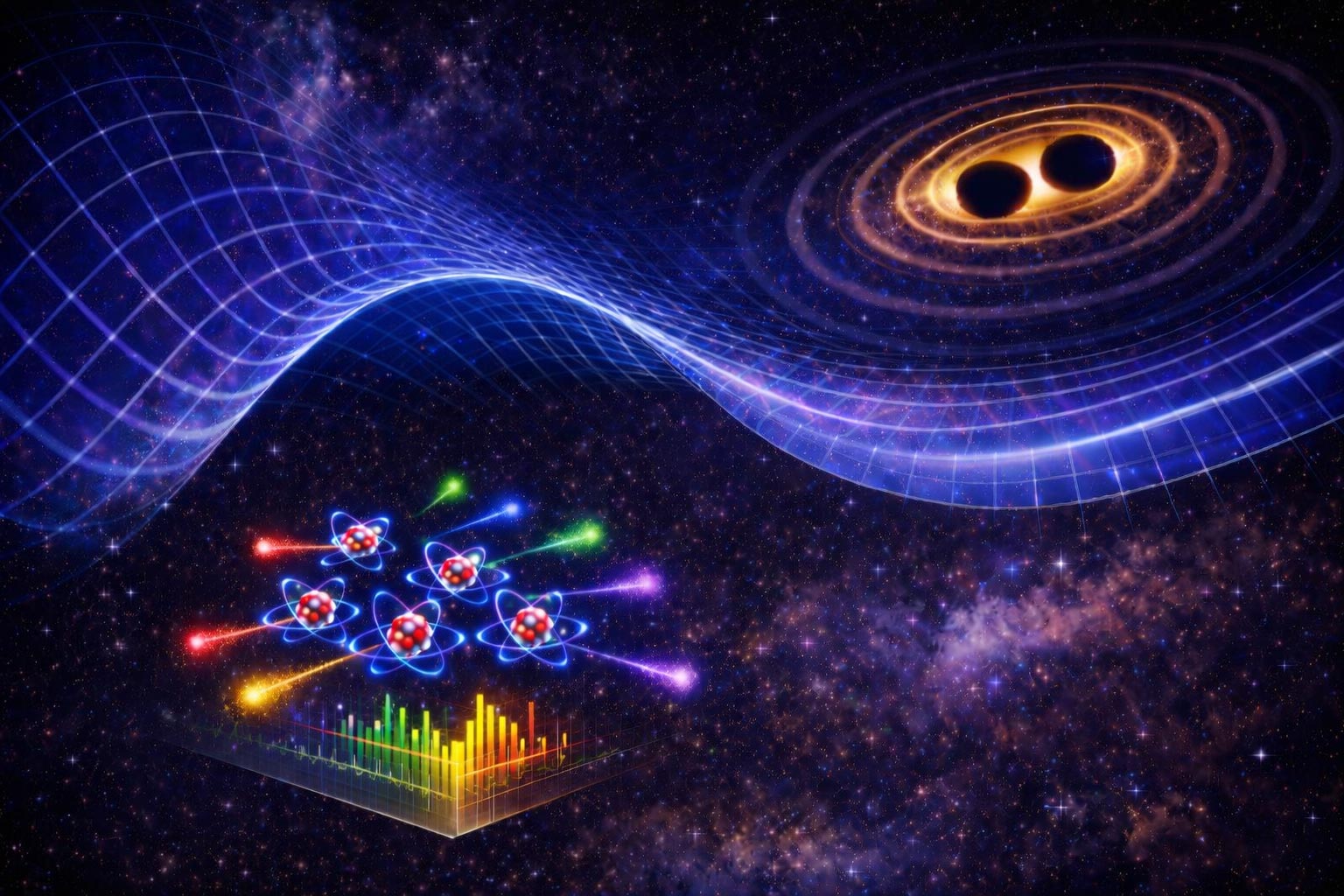
A new theoretical study suggests that gravitational waves may leave subtle signatures not in giant detectors, but in the light emitted by atoms.
Gravitational waves are faint tremors in spacetime set off by some of the most extreme events in the universe, including colliding black holes.
So far, scientists have found them by tracking almost unimaginably small changes in distance across kilometer-scale instruments (about 0.6 miles). Facilities such as LIGO have shown that this works, but the method depends on huge detectors built to sense tiny distortions.
A new theoretical study, published in Physical Review Letters, introduces a different idea. Researchers from Stockholm University, Nordita, and the University of Tübingen suggest detecting gravitational waves by observing how they influence the light emitted by atoms. While the concept outlines a potential method, it has not yet been tested experimentally.
How Atoms Could Reveal Gravitational Waves
Excited atoms naturally return to a lower energy state by emitting light at a specific frequency, a quantum process called spontaneous emission. This process arises from interactions with the quantum electromagnetic field.
“Gravitational waves modulate the quantum field, which in turn affects spontaneous emission,” said Jerzy Paczos, a PhD student at Stockholm University. “This modulation can shift the frequencies of emitted photons compared with the no-wave case.”
The researchers predict that this emission depends on direction. Atoms would still emit photons at the same overall rate, which helps explain why the effect has gone unnoticed until now, but the frequencies of those photons would vary depending on the direction in which they are emitted. This directional pattern could carry information about the gravitational wave’s direction and polarization, making it easier to separate real signals from background noise.
Why the Idea Could Matter
Low frequency gravitational waves are a key focus for future space-based observatories. The team points out that narrow optical transitions used in atomic clock systems allow for long interaction times, which could make cold atom setups a useful platform for testing this concept.
In simple terms, atoms emit light like a steady musical tone, but a passing gravitational wave would subtly change how that tone is heard in different directions. “Our findings may open a route toward compact gravitational-wave sensing, where the relevant atomic ensemble is millimeter-scale,” said Navdeep Arya, a postdoctoral researcher at Stockholm University. “A thorough noise analysis is necessary to assess practical feasibility, but our first estimates are promising.”
Reference: “Gravitational Wave Imprints on Spontaneous Emission” by Jerzy Paczos, Navdeep Arya, Sofia Qvarfort, Daniel Braun and Magdalena Zych, 19 March 2026, Physical Review Letters.
DOI: 10.1103/1gtr-5c2f
Funding: Knut och Alice Wallenbergs Stiftelse, Wallenberg Initiative on Networks and Quantum Information, Marie Sklodowska-Curie Actions, EU EIC Pathfinder project QuCoM
Never miss a breakthrough: Join the SciTechDaily newsletter.
Follow us on Google and Google News.