
Kitchen sponges are among the most commonly used household items, but scientists say the cleaning tool may be playing an unexpected role in environmental damage.
A study led by researchers from the University of Bonn, in Germany, examined how many plastic particles are released from sponges during everyday dishwashing—and what impact this has on the environment.
However, the findings show that while measurable amounts of microplastics are released during use, the largest environmental impact linked to manual dishwashing does not come from plastic particles.
Instead, water consumption accounts for the vast majority of the overall environmental burden.
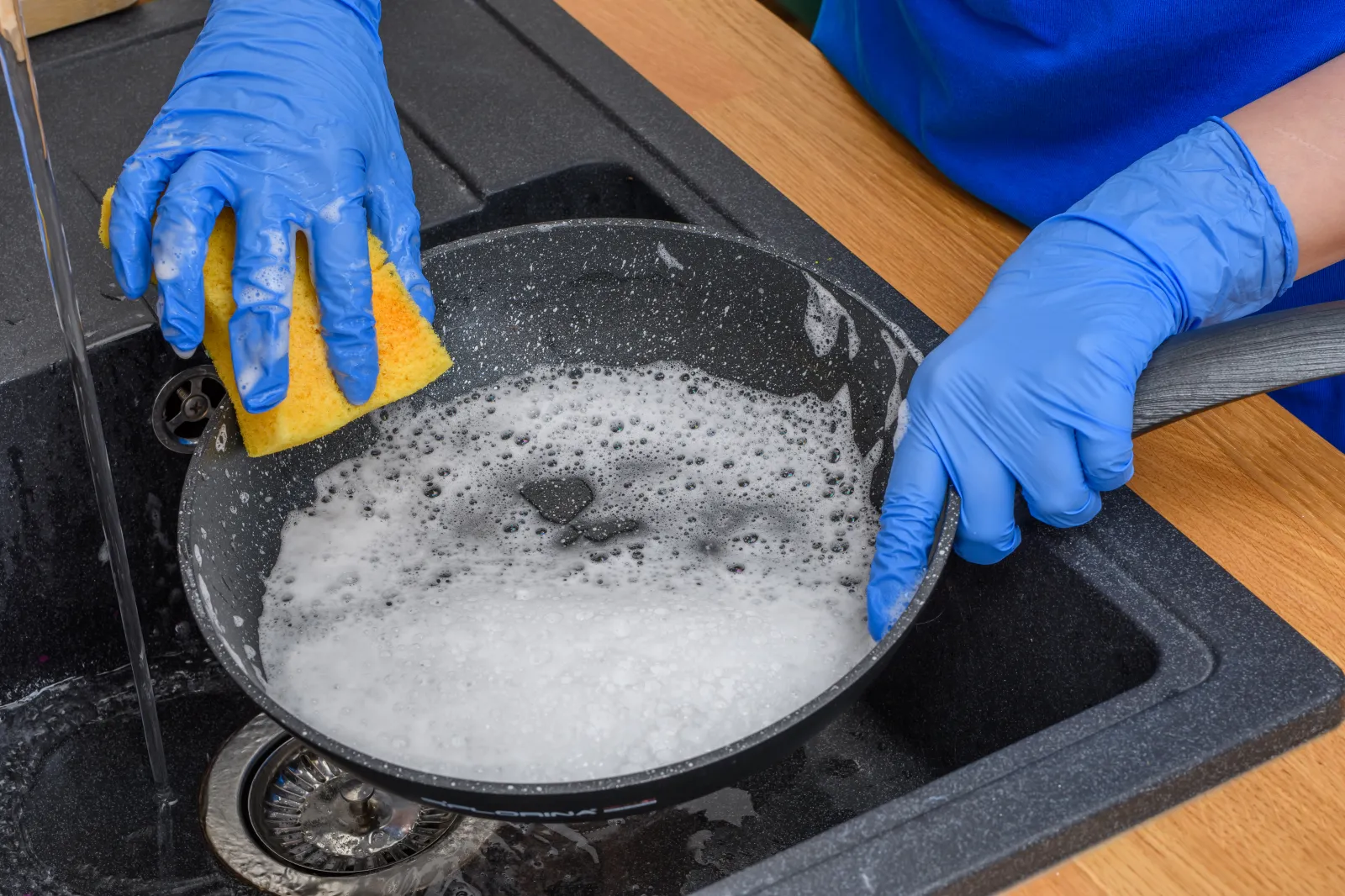
Studying Sponges in Real Homes
Kitchen sponges have long been considered a potential source of microplastics, but they remain relatively understudied. The research aimed to quantify how many microplastic particles are released during realistic use and to assess the resulting environmental impact using a life cycle assessment.
To capture everyday dishwashing habits, the researchers combined laboratory testing with citizen science. Volunteer households in Germany and North America took part in the study, using one of three different types of kitchen sponge as part of their normal routines.
Participants documented their sponge use, and each sponge was weighed before and after use to determine material loss and the release of microplastics. In parallel, laboratory experiments were carried out using an automated testing device known as “SpongeBot,” which simulates the mechanical stress sponges experience during dishwashing.
By combining real-world data with controlled laboratory testing, the researchers were able to estimate microplastic release under realistic conditions rather than relying solely on simulated use.
Microplastics Are Released—But Water Use Dominates Impact
The study found that all sponge types lost material during use, releasing microplastics in the process. The amount released varied by sponge type, ranging from approximately 0.68 to 4.21 grams of microplastics per person per year.
Previous research has shown that microplastics can become lodged in the airways and have been linked to a range of potential health concerns, including cancer and male and female infertility.
Sponges with a lower plastic content released significantly fewer microplastic particles. However, when the researchers assessed the overall environmental impact of manual dishwashing, microplastic release accounted for only a small share of the total damage.
Instead, water consumption was found to be the dominant factor, responsible for an estimated 85 to 97 percent of the total environmental impact associated with dishwashing.
According to a 2017 report from Reviewed.com, nearly 20 percent of Americans who own dishwashers use them less than once a week. The consumer product review website found that washing dishes by hand can use up to 3.5 times more water than a modern automatic dishwasher.
Small Amounts Add Up
Although the amount of microplastics released per person appears relatively low, the researchers note that the numbers become more significant when extrapolated across an entire country.
In Germany, for example, the use of one specific sponge type in every household would result in up to 355 tonnes of microplastics being released each year.
While a large proportion of these particles is retained in wastewater treatment plants, several tonnes are still estimated to enter aquatic environments or soils annually.
Newsweek spoke to Harry Macpherson, senior associate for climate at Deep Science Ventures (DSV), a London-based firm that creates science-driven startups.
Macpherson, who was not involved in the study, said: “The fact that most microplastics are caught in wastewater treatment is not necessarily reassuring since the solid sludge from wastewater treatment is, depending on location, spread on fields as fertilizer.
“It’s important that we either find ways of removing the hazardous substances in sewage sludge before using it as fertilizer or find safer methods of sludge disposal.”
How Consumers Can Reduce Impact
Macpherson said: “If consumers are concerned about protecting their own health as well as the environment, then getting plastic out of the house, particularly plastic coming into contact with food, is a good start.”
The expert also recommends buying plant-based, degradable sponges, as well as trying to minimize water consumption.
Do you have a science story to share with Newsweek? Do you have a question about microplastics? Let us know via science@newsweek.com.
Reference
Hamann, L., Galafton, C., Rühr, P. T., Blanke, A., & Thonemann, N. (2026). From sink to Sea: Microplastic release from kitchen sponges and potential environmental effects. Environmental Advances, 23. https://doi.org/10.1016/j.envadv.2026.100693