
We may receive a commission on purchases made from links.
On March 22, 2026, William Shatner turned 95, and it’s impressive how alert and active he still is. He still attends “Star Trek” conventions on the regular, and is something of a television gadfly, turning up in cartoons, on game shows, and as a presenter on various shows across the medium. He recently announced that he’s working on a heavy metal record, which will be an interesting chaser to the kids’ music album he recorded in 2024. He’s even still occasionally appearing in “Star Trek”-related projects: Shatner was the executive producer on — and his likeness was used in — a complex tech-forward experimental fan film called “765874 – Unification.”
And, as you might expect, Shatner is often asked about his favorite sci-fi movies. Thanks to his near lifelong association with “Star Trek,” Shatner remains at the center of the genre’s pop canon. James T. Kirk is one of the most famous TV characters of all time, and Shatner has likely spent plenty of time thinking about him, as well as his place in the general pop firmament.
Case in point: Shatner was interviewed by The Daily Beast in 2011 about his favorite outer-space movies. This was done in conjunction with his album “Seeking Major Tom,” his album of space-related pop covers. It’s a two-CD set. I have a copy. Where’s yours?
Shatner’s favorite outer space movies might seem a little predictable, as they are all well-known classics. He likes Steven Spielberg’s “E.T. the Extra-Terrestrial,” for instance. He loved the special effects of “Star Wars.” And he said he couldn’t stop watching Stanley Kubrick’s 1968 classic “2001: A Space Odyssey.” Mostly because he was still trying to figure out what it all meant.
William Shatner rewatches 2001: A Space Odyssey a lot because he can’t figure it out
William Shatner was asked about some sci-fi classics that he wasn’t so fond of. For instance, he didn’t much like Mel Brooks’ 1987 “Star Wars” spoof “Spaceballs,” comparing it to two-day-old Chinese food. He did, however, love Ridley Scott’s “Alien,” calling it one of the most frightening movies ever made. Naturally, he also had positive things to say about “Star Trek: The Motion Picture,” noting that “Star Trek” birthed everything that came after it, and that its first movie had a very handsome leading man (whose name he said he couldn’t recall). About Stanley Kubrick’s “2001: A Space Odyssey,” Shatner said:
“‘Space Odyssey’ was a work of genius. With a computer that goes bad and the mystery of the monolith and the indescribable ending that nobody could understand. What a great movie to see again and again. And again, and again, and again because of that ending. Can anyone explain it please?”
Sure thing, Shatner. I know you’re reading this, and I have already written a handy-dandy explanation about what the ending of “2001: A Space Odyssey” means. The large black monoliths are extraterrestrial tools placed on Earth to serve as evolutionary catalysts, allowing human beings — and our ape-like proto-human ancestors — to leap forward in their growth as a species. The monoliths inspire us to create new tools, which is, of course, a double-edged sword. We can use tools to hunt, but we can also use them to kill. There is, in this sense, no difference between using a tapir jawbone as a club and inventing an artificial intelligence to guide us through the stars. Our tools are helpful, and they may also kill us.
What 2001: A Space Odyssey means
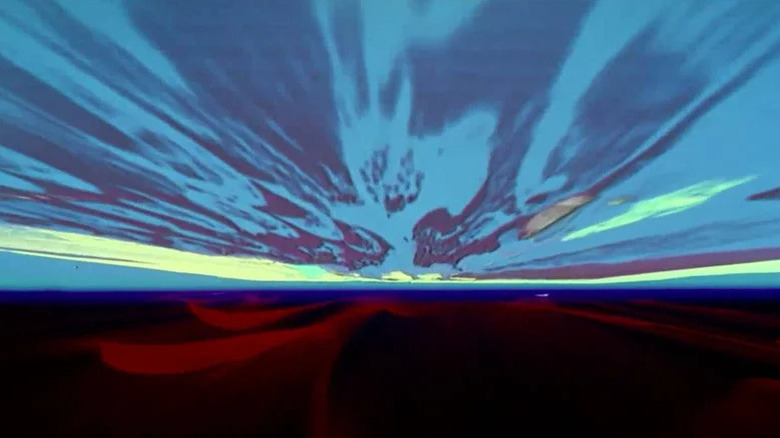
The monolith then appears in a psychedelic sequence at the end of “2001: A Space Odyssey.” The astronaut Dave (Kier Dullea) soars his ship into orbit around Jupiter, and the film ends with a 20-minute psychedelic sequence called “Jupiter and Beyond the Infinite,” which is the part that confuses most audiences, not just William Shatner. The ending is easier to take, though, once we realize that Dave is not the main character of “2001.” The main characters of “2001” are humans in general.
The main relationship is between humans and an off-screen cadre of ultra-powerful alien masters of some kind, who have been planting monoliths and portals in our path, guiding us over hundreds of thousands of years into the heavens. Once we reach the Infinite, however, our minds can’t handle it. Space looks like colors, shapes, and ineffable things that we cannot interpret. It’s been said that alien technology will be so advanced that it will look like magic to the modern eye. I disagree. It will look more like chaotic nonsense. Aliens were trying to guide Dave into a new era, but his mind had to reinterpret what he saw as recognizable images, like palace rooms and comfy beds, to make sense of it.
And then, of course, the movie’s final symbol is the Starchild, a moon-sized, glowing fetus that drifts back to Earth, indicating that humanity, after all this time, is finally ready to be born. We are but infants in the cosmic timeline of space, and by traveling into space, we have finally become part of a larger universal community. As someone who is long associated with “Star Trek,” William Shatner might appreciate that.