
Alinea Analytics estimates show that Marathon has generated gross revenues of $55M via 1.2M copies sold on Steam, PS5, and Xbox:
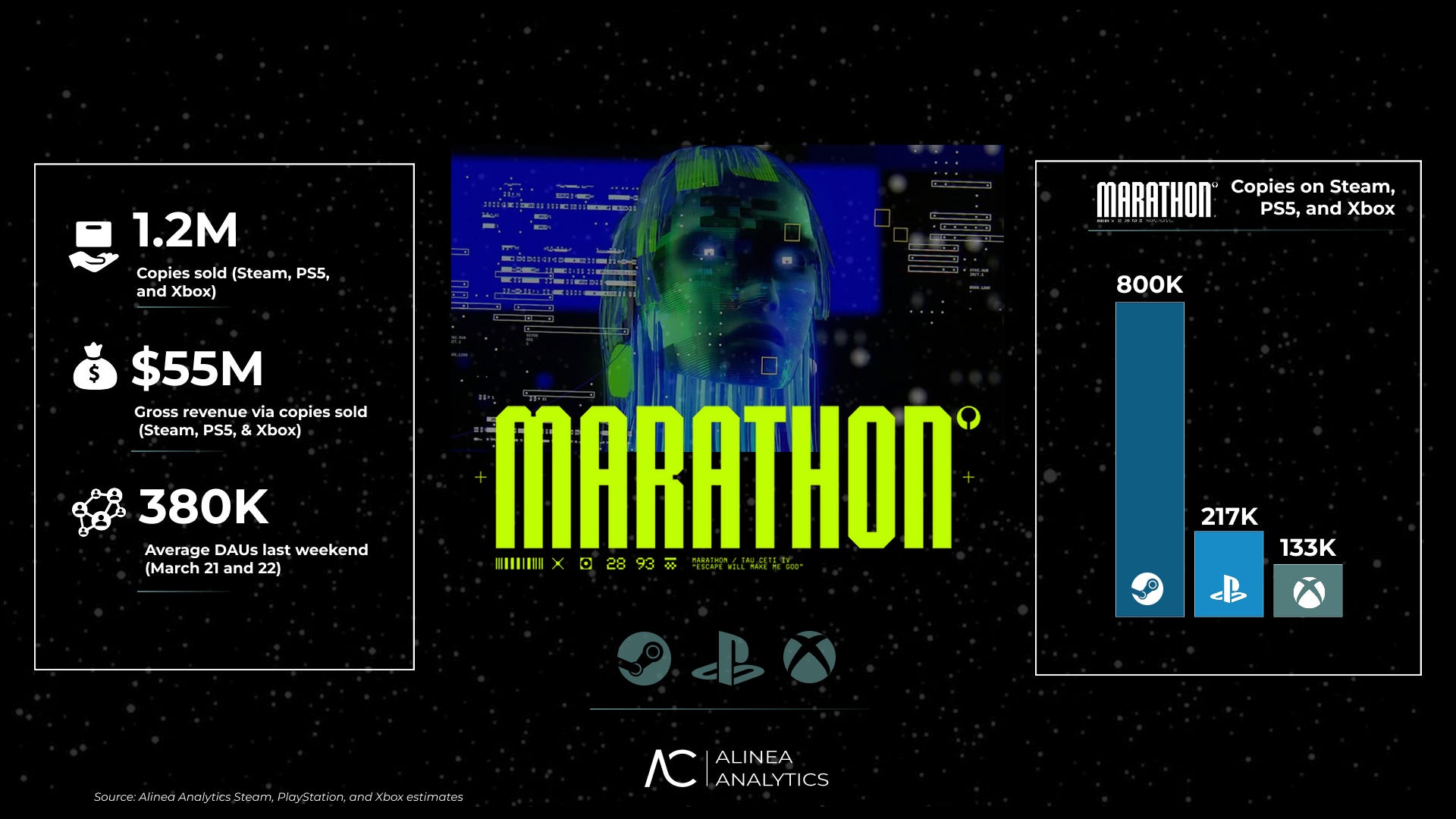
Looking at the split between Steam, PS5, and Xbox, Steam is clearly the main platform for Marathon, accounting for a little under 70% of the audience (800K copies sold). Meanwhile, PS5 takes about 19% (217K) and Xbox (including console, PC, and cloud) accounts for a bit over 11% or 133K.
Marathon is technically a first-party Sony title, so seeing the home console struggle to break 20% of the volume is a notable data point for the ongoing platform-agnostic debate. PlayStation Studios online games will almost certainly continue being multiplatform (despite Sony reportedly pulling back on PC releases).
As for Marathon, the consensus among hardcore players who pushed through the awkward onboarding phase – myself included – is that it’s fantastic. The gunplay, aesthetic, and presentation are among the best in the shooter genre.
A great game doesn’t always equal an immediate hit, though, as shown by our estimates. Things are looking lukewarm right now. But this might be one of those marathon-not-a-sprint situations. Had to, didn’t I?
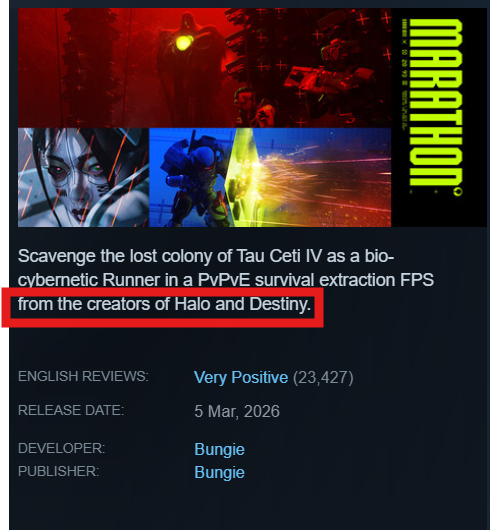
One topic that came up in a lot of conversations at GDC this year was why Marathon hasn’t hit the same stratosphere as Arc Raiders. On paper, they’re both extraction shooters, and Marathon has the Bungie pedigree – the house that built the gold standard for gunplay in Halo and Destiny.
Marathon’s neon-futuristic aesthetic also distinguishes itself from the gritty realism of Tarkov or the post-apocalyptic hope of ARC Raiders. But vibes can only get you so far for first impressions if the onboarding feels like a brick wall.
Marathon is a sweaty PvP-focused experience with a first-time user experience and UI that I can only describe as dreadful. Players are dropped into a complex ecosystem where the UI, though visually striking, is functionally uninformative, forcing users to manually hover over nondescript, identical icons just to identify basic gear or weapon mods.
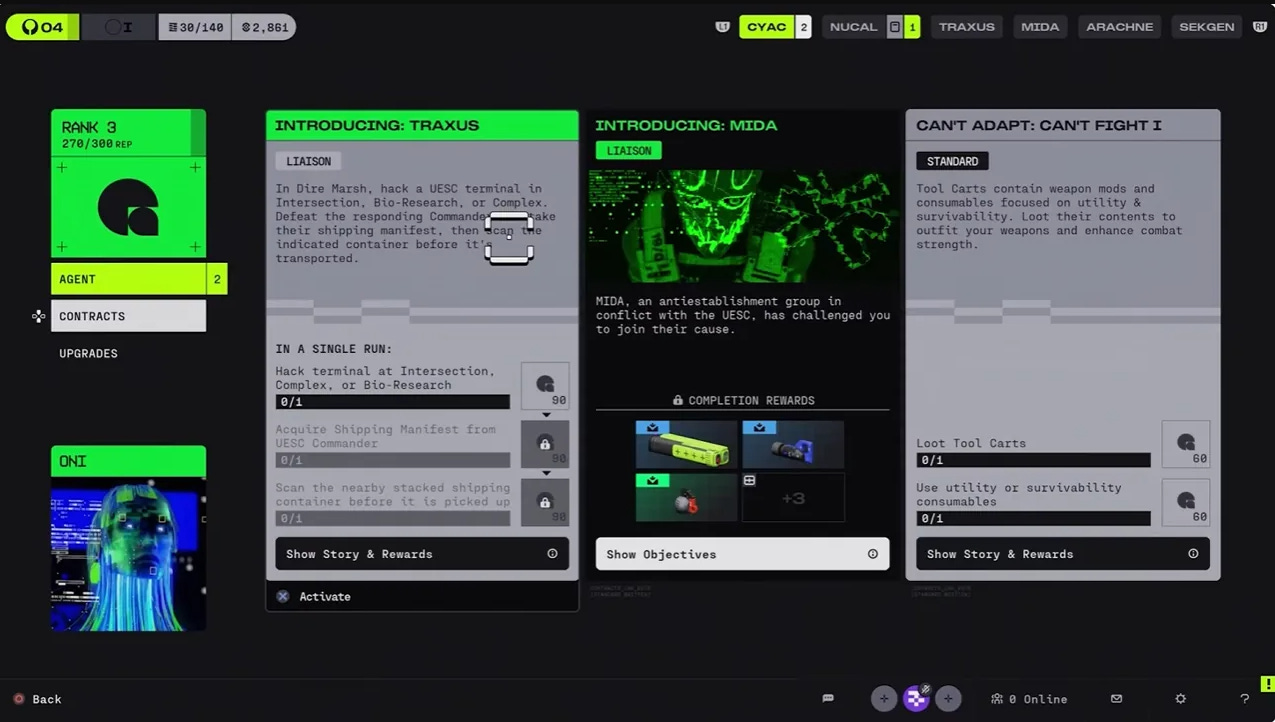
This lack of clarity is compounded by punishing mechanics like a severe heat gauge for movement and a scarcity of vital resources, all without a clear tutorial or a low-stakes mode to learn the ropes. Most people – even top streamers and veteran shooter players – have no idea what’s going on in Marathon at first.
Arc is on the complete other end of the spectrum. As we covered here and here, Arc Raiders offers a more collaborative, approachable loop where players often work together toward shared goals. And the objectives are instantly clear. To many players, this contrast only emphasised Marathon’s issues, especially during the testing period.
Players understand the Arc Raiders loop within 30 minutes, while Marathon acts as a massive filter, chewing up newcomers and spitting them out before they can experience the depth of Bungie’s signature gunplay.
What I’m getting at here is that the poor first-time user experience of Marathon’s Server Slam likely stifled launch sales, while the opposite was true for Arc. Let’s look at the pre-launch copies sold for each game during their respective Server Slams (launch-aligned) :
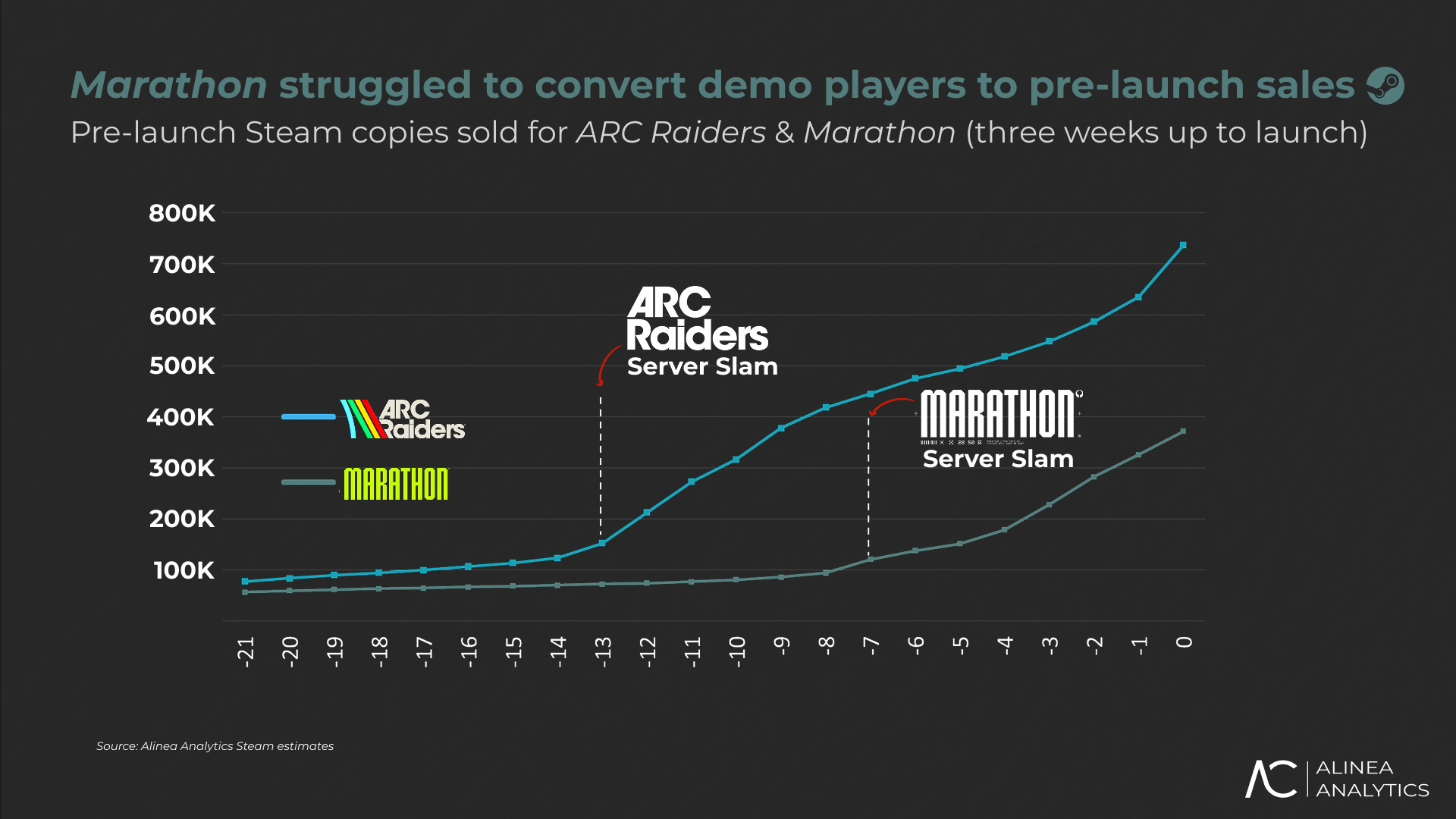
Looking at the trajectory:
-
Arc Raiders saw a massive 80% jump in copies sold during its three-day Server Slam (day -13 to -11). Players jumped in, realised the water was fine, and immediately opened their wallets.
-
Marathon, meanwhile, saw a 49% increase in the four days following its Slam (Day -7 to -3).
-
At the time of each game’s respective launch, Arc Raiders had nearly double the Steam footprint of Marathon – and word of mouth only continued to grow.
Bungie could have had more time to fix the onboarding process had the beta happened earlier. But Marathon launched three days after the beta finished. These factors limited the launch sales quite a bit, I reckon.
Despite the friction-heavy start, the data suggests that those who survived Marathon’s onboarding are loving life. We’ve been tracking cross-platform DAUs, and while there’s the expected post-launch leakage, many players are sticking with it.
After peaking at 478K total DAUs on its first Saturday, Marathon has settled into a respectable rhythm, holding 345K DAUs as of yesterday and averaging 380K DAUs across the weekend.
Steam continues to do the heavy lifting here, consistently accounting for the lion’s share of the daily players. Players have been putting in the hours, too:
-
On Steam, Marathon’s average playtime has climbed to 27.8 hours, significantly outpacing the console averages on PS5 (16.5h) and Xbox (17.3h).
-
Even more telling than the averages: 22% of the Steam audience has surged past the 50-hour mark, and nearly 7% have already logged over 100 hours.
There’s also started to be a shift in the game’s discourse. Marathon launched as one of those games that’s cool to hate. But as Marathon’s 100-hour club grows, we’re seeing conversations around its mechanical merit outweigh the negativity.
Several high-profile creators, who were initially vocal critics, have spent the last week coming around on the mechanical depth of the endgame. It’s a subtle but positive signal; the hate train is losing steam, and a new narrative about the game is emerging.
Another interesting metric in Marathon’s first few weeks is who, exactly, is playing. Bungie leans heavily on its prestige as the “makers of Halo and Destiny,” in its marketing, and that message has clearly hit the mark.
On Steam, the gravity (hammer) of Bungie’s previous work is unavoidable. A staggering 78.2% of Marathon players also played Destiny 2. The trend carries across other platforms, with 74.2% of PS5 players and 82.7% of Xbox players also having played Destiny 2. The Halo legacy lives on, it seems. More on that in a bit.
While Destiny 2 went free to play, these numbers still represent a high-intent migration of a fanbase that trusts Bungie’s specific brand of kinetic gunplay and cryptic world-building.
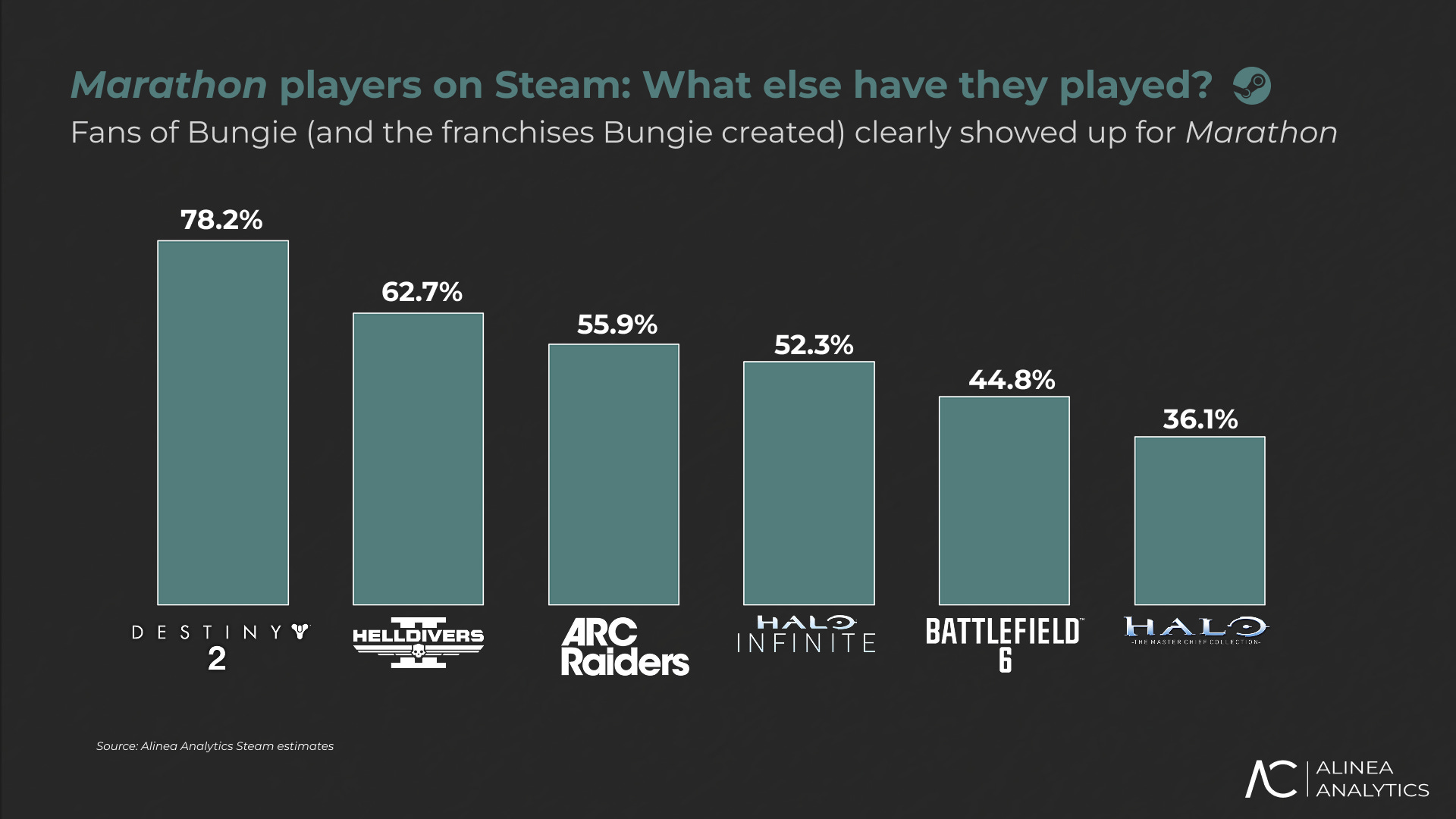
The Xbox data adds another layer of legacy. About 85.7% of Marathon players on Xbox have played Halo Infinite, while over half of the Steam audience has spent time in Halo Infinite and 36.1% in the Master Chief Collection (a paid collection of the old Bungie-made legacy games).
Interestingly, we see a 55.9% overlap with ARC Raiders on Steam. Overlap is even higher there on PlayStation (60.5%) and Xbox (66.5%). And there’s also significant crossover with Helldivers 2 on all platforms, too.
Bungie has found some of its fans with Marathon, and the challenge now is keeping this engaged in a high-stakes PvP environment when they’ve spent the last decade primarily enjoying the power fantasies of PvE.
On that note…
Time for some could’ve, should’ve, would’ve. These things would have improved Marathon’s performance at launch:
-
A more robust onboarding process, perhaps in the form of a short single-player/PvE campaign. We know Bungie fans love this stuff.
-
A traditional arena-based mode akin to Destiny’s Crucible could have been a bridge for the cautious players who’d have been otherwise deterred by the Server Slam. It’s also a great palate cleanser after getting merked.
-
Introducing a dedicated PvE environment would have similarly diversified the conversation and lowered the barrier for the Bungie faithful who found the pure PvP extraction loop too abrasive. PvE is safer than PvP these days.
There’s an argument that a thin PvE mode would have just felt like a budget Destiny, potentially hurting the brand more. But given how dire the FTUE is, I think it would have been a net positive. Any kind of tutorialised loop that demystifies the stakes, really.
While there is merit in a studio sticking firmly to a singular creative vision, and going all in on the hardcore extraction loop. Less forgiving is the technical reality is that the user interface and first-time user experience (FTUE) were not at a commercial standard for launch.
In a landscape where player time is oversaturated and the most contested currency, a flawed FTUE is a critical failure point. But it’s not all doom and gloom, as Marathon has an incredible, unique gameplay loop, suggesting that financial success is still attainable if Bungie can pivot effectively.
Bungie and PlayStation now face a difficult strategic crossroads, though – one within a challenging games market.
They could:
-
Double down on Marathon with a long-term Rainbow Six Siege– or No Man’s Sky-style recovery plan, which is something I heard Last Stand Media’s Chris Maldonado mention last week. While this could be a sunk-cost fallacy in action, it could eventually yield the audience the game’s mechanical depth deserves.
-
Shift focus toward the inevitable Destiny 3 or another project, mitigating the escalating opportunity cost and cutting their losses, so to speak.
-
Doing both is an expensive proposition, given the high overhead and burn rate of operating out of Bellevue, Washington. With Sony recently demonstrating a lower threshold for underperforming studios and projects, the margin for error has vanished.
Whatever happens, the next six months will determine whether Marathon becomes a cornerstone of Sony’s live-service portfolio or a cautionary tale of vision exceeding accessibility.
I’m hoping it’s the former, because Marathon rocks. As always, hit subscribe to get updates on Marathon and other relevant games.
We’re offering a free trial of our platform for games companies.
Send us a message here, or reply to this email, and we’ll set you up.
Reply to this email – or reach out here – if you have any feedback for the newsletter – or want to request a game for us to cover.
[Alinea Analytics boasts the most accurate PC and console estimates in the business. Game makers use our platform to understand their audience, keep an eye on the competition, monitor sales trends, and spot new opportunities. We equip game studios and financial institutions with accurate data and the confidence to make smarter, data-driven decisions. Want to talk about all things games market data? We’d love to chat!]