
A greenhouse agrivoltaics trial in Greece has demonstrated that solar-tracking photovoltaic panels can generate an energy surplus while maintaining stable crop performance. Researchers at the Laboratory of Agricultural Constructions and Environmental Control (LACEC) of the University of Thessaly are evaluating how photovoltaic systems integrated inside greenhouses can simultaneously produce renewable electricity and vegetables while improving overall land-use efficiency.
The study was conducted within the European REGACE research project and tested a dynamically moving photovoltaic system installed above greenhouse crops at the experimental farm of the University of Thessaly in Velestino.
The concept of agrivoltaics—combining photovoltaic electricity generation with agricultural production—is gaining attention as greenhouse growers face rising energy costs and increasing pressure to reduce carbon emissions.
The REGACE project focuses on the development and evaluation of agrivoltaic systems, namely the installation of photovoltaic (PV) panels inside greenhouses where vegetable crops are cultivated. This approach presents a technical challenge, as both crop production and photovoltaic systems rely on the same solar radiation resource. The aim of the project is to enable the combined production of renewable electricity and agricultural products within the same space, maximizing land-use efficiency.
As part of the Horizon REGACE project, an agrivoltaic installation consisting of PV panels positioned above vegetable crops was installed in the greenhouse complex of LACEC at the experimental farm of the University of Thessaly in Velestino. The main innovation of the installed agrivoltaic system is the dynamic movement of the PV panels, which allows automatic tracking of the sun’s path in order to maximize solar energy collection. At the same time, the movement of the PV panels can be adjusted to regulate shading inside the greenhouse, helping to ensure suitable light conditions for plant growth. In this way, both electricity production and crop performance can be optimized simultaneously, improving the overall economic performance of the system.
UTH carried out multiple crop cultivations during different periods of the year in order to evaluate how different agrivoltaic configurations influence crop growth, greenhouse microclimate, and energy production.
Professor Nikolaos Katsoulas, Director of LACEC, highlights the importance of this research: “The REGACE project allowed us to test continuously for more than 20 months the effect of different shading strategies and PV tracking modes on greenhouse microclimate, crop performance and energy yield. Solar-tracking technologies, in particular, show great promise for increasing energy production, while maintaining acceptable light conditions for the crop.
The installed agrivoltaic system at LACEC’s greenhouses has a total installed power of 14.4 kW (approximately 0.03 kW per square meter of greenhouse surface), with an initial investment cost of approximately 900 euros per kW. During the period from April to June, the photovoltaic system produced an average of 0.18 kWh per square meter of greenhouse per day.
The energy consumption for the operation of the greenhouse systems (including fan and pad system needs) amounted to 0.14 kWh per square meter per day, creating a surplus of electricity of about 30% (approximately 0.035 kWh per square meter per day).
No negative effects of photovoltaic-induced shading on crop production were observed during the spring, summer, and autumn periods, while during winter, any potential impact of reduced solar radiation combined with PV shading was offset by CO₂ enrichment in the greenhouse.
These results indicate that greenhouse agrivoltaic systems could allow growers to significantly offset their electricity demand while maintaining crop productivity.
Taking into account that the cost of purchasing electricity from the network amounts to 0.15 euros per kWh, if the photovoltaic system operates with net metering, where the selling price of the surplus energy is equal to the purchase price, the payback time of the investment is estimated at approximately 3 years. Correspondingly, with the net billing method, where the selling price is approximately 0.07 euros per kWh, the payback time is 6 years.”
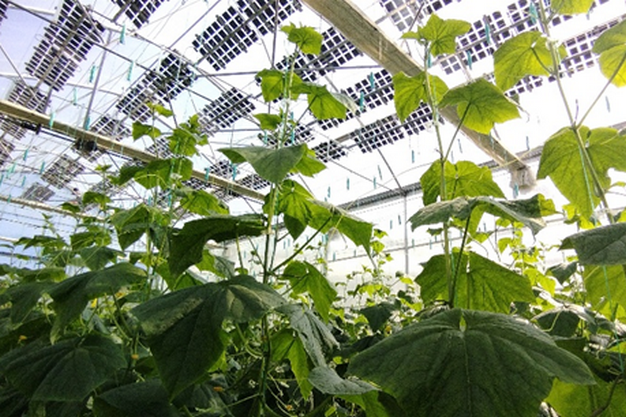 © University of Thessaly – Laboratory of Agricultural Constructions and Environmental Control (LACEC)
Professor Chrysoula Papaioannou, project leader for UTH, emphasises the significance of the findings: “The energy surplus we observed is a strong indication that greenhouse agrivoltaics can evolve into a reliable, self-supporting system. With optimised photovoltaics operation strategies, growers could substantially lower their energy footprint. The positive energy balance and the limited effects on crop yield highlight the potential for greenhouses
to partially or fully offset their electricity demand through integrated agrivoltaics without compromising crop yield.”
The results from Velestino, combined with those of the five other pilot plants of the REGACE project, are expected to contribute to the future development of agrivoltaic systems in Europe and beyond. The results indicate that solar-tracking photovoltaics can enhance energy production while maintaining suitable conditions for crop growth, particularly when greenhouse climate control strategies are properly adjusted.
The REGACE project demonstrates that agrivoltaic greenhouses can deliver both agricultural output and renewable energy, supporting European goals for climate neutrality and sustainable agricultural production.
For more information:
University of Thessaly – Laboratory of Agricultural Constructions and Environmental Control (LACEC)
[email protected]
[email protected]