
On my rare productive day off, I happened to make my way to Missoula with my Costco membership and a mission: get a hotdog and go to the movies. Both are somewhat uncommon, but my unwillingness was bolstered by something else — I had done my homework. Before deciding to cave on movie tickets (definitely get a cheaper matinee ticket if you can, saved my life) I did my due diligence as a bookseller and read “Project Hail Mary” before seeing it up on that big ol’ screen. That movie, despite my reservations, might just get me back in the theater again.

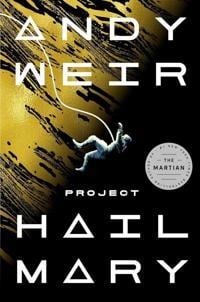
Let me back up. “Project Hail Mary” is Andy Weir’s third novel. His first, “The Martian,” saw box office success in 2015, but his second novel, “Artemis,” languished long enough to be dismissed; director duo Phil Lord and Christopher Miller remained with Weir, and shifted their focus to what would become “Project Hail Mary’s” screen adaptation. The duo has a broad resume of directing, writing and producing both film and television: both 21 and “22 Jump Street,” both “Cloudy With a Chance of Meatballs” movies, several Lego movies, and both Spider-verse installments. Their TV credits include a smattering of episodes of “Brooklyn-99,” “Clone High,” and “How I Met Your Mother.” This should give you some idea of their production style: punchy, earnest and silly. This is tempered by the hard sci-fi setting of “Project Hail Mary,” but right from the first shots, their hand is evident.
Back to the book. To summarize: something is eating the Sun’s energy, and if left unchecked, could dim our star by about fifteen degrees in thirty years, leading to a mass starvation event that could kill up to 25% of the world’s population. Our protagonist, middle school teacher Ryland Grace, finds himself aboard the Hail Mary with no memory of how he got there or how long he’s been out for. Through a series of flashbacks we learn that his mission is a one-way trip, with just enough fuel to get him to a neighboring star that is mysteriously untouched amongst a collection of other stars suffering the same fate as the Sun. Along the way he meets a certain interstellar traveler, and I won’t spoil anything else, because the development of events and relationships from there is the core of the book. This high-stakes premise is combined with Lord and Miller’s sense of humor and emphasis on humanity, and we end up with a moving story that sticks to its core philosophy: kindness, ambition and creativity have the potential to change the classroom, the planet and maybe even the galaxy.
Watching the movie gave me a new perspective on Weir’s book. We’re (mostly) isolated on the Hail Mary, left only with Grace’s thoughts, fears and eventually his memories. But what struck me while sitting in the theater, surrounded by people, was the work of human hands that was evident in the film. The choices of each shot, the acting decisions, and the voices of the people around me were profoundly moving in a way I didn’t expect.
I’ll be honest and say much of my time is spent in front of a screen, whether it’s games, television, or artwork; about 60% of that is detrimental to my brain, between keeping up with the news or staying vigilant against AI. My bubble of the internet had become more cramped, and more hostile. But the spectacle of seeing a movie, seeing the credits roll and knowing that those are all creative people with a vision — and no AI to be found — it gave me a little extra hope, and a little bit of leg room in my bubble.
My assignment for you is this: if you’ve only read the book, or only seen the movie, I highly recommend its counterpart, and reflect on the difference between the two, and how their differences in scale may have changed Weir’s vision and your impression as a whole.
The Mortal Reader is a weekly book column written by the owners and staff of Chapter One Book Store, 252 W. Main St., Hamilton, Montana 59840. To find a book you have read about here, or to learn more about events at Chapter One, please go to chapter1bookstore.com.