
Lead ImageKuba Dabrowski Awar Odhiang, Paris, 2025 Schiaparelli by Daniel Roseberry Schiaparelli haute couture Autumn Winter 2024 © Kuba Dabrowski. Photo courtesy Patrimoine Schiaparelli, Paris
Once upon a time, after a global pandemic, economic collapse and as global conflict, spurred on by a power-hungry dictator eager to expand his territories, began to spark, the house of Schiaparelli made some weird clothes that chimed inherently with their weird times. The parallels between the back-then of the house’s first heyday in the 1930s and the right-now – when, as we all know, Schiaparelli is again enjoying a renaissance under creative director Daniel Roseberry – are so obvious as to barely bear mention. But that is perhaps why the Victoria and Albert Museum’s new exhibition Schiaparelli: Fashion Becomes Art – the first retrospective of that house in the UK – feels particularly apt.
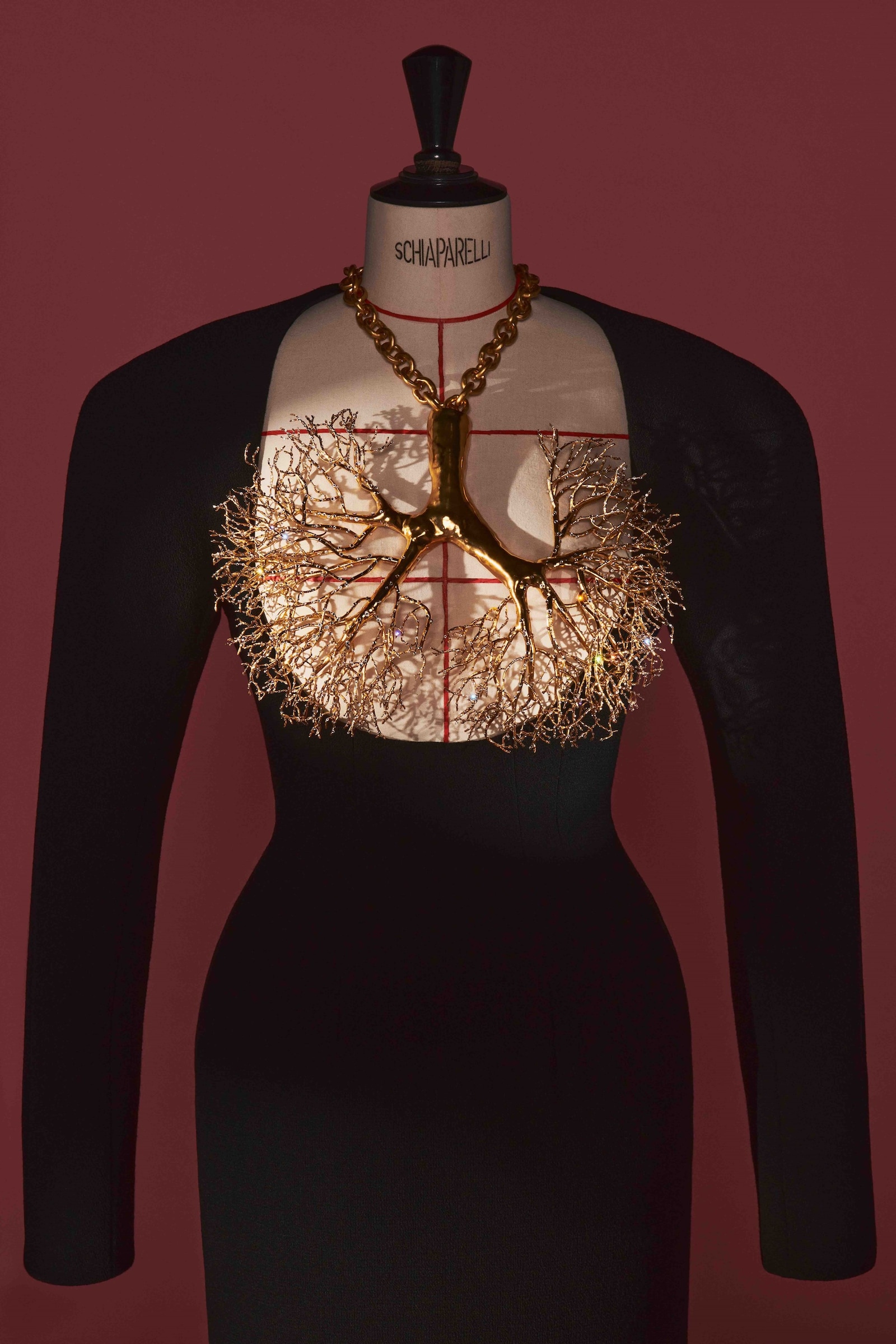
Schiaparelli’s clothes, back then, were profoundly disturbing. “Shocking” is the word Daniel Roseberry uses to describe the work of its founder, Elsa Schiaparelli. She was an Italian aristocrat born in Rome whose uncle, the astronomer Giovanni Schiaparelli, still surpasses her fame in some circles as the discoverer of the Martian canali. After a failed marriage and the birth of her daughter in the mid-1920s, Schiap, as she was convivially known, decided to apply her talents to clothes. She made them first for herself, including a black and white knitted shirt with a trompe l’oeil bow, a slightly surreal motif that hinted at what lay beneath Schiaparelli’s habitually placid exterior. Later, she christened an acidic shade of purple-pink ‘shocking’, and made clothes of synthetics furrowed like tree bark, almost crudely embroidered with metal threads, jackets cut to simulate chests of drawers (actually, a few) and a truly terrifying black silk dress with a skeleton swelling from beneath its surface. It’s still mildly appalling today – a treasure of the V&A archives, the show’s curator, Sonnet Stanfil, paired it with Roseberry’s own inside-outside anatomical dress, with a necklace of gilded lungs over chest bared by a low-scooped neckline, famously worn by Bella Hadid.
That is one of only two places where Elsa’s Schiaparelli clothes are placed in direct conversation with Roseberry’s. “People ask, ‘Do you think she would have loved you, if you sat together at dinner?’,” Roseberry posed. “And I say: no. She would’ve eaten me for breakfast.” He was talking, at that point, in the final room, the other place where a dozen or so of his dresses, from his seven-year tenure at the house, are juxtaposed with a trio of Schiap oddities. They are a virulent green feather cape, a papal gold coat, and another with pockets embroidered to resemble Sevrès porcelain ewers – none of which are especially Schiap-ified. But that space shows what Roseberry has brought to the house, his codifications, including contrasts of black and gold, jewellery pieces that seem to blow up Elsa’s signature bijou buttons into entire dresses, and a hefty dose of Americana. He’s from Texas, and Schiaparelli herself spent a chunk of her twenties in New York, returning during the Second World War. She loved the country.

“She’s at play,” was Roseberry’s declaration of the Schiap on show. And she was, but with a straight face. Schiaparelli’s clothes are witty, not funny, unless you mean funny looking rather than amusing. Her collaborations with Surrealist artists – which is where the name of the exhibition comes from, and is probably the best-known aspect of her work – have had their shock value blunted, honestly, but we can still trace their historical importance. Schiap was lucky, in a sense, because unlike so many other artists before and since, the Surrealists adored fashion, seeing it as expressive of human sexuality and fetishism, as well as displacement – a shoe as a hat, obviously. They were happy to collaborate. “Beauty will be convulsive or will not be at all,” André Breton wrote, and Schiap interpreted that via arresting cross-overs between her work and the art world. Jean Cocteau concocted embroideries, Alberto Giacometti made buttons for her, and Leonor Fini devised her perfume bottles. Salvador Dalí, meanwhile, was the inspiration behind a dress printed with a giant lobster, laying phallically against the thighs – Dali wanted to splatter it with real mayonnaise, but Schiap somehow talked him out of it. It’s a dress that wound up being worn by the American wife of a controversial, title-stripped former royal prince – Wallis Simpson, and Edward Duke of Windsor, respectively. Again, ringing bells.
Those works, taken from Schiap’s most fertile and influential work of the 1930s, are juxtaposed with art. Alongside 100 ensembles (many of which, Stanfil confirmed, have never been on public display previously) there are 50 artworks in the show, including Dali’s 1936 painting ‘Necrophiliac Spring,’ once owned by Schiaparelli herself. Nearby is the famous ‘Tears’ dress, a weird blue dress printed and appliquéd with bruised purple rifts that resemble flayed flesh. It is itself inspired in part by a shredded skin dress worn by a figure in Dalí’s painting Three Young Surrealist Women Holding in their Arms the Skins of an Orchestra, painted two years earlier. Dalí collaborated on the print design.

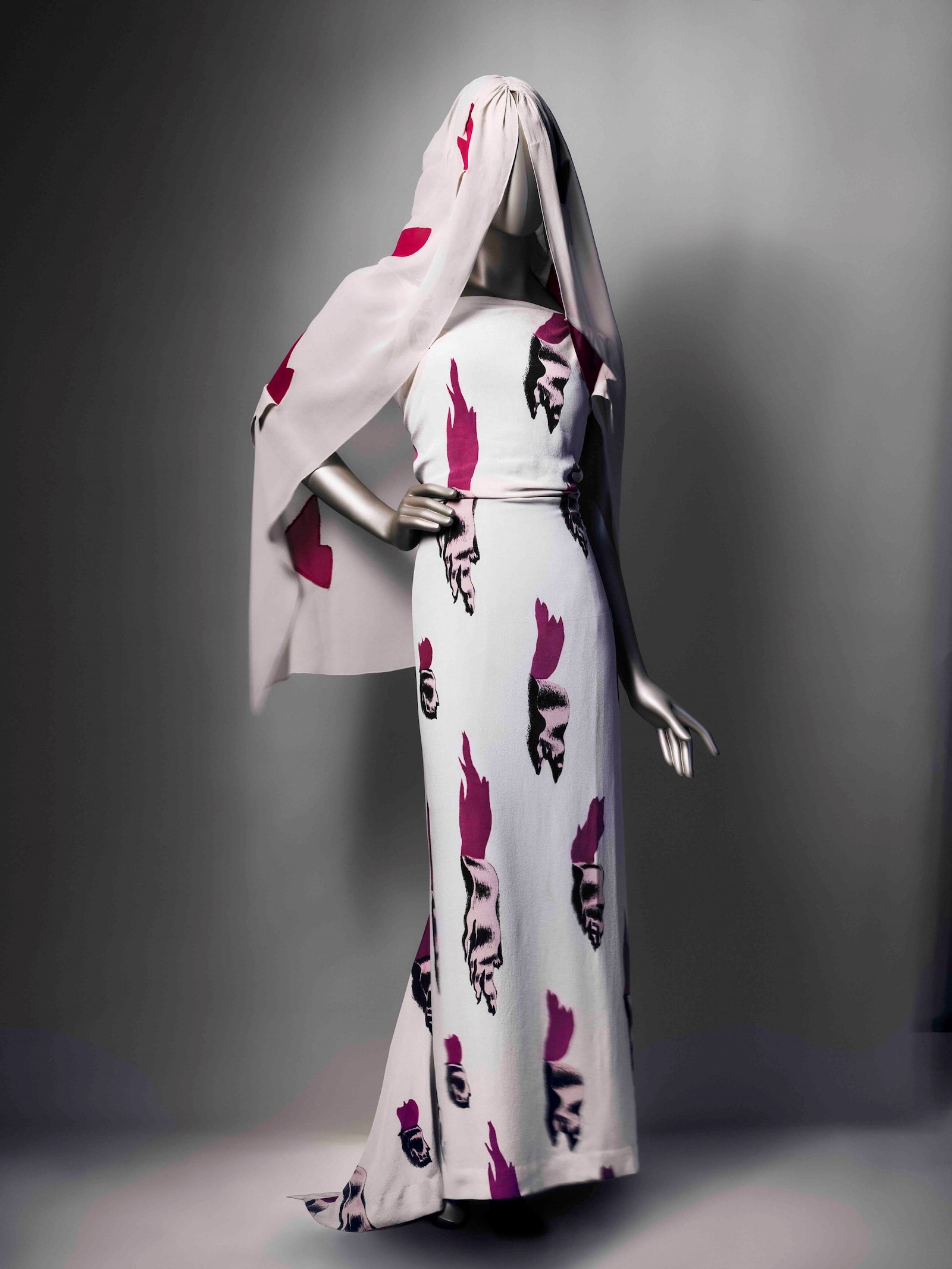
Such shenanigans led Gabrielle Chanel to dub Schiaparelli “that Italian artist who makes dresses.” It wasn’t intended as a compliment, but certainly Schiap didn’t shy away from pushing at the boundaries of what couture may represent. “She was the first person to do so many things – themed collections, unisex fragrance, shows set to music,” commented Roseberry. Add art collaborations to that too, which seems especially contemporary. “Was she the first real creative director?” He asked, probably metaphorically. Certainly, her universe is especially rich, and all creative roads lead back to her.
For Schiap’s own artwork, her canvas was often the jacket – sharply shouldered, an expression of a notion christened “Hard Chic” that she was perceived to have invented, they were vibrantly embroidered in seemingly ceaseless iterations according to the themes of her collections, with arabesquing ornamental buttons specially-made to match. A room in the V&A presents a constellation of them, in a semi-circle around a Roseberry example that seems to Frankenstein together half-a-dozen examples into one look. “You have the Chanel jacket, you have the [Dior] Bar jacket, and you have the Schiap jacket,” says Roseberry. “That jacket, with the sensibility of collage and embroidery, feels so relevant.” As does so much else – not least the final look in that final room, a lacy Alien Resurrection-meets-rococo fantasy with a curling six-foot scorpion tail, taken from Roseberry’s January haute couture show. “In difficult times, fashion is always outrageous,” said Elsa. Amen to that.
Schiaparelli: Fashion Becomes Art is on show at the Victoria and Albert Museum in London from 28 March – 8 November 2026.