
Half an hour before the event started on March 25, Buckley Center Auditorium was already overflowing.
With nearly all the seats claimed, attendees pressed shoulder to shoulder along stairways to hear Robin Wall Kimmerer, an author, activist, botanist and enrolled member of the Citizen Potawatomi Nation.
She’s this spring’s speaker for the Schoenfeldt Distinguished Writers Series.
Students, faculty and local community members squeezed into slim pockets of space, some sitting cross-legged on the floor near the podium. After exceeding fire-code capacity, however, others were redirected to an overflow livestream in Dundon-Berchtold (DB) Hall.
Known for weaving indigenous wisdom with environmental science, Kimmerer visited campus as part of ReadUP, a campaign that aims to unite the university community by reading the same book throughout the school year. 400 free copies of “Braiding Sweetgrass” were distributed last fall.
Lars Erik Larson, English professor and ReadUP organizer, knew that the free and public event would be well-attended, as “Braiding Sweetgrass” was one of the most checked out books from the Multnomah County Library in 2025. But the unexpectedly large turnout of UP and Portland community members “stunned” him.
“We had thought about opening up the Chiles Center, but we just love the intimacy [of Buckley Aud], and it hasn’t quite been like this ever before,” Larson said.
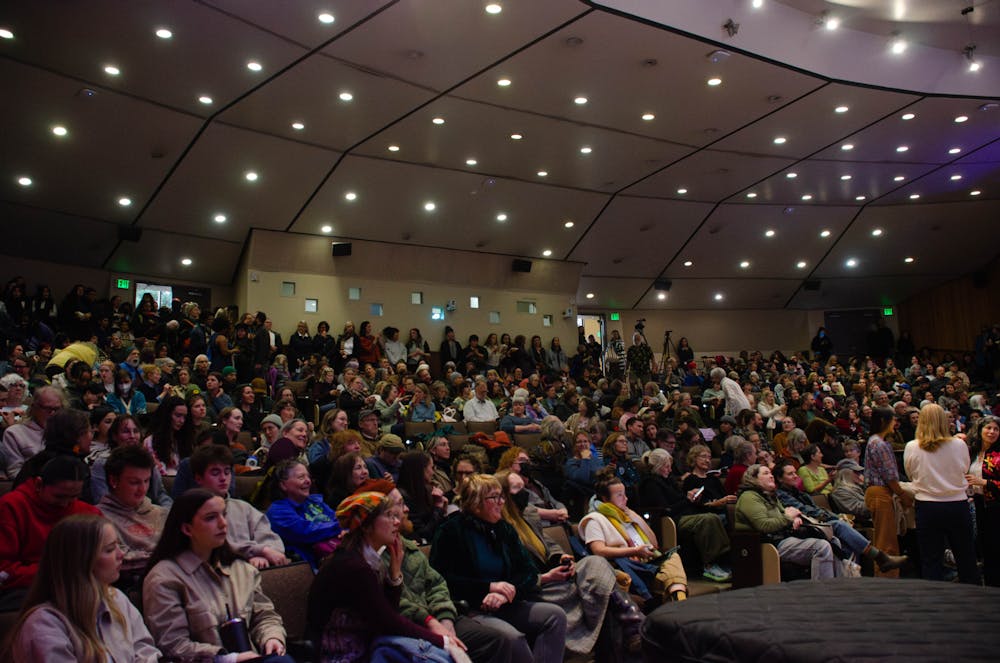
Buckley Auditorium was past capacity, with people standing in the back for a chance to hear Kimmerer.
As a crowd of shuffling feet and anticipation swelled around her, one woman in the front row calmly knitted. To her left, Kimmerer sat waiting for her cue.
“Hello, my relatives,” Kimmerer said as she approached the podium, alternating between English and the Potawatomi language.
The audience immediately erupted into applause. She opened with gratitude for the invitation to speak at the university and for all who showed up to GreenUP the day prior at the Student-Led-Unity-Garden.
“We want to live in such a way that the Earth will be grateful for us too, and the people who gathered yesterday to plant, to learn to be in community and in reciprocity, was really beautiful” Kimmerer said.
GreenUP was inspired by “Plant Baby Plant,” Kimmerer’s initiative to combat native erasure and promote biodiversity across the country.
Sophia Maks, sophomore and president of UP’s Eco Club, was handing out take-home native plants at the event. Maks says that the participation of local activist and environmentally-focused organizations showed community bonding and togetherness.
“You see a lot of siloing on campus,” Maks said. “But this is an event where there are a lot of students and community members outside of the school, which has been really cool to see people caring about this common thing of the environment, of the goodness of the Earth and how we can protect it.”
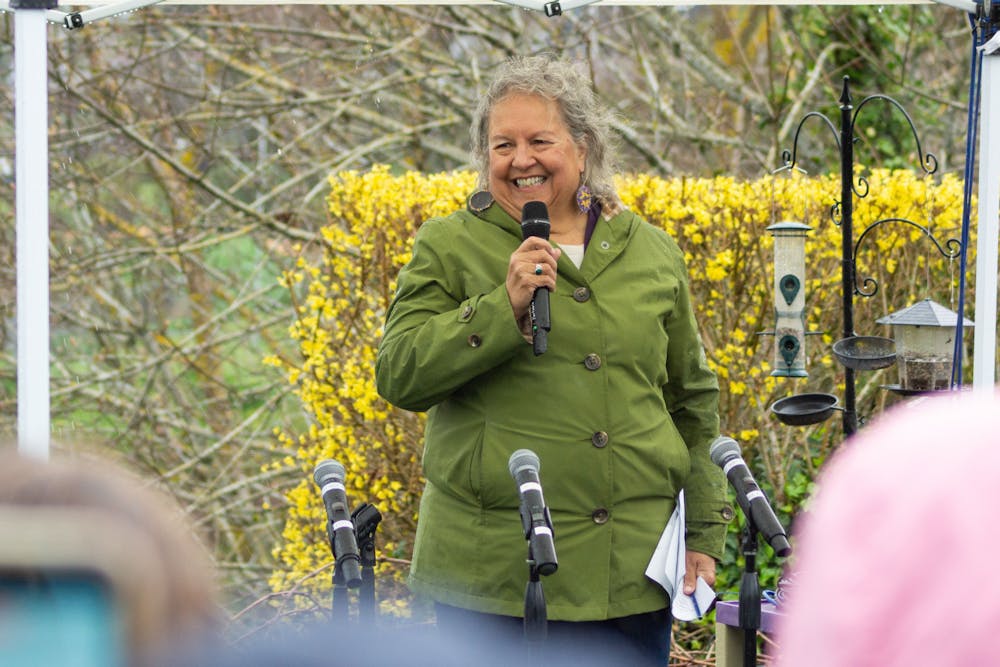
Robin Wall Kimmerer speaks to students and community members at the GreenUP/Plant Baby Plant event.
How to treat the Earth and its beings with proper care was the dominant theme of Kimmerer’s lecture. To illustrate this relationship, she prompted the audience to partake in an experiment: When you hear the word “land,” what comes to mind?
In Western contexts, land is often viewed as property, ownership and rights, while indigenous cultures see it as a source of identity and knowledge, according to Kimmerer.
“The fundamental question we face when we look at these conceptions of how we think about land is inferior, isn’t it?” Kimmerer said. “Is land just a source of belongings, or is it our most profound source of belonging?”
In “Braiding Sweetgrass,” she explores this question of care by using the practice of braiding sweetgrass as a symbol for braiding Mother Earth’s hair and the bond created by that action.
“We braid one another’s hair, by way of saying, ‘I want you to be beautiful,” Kimmerer said. “‘I want you to be at your best,’ and that’s why we braid sweetgrass. We are braiding Mother Earth’s hair to say, ‘I want you to be at your best.’”
Part of promoting reciprocity with the Earth, then, is reframing our interactions with nature to be givers rather than takers. One way to do so, she proposes, is by adjusting the way that humans refer to nature and non-human living beings: use “Kí” in place of “it.”
“This little word is a big word,” Kimmerer said. “It’s a really big word. And in the Potawatami language, of which I am just a rudimentary beginner, it’s impossible to say ‘it’ about a tree or a robin or a river or a fish.”
So she asks the audience what it would be like to speak of the world not as commodity or as objects, but as living relatives. And audience members resonated with this proposal.
Glenn and Marky Hill, a local couple from Northeast Portland, heard about the event through the Extinction Rebellion. They said they were “mind blown” by how even the word “it” creates an “us versus them” mentality.
“I thought she very gently took a paradigm and said, ‘You guys are so surrounded by it, but if you just pay attention, you know, this is so much better,” Glenn said. “Just open your mind.”
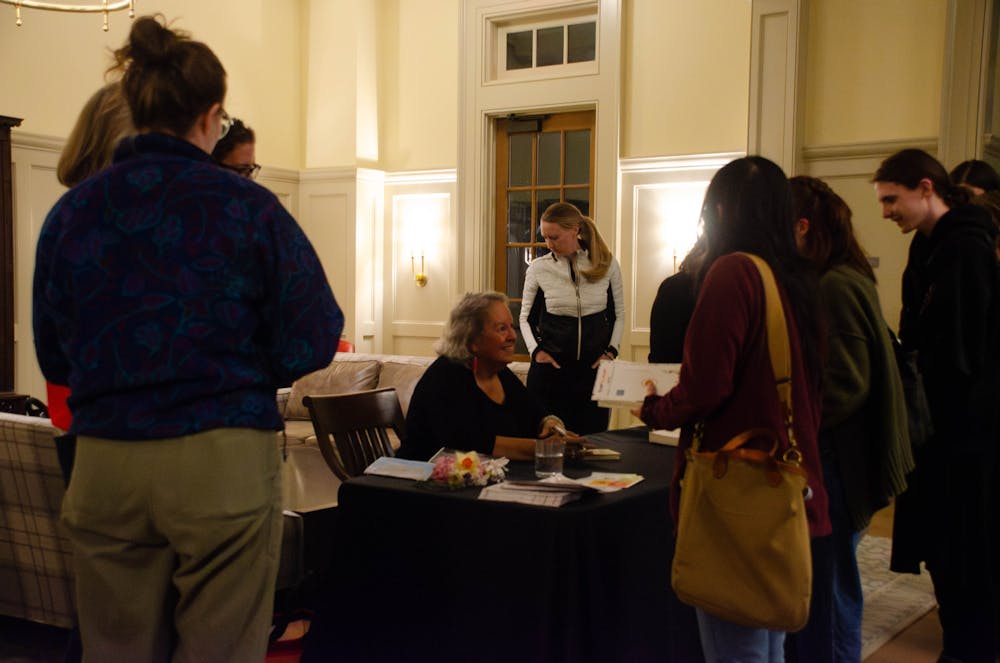
Kimmerer signs books after her lecture.
Miranda Lara and Claire Beaumont, both senior English and secondary education majors, attended the event together. Lara is currently writing a capstone paper on plant consciousness, so when she heard that one of her primary sources was speaking on campus, she knew she had to go.
“[Kimmerer’s talk] made me emotional,” Lara said. “I liked the interconnectedness of everything, like with her indigenous language and to the English language, just being able to replace ‘it’ in itself makes everything so much more personal and holistic,” Lara said.
She’s excited to deploy that new language in her paper. While Beaumont hasn’t read Kimmerer’s books yet, she knew she’d be remiss if she didn’t seize the opportunity to see her speak.
“I found it really inspiring,” Beaumont said. “I just really appreciate everything she said, like beyond land acknowledgments, how are we actually going to respect indigenous knowledge and use it to create a better world not only for ourselves, but for all living beings on the planet?”
Upon Kimmerer’s closing remarks, she received a standing ovation. A book signing followed the lecture in DB, and the line of attendees with copies of “Braiding Sweetgrass” in hand wrapped around the building.
For those who couldn’t attend the event, a recording will be uploaded to the ReadUP webpage and will be available for the UP community members to access for two weeks.
Kaylee Monahan is the Copy and Opinions Editor for The Beacon. She can be reached at monahan26@up.edu.