
Welcome to The Content Report, a newsletter by Vince Mancini. I’ve been writing about movies, culture, and food since the late aughts. Now I’m delivering it straight to you, with none of the autoplay videos, takeover ads, or chumboxes of the ad-ruined internet. Support my work and help me bring back the cool internet by subscribing, sharing, commenting, and keeping it real.
—
Brief Plug: I wrote about the Neighbors finale for GQ. Not only the wildest episode of television I’ve seen in the last five years, but a show that captures the soul of 2020s America like perhaps no other.
In episode one, a court-appointed mediator rides a custom motorcycle and always wears shades, seemingly fancying himself the star of his own Dog-the-Bounty-Hunter-style reality show. With every practiced pose he exudes the confidence of a guy who “gets shit done.” Yet when he actually shows up to the disputed horse pasture, the entirety of his “mediation” consists of him sitting quietly on his Harley, waiting in vain for his moment to speak as the two families go round and round bickering. Ultimately the mediator just throws up his hands and rumbles off into the Great Plains. This is America in 2026: the students are all locked in esoteric blood feuds and the teachers are all dead.
Meanwhile, at least one person in each feud always invariably has a sizable online following somewhere, often as a direct result of the feud itself. They’re all performing for an army of invisible followers somewhere, all convinced that it is their neighbor, and not them, who is the real Crazy Karen. The finale, “Yellow Thong Bikini,” begins as this kind of story, but eventually evolves into something more, as its pathos and absurdity reach an almost hallucinatory crescendo. I watched most of it with palms glued to face, occasionally shrieking; it’s a benchmark of cringe comedy I haven’t experienced since Nathan Fielder turned himself into a giant baby for The Rehearsal.
I quoted the line “There’s something coming out of my penis, but that’s normal,” but that comes in the first five minutes and isn’t even the craziest line of the episode. It’s an absolute must-see/must-read. Variety did a follow-up interview with Danny, and it’s uncanny how much he sounds like Trump in print.
—
It took a few weeks since release to catch the new Pixar movie, which seems like an eternity considering how many times we’ve watched virtually every Pixar movie at home. My son has even coerced me into rewatching Elemental on occasion, which I hate. The things we do for family.
This past week we had another opportunity for father-son movie bonding, and my first instinct was to check out the Pout-Pout Fish, the movie version of a book we’ve read probably as many times as we’ve watched Zootopia. Strangely it was only playing at a couple theaters in town, mostly at odd times (which seems like money on the table at a time when almost everything else in theaters is horror movies or Christian films). It must either be terrible or the distributor has no pull.
That basically left Hoppers. Which is about… what, again? Bunnies or something? Pixar has clearly lost their fastball when it comes to easily encapsulating a concept in a one or two-word title. The fact that Hoppers’ couldn’t be is arguably a point in its favor, at least to us minor-accompanying adults. Turns out it’s about humans who can transfer their consciousness into hyper-realistic animatronic animals, understanding their language and learning their ways and so forth, like Avatar for beavers and bears. “Stop saying it’s like Avatar! It’s nothing like Avatar!” goes one winking joke in Hoppers’ first act.
I had just enough time in between picking my kid up from daycare and start time to take him through McDonald’s on the way. I know enough to know that I did not want try to enforce two hours sitting stationary in a dark room on a hangry gremlin. I try not to fill him full of too much processed junk food and sugar, but I’d rather build in good associations with moviegoing than fight that particular battle at this particular time. Happy meal, happy child. We’ll worry about preservatives again tomorrow.
Unfortunately toddlers don’t really treat fast food like you and I, as something to quickly force feed yourself in the limited time between destinations. For them it’s more like a bounty of rare delights, to be carefully unboxed and examined before savoring. He was still mostly fiddling with his plastic croc (yes, like the footwear, a truly deranged idea for a toy that was nonetheless a hit with its target demo) when we arrived. And so I got to school my son, for the first time, in the fine art of illegally smuggling food into a movie theater.
The cheeseburger wrapped up just fine, but the fries quickly escaped their cardboard prison and made a salty, greasy mess of my left jacket pocket. I still managed to pull them out by the handful and lucklily he didn’t mind, and spent the first half hour of the film contentedly munching. This even as a handful of the other children present turned the auditorium into their personal bouncehouse, cackling like jackals as they crawled over the empty rows down in front. Through it all my son stayed quietly seated, a rare behavioral win for a Mancini progeny.
The movie itself concerns a Japanese-American girl with anger issues named Mabel, whose loving grandma attempts to inculcate some chill by taking Mabel to a forested glade near their home, in the apparently-not-fictional town of Beaverton (I believe your mother matriculated there?). The trees, rocks, and pond don’’t look like much at first, but, grandma counsels, the longer you sit quietly, the more action you begin to see — the leaves gently swaying in the breeze, the animals going about their business, even their individual personalities. Hoppers introduces a nice sub-theme here, of life being better when you relax, shut up, and listen. Touch grass, kids. (Not now though, we’re watching movies).
Fast-forward to the present, and wise old grandma is obviously dead (RIP to all the dead moms and grandmoms and childless would-be moms who died in the first act of Pixar movies to give stakes to protagonists’ character arcs), but college-aged Mabel still honors meemaw’s memory by spending her downtime at the peaceful glade, occasionally cutting class to do so (she’s some kind of STEM prodigy like all kids’ movie characters these days, but the movie thankfully doesn’t belabor that point). She’s just chillin’ out, maxin, observing some ducks and beavers one day, when some bad guys, they are up to no good, pull up with some bulldozers and f*ggots of dynamite (this is historically correct usage, I’m reclaiming it). They’re there to blow up the beaver dam and build a new expressway, at the behest of the slick, Gavin Newsom-coded Beaverton mayor, Mayor Jerry — voiced by Jon Hamm, who previously played the metaphorical “Mayor of Beaverton” on Mad Men.
Mabel does her level best to sabotage the bulldozers and rally the town to save her beloved beaver glade (a beauty product your mother could surely use), but it becomes abundantly clear that no one cares about the place but her. It seems even the animals don’t go there anymore. If Mabel could just prove that they did, the glade could be deemed worth saving.
Mabel goes to her professor of something-or-other, Dr. Sam (Kathy Najimy), who explains that the beavers are the keystone species supporting the entire ecosystem, and if they could just entice one beaver to post up in the glade, the rest of the forest animals would surely follow suit (scientifically accurate, sort of!). This proves as difficult as gathering signatures for her save-the-glade petition, but Mabel soon discovers Dr. Sam’s current project: the animatronic animals, the consciousness-transferring machine, the built-in animal translation software…. it’s just like Avatar! (Stop saying it’s like Avatar!)
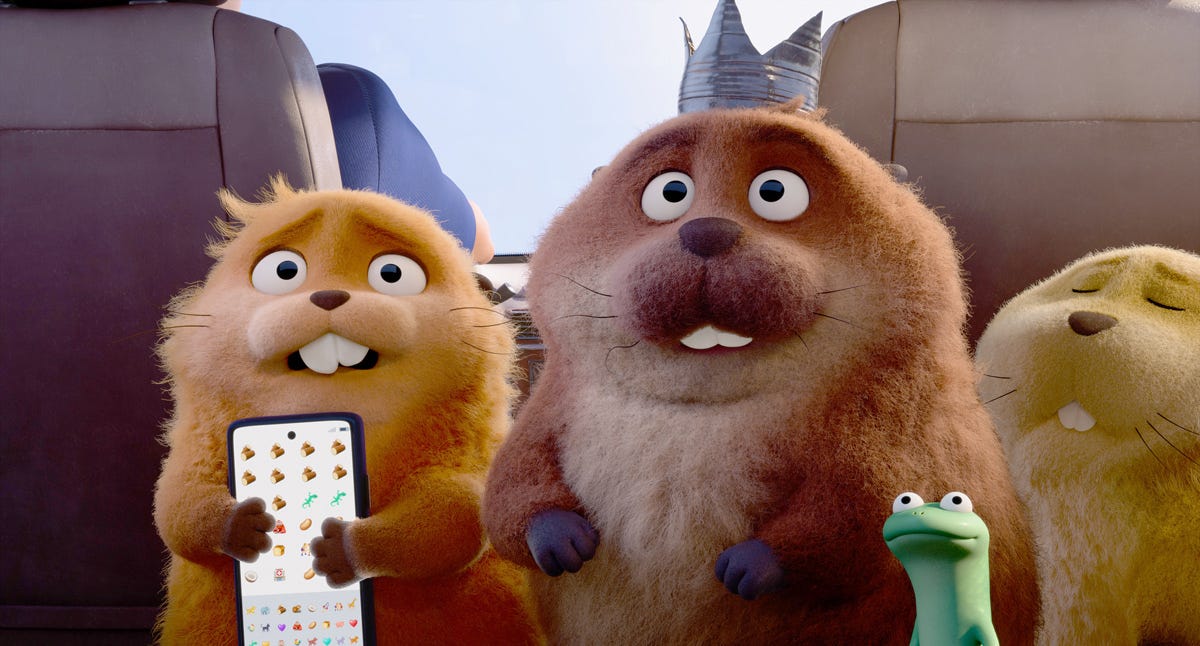
Mabel obviously figures out a way to sneak in and take a beaver for a test drive. Doing so uncovers a complex animal society previously invisible to humans. From Mabel’s new beaver’s eye (and ear) perspective, the forest creatures transform from sweet little furry things with glassy black dots for eyes to nuanced, individual personalities, who flirt and fart and gossip just like kooky humans do, and in the process present more anthropomorphized forms, complete with expressive, human-like eyes, with whites and pupils and stuff. It’s actually a pretty brilliant artistic conceit, a succinct visual vocabulary for empathy. In its cartoony way, it even sort of recalls the restated theme of HBO’s suburban gothic, DTF St. Louis: “Everyone is weird, they only look normal from across the street.”
Animals, they’re just like swingers.
Ensconced in her beaver bod, Mabel infiltrates animal society, which she soon discovers to be a complex web of rules and accepted hierarchies, led by an all-powerful but extremely chill monarch, King George (Bobby Moynihan). He’s sort of a cross between Hammurabi and Richard Simmons, leading aerobics classes and wearing a little beaver crown. (I’m a sucker for all talking-animals-style kids stories).
King George, we soon come to learn, has pioneered an animal behavioral code known as “Pond Rules” (Pond Rules!), designed to keep this shrunken, human-encroached, shared Bantustan ecosystem running smoothly. His simple rules are: don’t be a stranger, eat when you have to, and we’re all in this together. Arguably Hoppers’ greatest strength is this sort of winning irreverence, where the script (with four credited writers) can zig and zag in unpredictable ways and have it feel inspired, rather than distracting. Pond Rules! It’s fun to say.
Beaver-Mabel soon discovers that Mayor Newsom er Jerry has actually been using fake trees and speakers pumping loud noise that only animals can hear into the glade, in order to specie-ally cleanse the area for his pet expressway project. That’s why the animals left. King George wants to stay chill and maintain the status quo, but Mabel, naturally, wants to take out the tree and reclaim the lost animal territory. She knocks it down and destroys the speaker, and for a minute, the animals return and everything seems peachy. George names Mabel “Paw of the King,” a la Game of Thrones (one of Hoppers’ weaknesses is this reflexive pop-culture referencing it does, when it already has its own rich mythology), and for a second it seems like a Beaver crisis of succession might be brewing.
Of course, Mayor Jerry retaliates with more speakers and more dynamite, throwing the animal kingdom into chaos. King George urges calm but Mabel wants to fight back, and she has succeeded in sort of radicalizing the animal kingdom. They stage a meeting of the council of kings from the animal world (George’s counterparts among the insect, bird, amphibian, and fish kingdoms…) at which point it becomes clear that their anger has grown beyond even Mabel’s hopes and her ability to control. Led by the hawkish insects, to the chagrin of Dovish George, the animals move to “squish” Mayor Jerry.
There’s a lengthy, admittedly visually inspired sequence, making full use of the contrast between animal vision (seeing every animal as anthropomorphized and individual) and the human vision of homogenous squeaky plush toys, in which Mabel and George try to save Mayor Jerry from the armies of pissed off animals trying to kill him.
Hoppers is part of a long spiritual tradition of these politics-inflected parables that seeks to humanize the “bad guys” and position “anger” as the real enemy (the first Shazam! for instance, did this reasonably well). In this case, it’s humans that the film attempts to humanize, because, as King George is fond of saying, they’re just as much a part of the pond as the animals.
Hoppers is brilliant at creating a visual shorthand for what empathy looks like, but there’s also a long stretch of this film that asks us to root against the slimeball mayor getting squished — even as he steadfastly refuses every olive branch from the animal kingdom. Hoppers’ antagonist shifts, from the rapacious bulldozing mayor to a petty animal tyrant ruled by id, in the form of a megalomaniacal caterpillar. It’s nicely unpredictable and indisputably inspired in execution, but also deeply unsatisfying.
Maybe it’s partly a timing thing, where it’s hard to accept sympathy for Mayor Jerry when he so easily evokes so many real-life tyrants (not naming any names!). Empathy is a good message, but it’s hard to imagine “anger” being the real enemy here. And anyway, isn’t part of empathy being able to understand someone else’s righteous anger? We don’t have to hate Mayor Jerry, but can’t we hate greed? Ecocide, usurpation? To me this is a story that’s clearly about greed, and Hoppers wanting so much for it to be one about anger feels misguided, if not propagandistic. Teaching the children sympathy for the bulldozers feels pretty far down the list of useful messages.
Hoppers eventually finds its way to a satisfying ending, and its winning sense of humor and inspired visual conceits can paper over a lot of sins, but so much the action surrounding its supposed climax just feels off. Way off. Empathy is great, and it’s good to know that hurt people hurt people, but there were times I yearned for the straightforward truths of, say, the Lorax. Won’t someone speak for the god damned trees? Fuck Mayor Jerry. He can take his data centers I mean expressway and shove them all the way up his ass.
Toddler Rating: 10/10.
The kid was downright transfixed. He contentedly finished his entire Happy Meal, and while the other little turds were running down the aisles and crawling over seats he climbed over the armrest and watched the last 20 minutes on dad’s lap. This is a kid who mostly refuses to even hug me if mom is around, so I was a very happy father that day.
Parent Rating: 7.5/10.
Solidly entertaining flick; funny, memorable, and often inspired. Arguably one of the funniest Pixar movies. But politically convoluted in a way that would give credence to all manner of Disney psyop conspiracies. Mayor Jerry can get fucked. Squish him, I say.