by Kevin T McEneaney
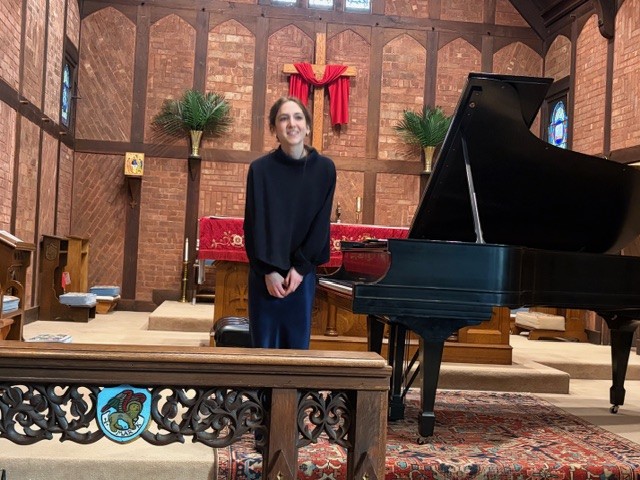
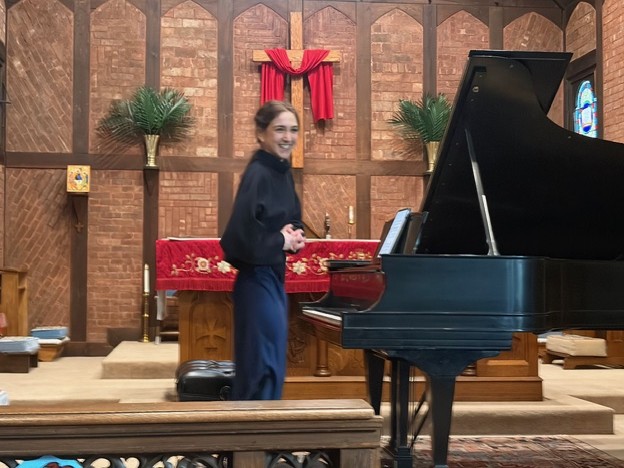
Pianist Julia Hamos from Hungary is an international sensation. It seems amazing to me that she is here playing in Millbrook for The Millbrook Music salon, a recent enterprise by Stephen Kaye who introduced Julia whom he has known over the past five years. Julia is a graduate of the Royal Academy of Music in London with Christopher Elton and the Mannes College of Music in New York with Richard Goode; Julia studied with Sir András Schiff at the Barenboim-Said Akademie in Berlin and studied at the Kronberg Academy where she now instructs. The program offered delight upon delight as Julia’s flaming fingers swept the keyboard with rapid finesse.
Julia opened with early Haydn: Sonata in E minor, Hob. XVI:34 (1767) to foreground the early evolution of the keyboard. The first movement appeared to address the claustrophobia winter and limited indoor routine. The second movement offered increasing hope for longer daylight, while the third movement celebrated the bursting of vegetation and flowers with longer days and satisfactory strolls through gardens and woods.
She performed three Études by the Hungarian composer György Ligeti (b. 1923-2006) who resorted to creating film music to make a living, eventually connecting to Stanley Kubrick for 2001: A Space Odyssey. Ligeti yearned to play piano as a child yet was not able (due to financial reasons) to play piano until the age of fourteen. Arc-En-Ciel (which literally means “God’s arc in the sky,” that is, a rainbow). This colorful arc offered a mélange of varied styles from classical to jazz and pop and South African music, a heady, careening blend of styles and techniques, a sort of Jacob’s robe. Fanfares was just that: a list of attractive roving medley pieces. Die Zauberlehrling (The Sorcerer’s Apprentice, based upon a poem by Goethe), which was my favorite of the three. Here was a biographical memory of Ligeti playing the piano that his father bought for him at the age of fifteen. The excitement of creation and experimentation was thrilling under the fingertips of Julia, whose fingers I imagined, were smoking the keys.
Julia then performed Mozart’s first masterpiece, Piano Sonata in A minor, K.310 (1778). I have listened to two recordings of this work and have heard it performed in concert twice, yet here was the best performance of this difficult composition wherein Mozart became Mozart. This is both a moving lament for the sudden, unexpected death of his mother who had accompanied him to Paris, and his entry into living alone and dwelling in newfound freedom. This autobiographical window is the signature birth of Romanticism, whereby feelings forage in the workhouse of art, where the heart is laid bare. There are sudden mood shifts, anxiety, the courting of a wealthy young soprano, the shadow of his mother’s sudden death, the feeling of exploring freedom on his own, and the failure of Parisian connoisseurs to understand his music. What a memorable performance!
After a short break, Julia returned to perform a comic interlude by Hungarian composer György Kurtág (b.1926). This composition was a rollicking satire on the playing of classical music with elbow-sweeping on piano keys and similar wacky hijinks. This was the only time that she played from a tablet score, the rest of the concert being played from memory.
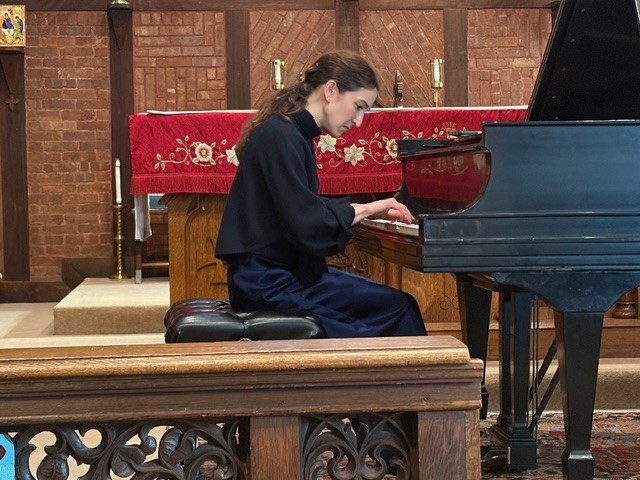
Next was another noted Romantic masterwork, Fantasia in C major, Op. 17 (1846) by Robert Schumann. The first movement is a melancholy lament that expresses Robert’s failure to court his future wife, Clara Wieck, telling her, “You can only understand the Fantasie if you imagine yourself in the unhappy summer of 1846 when I gave you up.” The opening movement features a descending scale plunge that dominates the composition, with bipolar perspectives. The second movement offers a heroic march in E minor, which he acclaims and quotes Beethoven, and the final serene movement in C offers resolution to the composer himself and Beethoven aficionados.
This composition later became Robert’s most popular work, and even Franz Liszt often played it when they became best friends. This long sonata (about thirty-five minutes) features bipolar fragmentation, as well as formal exultation, a peculiar mix of what is most personal, as well as public acclamation of a composer who was greater than this composer.
This was an unusual concert to be treasured in one’s memory due to transcendent, flying fingers on the keyboard that delivered a rainbow of deep emotion.