
Physicists at the Large Hadron Collider have accidentally turned lead into gold while trying to recreate the Big Bang.
Researchers working on the “Alice” experiment at Cern in Switzerland produced tiny quantities of the precious metal while attempting to recreate conditions from moments after the dawn of the universe.
Medieval alchemists had tried to turn lead into gold for centuries to no avail – but modern scientists achieved the feat by smashing atoms of the former together at extraordinarily high speeds.
However, their yield was minuscule, totalling approximately 29 trillionths of a gram.
Ancient alchemists long believed they could convert base metals like lead or copper into gold or silver through chemical processes.
They even thought they could discover a cure for disease or a way of extending life.
The practice, which began in ancient Egypt, India and China, eventually worked its way to Britain and Europe by the Middle Ages.
There, it became more of a mystical pursuit, but ultimately laid the ground for many of the processes used in modern chemistry.
Nowadays, scientists are quite aware that lead and gold are distinct elements – one atom of lead has three more protons in its nucleus than one atom of gold.
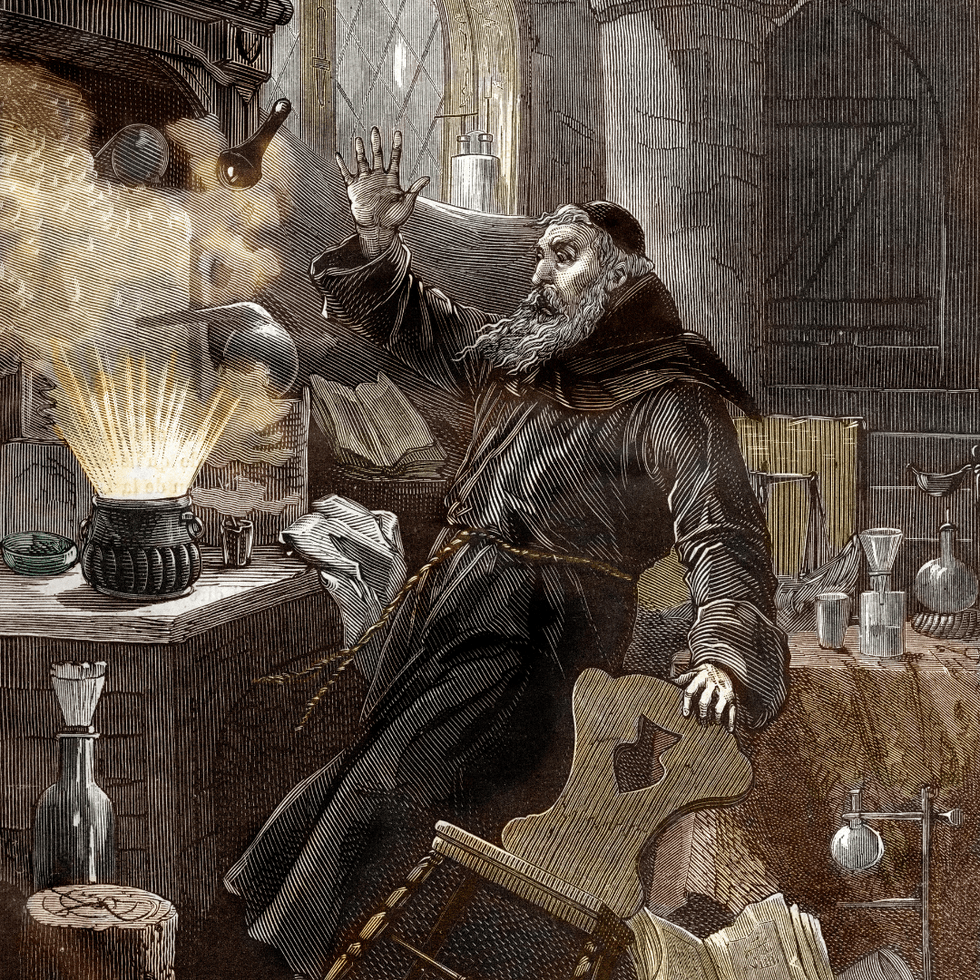
Ancient alchemists long believed they could convert base metals like lead or copper into gold or silver through chemical processes
|
GETTY
Removing protons from a nucleus requires overcoming the strong force which binds particles together with immense power – the sort available inside the LHC.
Electric fields can manipulate protons due to their charge, but the field strength needed is one million times stronger than a lightning bolt.
Scientists at Cern generate these extreme conditions by accelerating lead nuclei to velocities approaching light speed.
They are specifically looking at high-energy collisions between the nuclei to mimic the extreme temperature and energy density that would have been found in the fractions of a second after the Big Bang.
When two nuclei narrowly miss each other rather than colliding directly, the electromagnetic force between them becomes extraordinarily intense.
SCIENCE BREAKTHROUGHS – READ MORE:
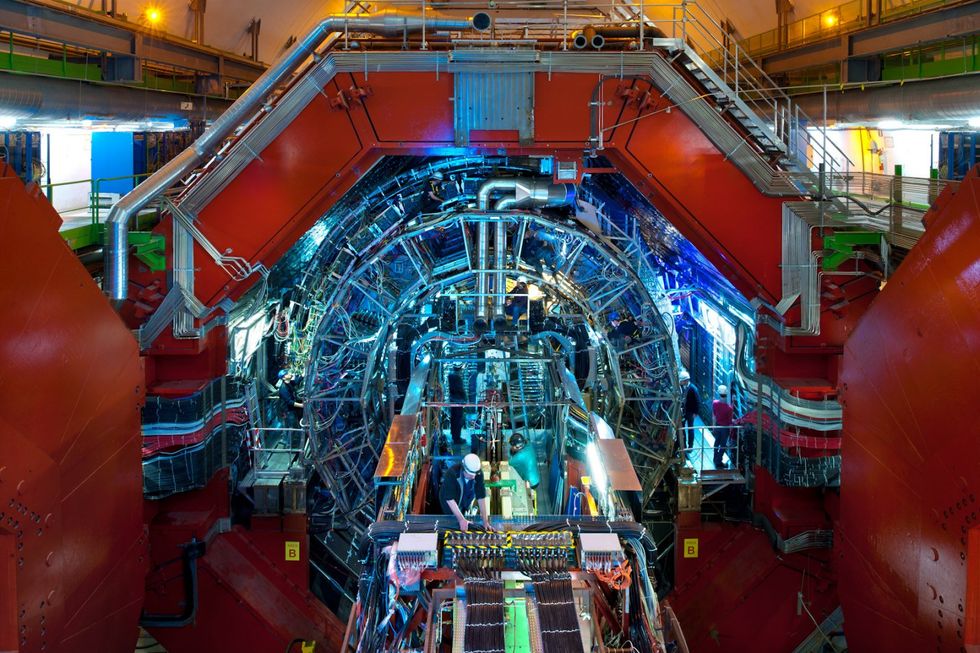
Researchers working on the Alice experiment at Cern in Switzerland produced tiny quantities of gold
|
WIKIMEDIA COMMONS
This proximity creates rapidly fluctuating fields that cause nuclei to vibrate and can rip protons from the atom altogether.
A lead nucleus that loses exactly three protons becomes gold, completing the transformation that alchemists once sought through chemistry alone.
At the LHC, the Alice experiment generates roughly 89,000 gold nuclei every second during operations.
Researchers also observed the creation of other elements, including thallium when a single proton is removed, and mercury when two protons are stripped away.
Seeing gold with the naked eye has so far been impossible for the scientists involved.
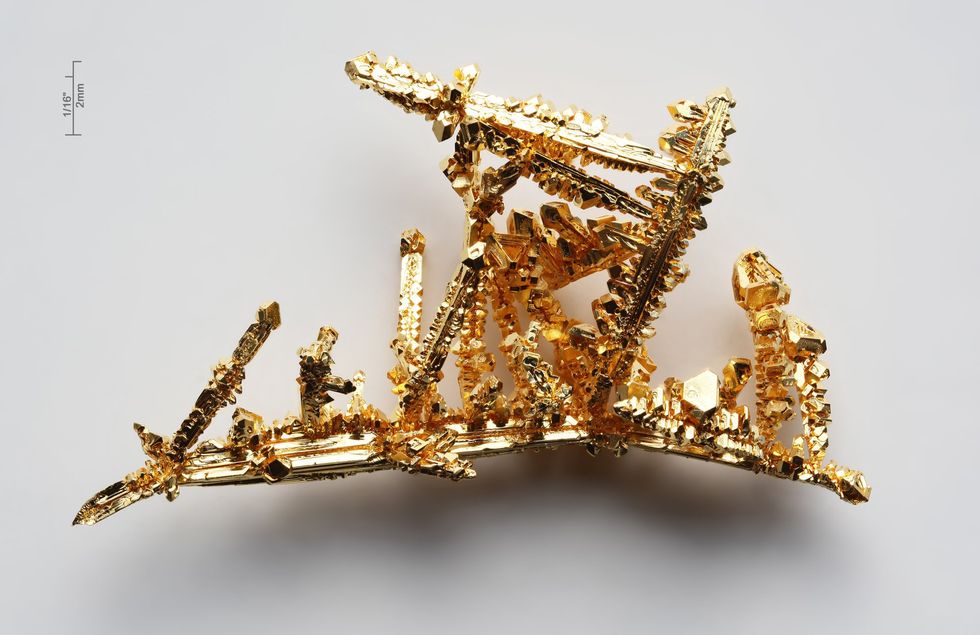
The Alice experiment generates roughly 89,000 gold nuclei every second – though nowhere near enough to see with the naked eye
|
WIKIMEDIA COMMONS
Instead, the team relies on specialised instruments called zero-degree calorimeters to count how many protons have been ejected.
Head-on collisions between lead nuclei result in complete destruction due to the strong nuclear force.
Near-misses, however, can change the elements entirely.
Once a lead nucleus loses protons, it strays off the path required to circulate within the collider’s vacuum beam pipe.
Within fractions of fractions of a second, these altered nuclei crash into the pipe’s walls.
This collision effect gradually diminishes the beam’s intensity over time.