

Kastoria’s famous greenish-grey lake in Western Macedonia, Greece, around which the city is built, has always been frosty and still in wintertime. But for the past few years, its frigidness and stillness echo the state of the town’s once booming, multi-million dollar fur industry: silent sewing machines, abandoned businesses and thousands of unsold fur coats hanging idly in showrooms. All are frozen in time since Europe suddenly slapped a number of sanctions on Russia, the biggest client for Kastoria’s fur business, after it invaded Ukraine.
Kastoria’s furriers were exporting around 95 percent of their fur products to Russia, making them one of Greece’s top exports. In 2022, shortly after the Russia-Ukraine war began, the European Union, Ukraine’s biggest western ally along with the United States, issued an overnight ban not only on exporting furs to Russia but also on selling retail items to Russian citizens. Four years on, as the war keeps raging thousands of miles away, the sanctions have inflicted the final blow on an industry already in demise.
“The damage is incredible for something that is not our fault,” Giorgos Papadakis, President of the Hellenic Association of Furriers told Greek Reporter recently from his showroom a few minutes outside Kastoria. “Ninety percent of the fur businesses at the moment have frozen their activities and only have an active tax ID. The rest are under-operating, mostly working for Italian fur firms. The losses are over 80 and 90 percent.”
Papadakis had a workforce of about 45 people. He has been forced to either lay off or keep on government subsidies of 534 euros ($549) per month for over 60 percent of them. Most other fur businesses have also severely limited the number of their employees, in a region that has been plagued by unemployment for years, and which has been Greece’s highest at 14 percent.
The road to Papadakis’ business is scattered with abandoned fur businesses with the MEXA sign (‘Furs’ in Russian) still hanging and massive buildings that wait to be auctioned off for debts to the banks.
“I know a business that in February of 2022 had a [Russian] order of about 5,000 pieces worth about six million euros ($6.176 million). He had started the order, he had begun to process part of it but when the ban came, he couldn’t materialize it. He was left with the fur coats, he never received any money, he may have had obligations toward the banks and he was left up in the air,” Papadakis said.
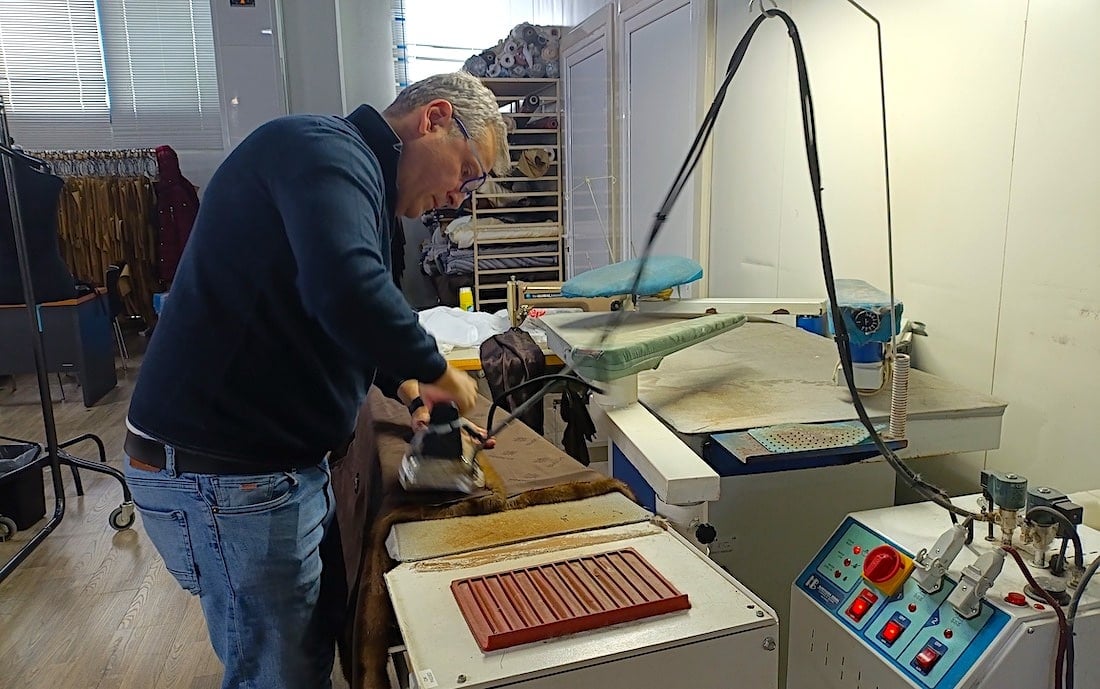
The compensation that cannot reverse the damage in Kastoria’s fur business
Kastoria‘s fur exports to Russia helped the businesses survive during Greece’s reeling economic crisis between 2009 and 2019. Then the Covid-19 pandemic hit, bringing the world to a standstill for two years, including Kastoria’s fur trade.
“After the pandemic, we were ready to start again, it looked like a good, promising year ahead, we were getting ready to go to exhibitions around the world,” Sakis Maleganos, a 4th-generation furrier, tells Greek Reporter.
He was having lunch with Papadakis in February 2022 when President Putin made an address signaling a war might be coming. Maleganos and Papadakis were concerned and speculated whether a conflict between Russia and Ukraine would soon start. When it did, they assumed it would be over in a week.
“Our [Russian] customers had not realized what was happening. In the first ten days of the war, they were calling us and telling us ‘don’t worry,’ ‘it’s OK,’ ‘we will continue working with you,’ ‘it’s nothing.’ But we could see things were getting serious,” Maleganos said.
Days later, at the end of March 2022, all fur businesses in Kastoria received a paper from Greece’s tax authorities, telling them they could no longer export their furs to Russia as part of the new EU-imposed sanctions on the country.
“A few days later, we received another paper, telling us retail sales to Russian customers of over 300 euros ($308) are also banned,” Papadakis said. “That was impossible, there is no fur that costs below 300 euros.”
The European Union later approved a compensation package for Kastoria’s fur businesses totaling 30 million euros ($30.8), of which the Greek government has allocated to furriers.
At the same time, Maleganos said that banks have long stopped issuing loans to furriers, given the risk associated with their current financial situation. Those with any money left use it mostly for their survival and for paying their utility bills until, as they hope, the ban is lifted.
“We need these compensations now so we can survive, both as businesses and as humans,” Papadakis added. “[Before the ban] some of us had some money and merchandise that we could have liquidated and use in some other way. Suddenly, both or money and our merchandise is gone. We were punched in the face and fell down.”
Maleganos then pointed to a fur coat and added: “This is our money now. It’s become animal hair.”

The race against time for Kastoria’s furriers
Restarting their once finely-tuned export machine to Russia will be an uphill battle. Maleganos estimates that only about 30 percent of their Russian clients will return.
Moreover, their merchandise has already been depreciated because there are fur coats that are now out of fashion, including thousands of unused fur skins that “have lost their freshness and color because they have been hanging for five years, including the time of the pandemic.” At the same time, many of the few hundred experienced fur technicians left in Kastoria, already in their 50s, have either found other jobs or left the city.
“I have some young people at my business,” said Papadakis. “But I have no work to give them. When we were making money we could invest in the future, we could have some technicians that we could pay them and teach them. This is how Kastoria moved on for 200 years.”
But with the global fur trade in constant and steep decline in the past decades, mostly because of the animal rights movement, the ban on fur farms in various countries, and the rise of China as a fur trade hub, the future for Kastoria’s fur trade is more uncertain than ever. Papadakis is optimistic that it can continue.
“Right now we want to survive, but survival alone is not enough,” Papadakis said. “Since we started working with Russia in the mid-90s, we have been evolving. The furs we manufactured back then have huge differences with the ones we produce today. Money is what helped us make new designs, bring good designers, find new techniques, try new things. All this costs. And to do all this again and restart, we need to get compensated.”
Maleganos recognized the global free fall of the fur trade. According to him, out of the 80 million fur skins once sold at worldwide auctions, now only eight million are sold, with the Chinese buying most of them for their massive production.
“I have hope that the fur trade in Kastoria can make a comeback and that fur coats can turn from a mass-market product into a luxury item again, maybe sold in smaller quantities but in better qualities and better prices.”
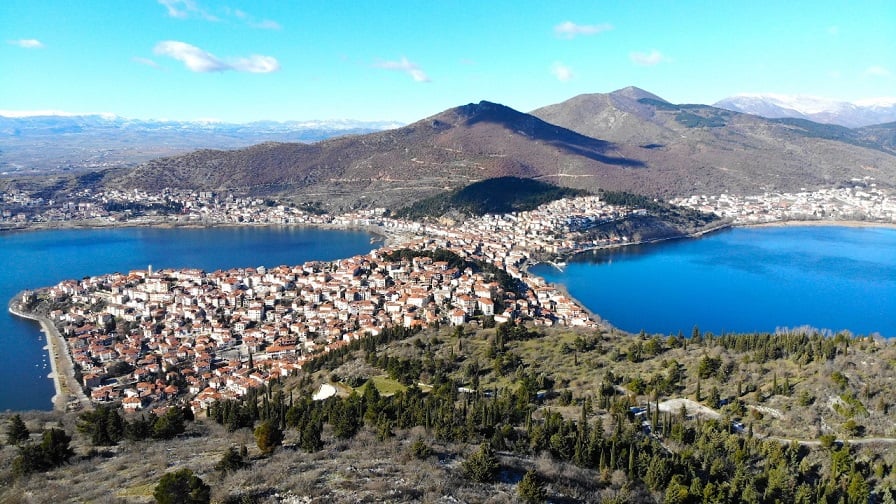
The 500-year-old history of Kastoria’s fur making
For decades, fur has been the main export product of Kastoria, while every year an international showcase of fur takes place in the city around April. Mink, raccoon, fox and chinchilla furs are just some of the materials used for the creations that have been successful in the Russian market.
According to the local furriers association, the processing and marketing of fur has its roots in the 13th century when they estimate the organized leather and fur processing began in Kastoria.
Some say Kastorians used to process the fur of beavers that lived in the town’s lake. They suggest that Kastoria was possibly named after one of the former staples of the trade—the European beaver (kastóras in Greek)—now extinct in the area. Others trace the local profession to Byzantine times, while some argue that the art was adopted during the Turkish occupation.
After the 16th century, there was an increase in demand for fur products, as they became a symbol of social status instead of merely a means of protection against the cold. In the early 1800’s fur makers embraced the technology of the era, with processing machinery and imports of remnant patches for stitching to Kastoria. The excellent quality, imagination and passion of furriers passed on from one generation to the next, as well as the large product variety, from coats to hats and gloves, established Western Macedonia’s reputation around the world.
The fur industry’s golden age began in the 60s, when tourists started discovering the beautiful town and its high-quality fur, making Kastoria a worldwide “brand name.” Hundreds of Kastorian furriers also emigrated in the United States, mainly to New York, where to this day they have an association.