
One aspect of the curriculum and assessment review that’s particularly notable for the future of science education is the focus on trimming down the curriculum. As head of science in a special school, I welcome this reduction in content.
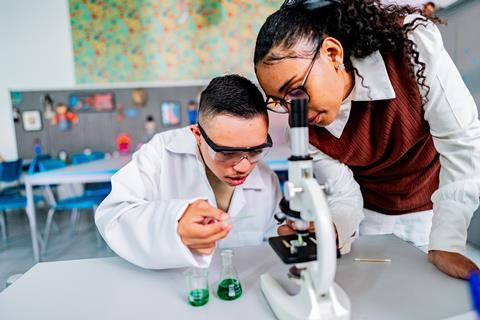
At my school, we already reduce the number of topics we teach at key stage 3 (KS3). This allows our students – who all have special educational needs and disabilities (SEND) – more time to master science knowledge and skills. We also adapt our lessons to ensure they are visual and include practical work wherever possible, focusing solely on topics that support the entry level certificate in science qualification and GCSE biology.
The review notes that reducing the curriculum will allow more time for enrichment activities, helping to increase the science capital of students – particularly those with socio-economic disadvantages or SEND. Streamlining the curriculum for mainstream schools would therefore not only benefit SEND students, but it would also have the scope to benefit all students regardless of individual needs.
The problem with transition
The report highlights a problem with the transition from primary to secondary. It is particularly evident in science teaching.
When I first taught primary science in the UK in 1996, it was assessed by standard assessment tests (SATs). After the removal of science SATs in 2009, however, it became clear that some schools had reduced their science teaching. My own children were at primary school at this time, and I was surprised by how little science they learned – an occasional afternoon per week in topic lessons. Even now, I feel that when learners are aged 11–14, we’re not only preparing them for 14–16 science, but are also trying to catch them up with primary-level science. Reducing content in the KS3 science curriculum could help alleviate this issue, allowing more time to be spent on ensuring students are at similar points in their learning after transition and have mastered the core skills.
Teachers need access to high-quality, diverse and representative resources
While reducing the primary science curriculum could also help this, it would still need to provide a balance of biology, chemistry and physics to build upon later. And, while accountability is necessary, it could lead to a new national assessment for primary science that may create difficulties for SEND students.
Triple or combined?
Another proposal of the review is to encourage schools to offer triple science at key stage 4 (KS4). Previously, a single science GCSE rather than combined science was a desirable choice for SEND students – for example, AQA’s science A or B. This GCSE covered biology, chemistry and physics topics, but it also included an independent skills assignment (ISA) worth 25 per cent, which helped SEND students gain marks.
Once this course was withdrawn in 2016, we had to decide on another course for a level 2 science qualification for the most able students. We chose to teach GCSE biology, as it includes less maths and focuses on relatable topics such as the human body and the environment. The offer of triple science could work for SEND students, if they are able to choose one or two science GCSEs. Mainstream schools need to be given the freedom to choose what they offer their students but also without the judgement of GCSE results and league tables.
The proposed new V-level at level 3 – designed to provide an alternative to A-Levels and T-Levels, and aimed at socioeconomically disadvantaged students as well as SEND – is a promising idea. Currently, there are few courses that our students can access if they want to continue studying science after year 11. Though we promote STEM jobs, our students see these as unachievable when the entry criteria are high GCSEs, A-levels, or a degree. Proposing other pathways that enable our students to continue learning science, while allowing them the freedom to follow their interests and pursue a career at their level, would be a good step.
Reviewing resources
The review also recognises that teachers need access to high-quality, diverse and representative resources. A good way to do this would be to review curriculum content, with lessons and resources for each topic designed by SEND teachers for SEND students. The Lightyear Foundation, an ambassador for SEND scientists whose work should be highlighted, would be an ideal starting point for developing suitable resources.
Overall, though, reducing the science curriculum would have many benefits for SEND students that could also positively impact the science learning experience for all students, across all schools. There would just need to be similar considerations around primary science and the creation of suitable resources alongside SEND teachers, too.