
Researchers have documented a chimpanzee removing and arranging floorboards to create a structured performance that combines drumming with vocal-like expression.
The finding shifts the origins of music toward a shared primate past, suggesting emotional expression may pass from voice to objects long before it resembles human song.
Repeated musical performances

Inside one enclosure in Kyoto, Japan, an adult male chimp named Ayumu turned loose floorboards into repeated drumming displays.
Working from those displays, Yuko Hattori at Kyoto University showed that the sounds came from boards Ayumu had pried free and repurposed.
Across 89 performances gathered over 37 days, Ayumu returned to the same behavior and sustained some bouts for minutes.
That unusual record makes the finding hard to dismiss as a stray outburst and points instead to a pattern that needs explaining.
A structured performance takes shape
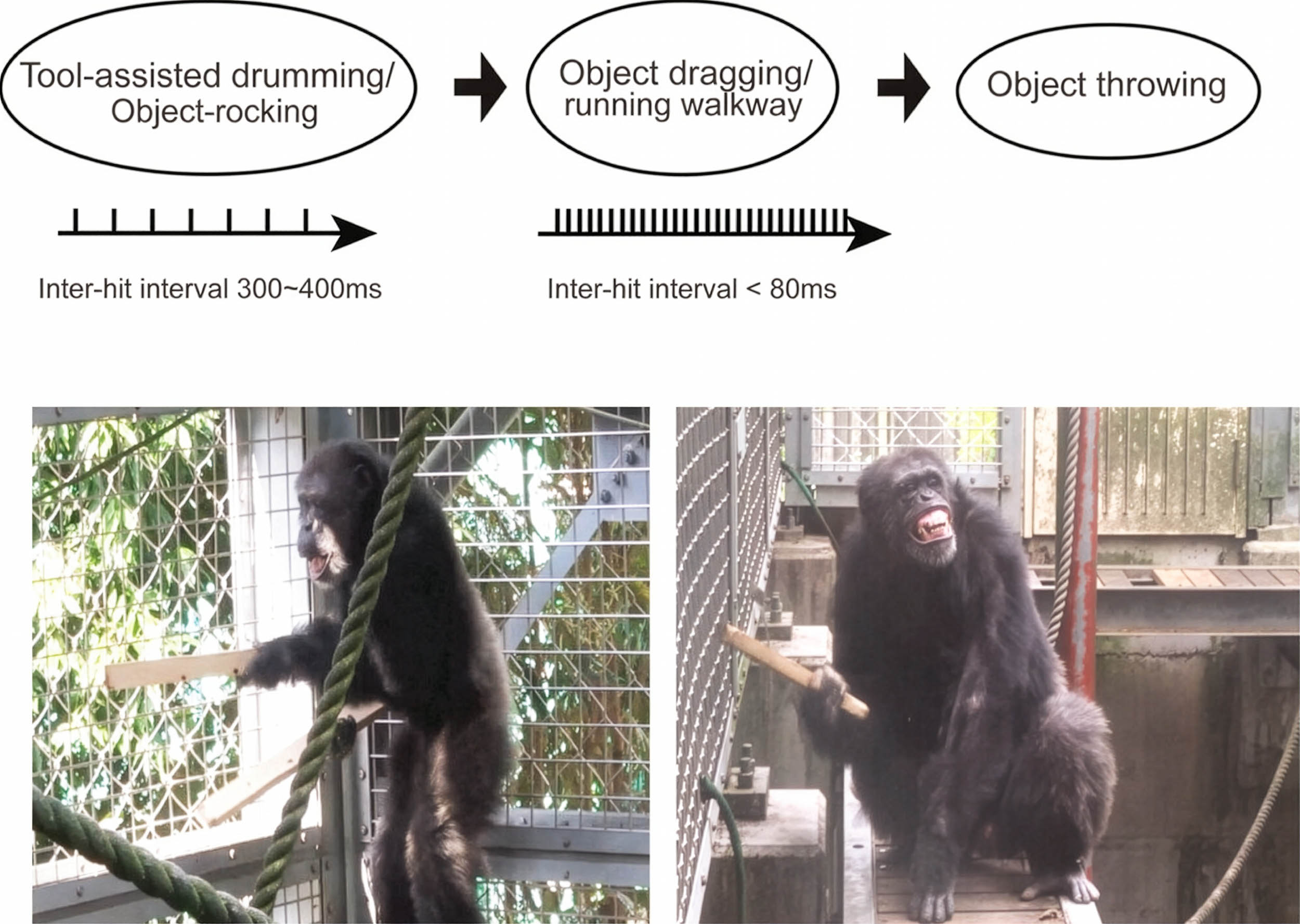
Once the board came loose, Ayumu did not simply pound it, because he moved through drumming, dragging, and throwing in runs.
Those runs sometimes stretched to 14 components, and certain transitions appeared far more often than chance would produce in shuffles.
A strong path led from tool drumming to scraping the board across mesh, then to a final thrown impact.
That ordering mattered because it suggested local rules inside the display, and those rules pointed straight to rhythm.
Chimp keeps steady rhythm
When the researchers measured the spacing between hits, the beat kept returning to isochrony, the near-even spacing of beats.
Nearly 60 percent of paired intervals clustered around a one-to-one ratio, far above the 34 percent expected from random timing.
Tool beats also ran slower than hand or foot beats, yet their timing wobbled less from strike to strike.
A detached object may have acted like a crude stabilizer, helping one chimp keep a steadier pattern than his body alone.
Drumming combined with vocal sounds
Ayumu’s performance also echoed a pant-hoot, a loud chimpanzee call that often builds toward a climax.
Vocal sounds turned up during many bouts, and just over one-third of tool-drumming episodes carried them alongside board strikes.
“It was fascinating for me to see how the chimpanzee used tools to produce various sounds while also expressing a vocal display,” said Hattori.
That overlap matters because the study’s central idea is not music as entertainment, but emotion moving from voice into objects.
Emotions that followed sound
During the loudest moments, Ayumu showed a play face, an open-mouth expression seen in playful states, and sometimes silent bared teeth.
Those signals usually appear in playful or tension-regulating social contexts, suggesting the display is not driven by threat alone.
Because these faces are not typically described in classic vocal displays, the board performance added an emotional layer researchers did not expect.
Emotion may have helped organize the act rather than simply spilling out after the noise began.
The boards were not just convenient noisemakers, because Ayumu first had to tear them loose from the walkway.
Researchers describe that first step as detachment, removing part of an object for later use, and they recorded it twice.
That matters because a tool that must be made or selected can change what kind of sound becomes possible.
Beyond one enclosure, early wooden or skin instruments rarely survive long enough to enter the archaeological record.
Captivity allows longer performances
Life in captivity may have opened room for longer displays, because predators were absent and resonant surfaces sat close at hand.
Wild chimpanzees already show rhythmic drumming with group-specific patterns in a recent study, but those bouts are usually brief.
Ayumu pushed that capacity further by turning loose boards into repeated sequences that could last several minutes.
The setting does not invent the behavior from nothing, yet it may expose abilities that life in the wild rarely lets unfold.
No formal training in musical performance
Long before this display appeared, Ayumu had lived around keyboards, touchscreens, and tool tasks inside Kyoto’s research program.
Earlier experiments also showed that sound can trigger rhythmic swaying in chimpanzees, with males responding especially strongly.
Even so, the paper says he never received extensive training in making specific rhythms or staged instrumental performance.
That balance makes the episode harder to dismiss as rehearsal and easier to read as spontaneous invention.
What remains uncertain
One chimp cannot settle the origin story of human music, and the authors are careful not to claim that.
No other group member regularly copied the routine, although one other male briefly struck an already detached board.
Researchers now want to watch how the rest of the group reacts, because social response could reveal whether the display carries meaning.
Until then, Ayumu stands less as proof of music’s birth than as a vivid clue about its building blocks.
Ayumu’s boards, voice-like calls, steady tempo, and expressive face all point to a simple possibility: sound-making can carry emotion across different channels.
Future comparisons across chimp groups, settings, and social responses may show whether this ability remains rare or extends beyond a single inventive performer.
The study is published in the journal Annals of the New York Academy of Sciences.
—–
Like what you read? Subscribe to our newsletter for engaging articles, exclusive content, and the latest updates.
Check us out on EarthSnap, a free app brought to you by Eric Ralls and Earth.com.
—–