
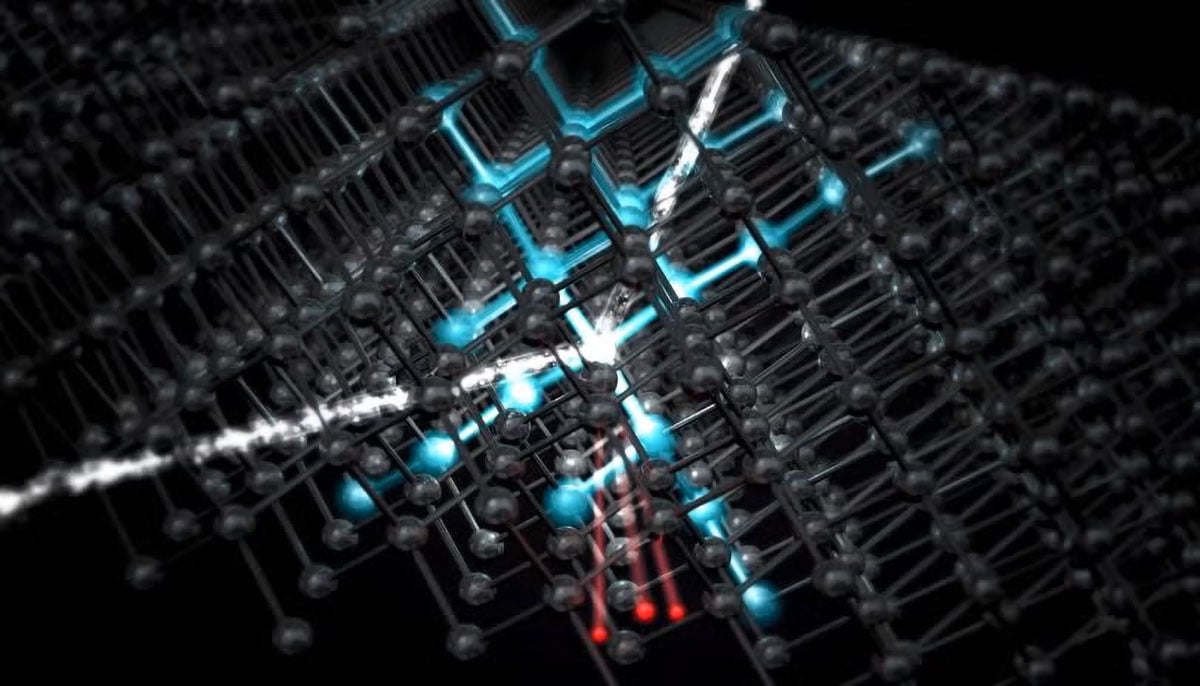
Deep beneath the Earth’s surface, a major physics experiment has reached a critical milestone, enabling detectors to operate at temperatures near absolute zero.
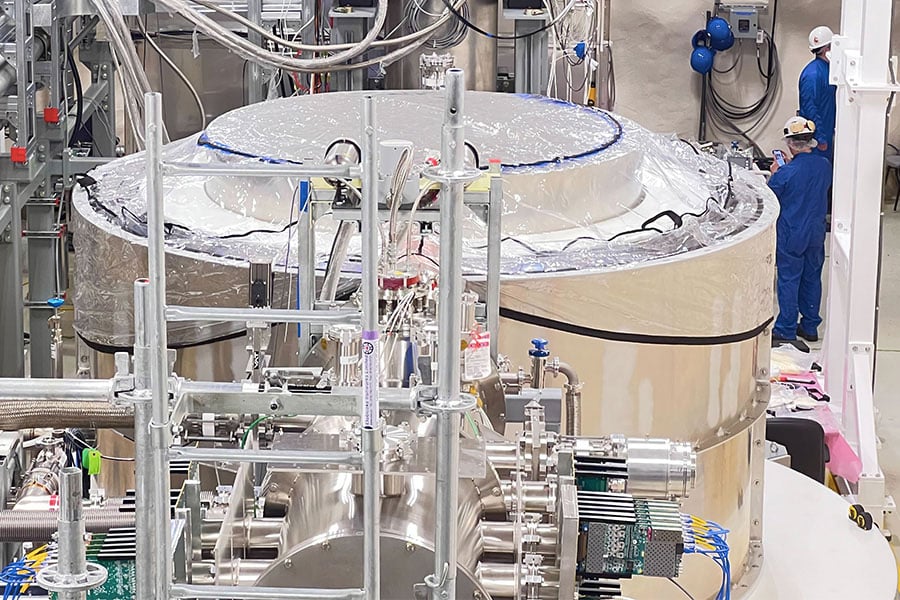
Far below the surface of a Canadian mine, scientists have brought one of the coldest experiments ever built to life. The Super Cryogenic Dark Matter Search (SuperCDMS) has now reached its operating temperature, allowing its detectors to finally switch on and begin probing one of physics’ biggest mysteries.
At just a few thousandths of a degree above absolute zero, the system is colder than deep space by a wide margin. At these temperatures, heat-driven motion inside materials nearly disappears, creating an environment quiet enough to detect incredibly faint signals that would otherwise be lost.
This milestone marks the shift from years of construction to the start of scientific operations. With the detectors now active, researchers are preparing to explore a part of the universe that has never been directly observed.
The experiment is designed to detect mysterious dark matter particles.
Dark matter makes up about 85 percent of all matter in the universe, yet it has never been directly detected. Scientists know it exists from its gravitational effects on galaxies, but its true nature remains unknown. If dark matter particles pass through Earth, as current models suggest, experiments like SuperCDMS are designed to catch the rare moments when one interacts with ordinary matter.
“Getting to base temperature is a major milestone in a years-long campaign to build a low-background facility capable of housing our sensitive cryogenic solid state detectors,” said Priscilla Cushman, a professor in the University of Minnesota School of Physics and Astronomy and the Spokesperson of SuperCDMS. “At these extremely low temperatures, our installed detectors can now scan a whole new region of parameter space where the lightest dark matter particles may be lurking.”
Engineering a Low-Background Environment
The University of Minnesota team designed, sourced, and assembled a shielding system that protects the detectors from trace radiation and neutrons created by cosmic rays interacting with the cavern walls. The structure is a cylindrical enclosure measuring four meters tall (13.1 feet) and four meters in diameter (13.1 feet). It is built with layers of ultra-pure lead to block gamma radiation and high-density polyethylene to reduce neutron activity.
In addition to helping install and cool the experiment, researchers from the university have developed advanced reconstruction algorithms and analysis methods to quickly identify possible dark matter signals once data collection begins in the coming months. The group plays a leading role in the scientific effort, supported by School of Physics and Astronomy Assistant Professor Yan Liu, who serves as the Analysis Working Group Chair.
Deep Underground for Precision Measurements
SuperCDMS is located at SNOLAB, a research facility about 6,800 feet underground in an active nickel mine near Sudbury, Ontario. This depth shields the experiment from cosmic rays and other background particles that could interfere with the extremely faint signals scientists are trying to detect.
Now that the base temperature has been reached, the team will begin detector commissioning. This phase will take several months and involves activating, calibrating, and fine-tuning each detector channel. In addition to searching for dark matter, the experiment will allow scientists to study rare isotopes, explore previously unmeasured energy ranges, and potentially reveal new types of particle interactions.
SuperCDMS is a collaborative effort supported by the U.S. Department of Energy Office of Science, the U.S. National Science Foundation, the Canada Foundation for Innovation, and the Natural Sciences and Engineering Research Council of Canada.
The University of Minnesota team also includes postdoctoral researchers Shubham Pandey and Himangshu Neog, research scientist Scott Fallows, and graduate students Zachary Williams, Elliott Tanner, and Chi Cap, all from the School of Physics and Astronomy.
Never miss a breakthrough: Join the SciTechDaily newsletter.
Follow us on Google and Google News.