
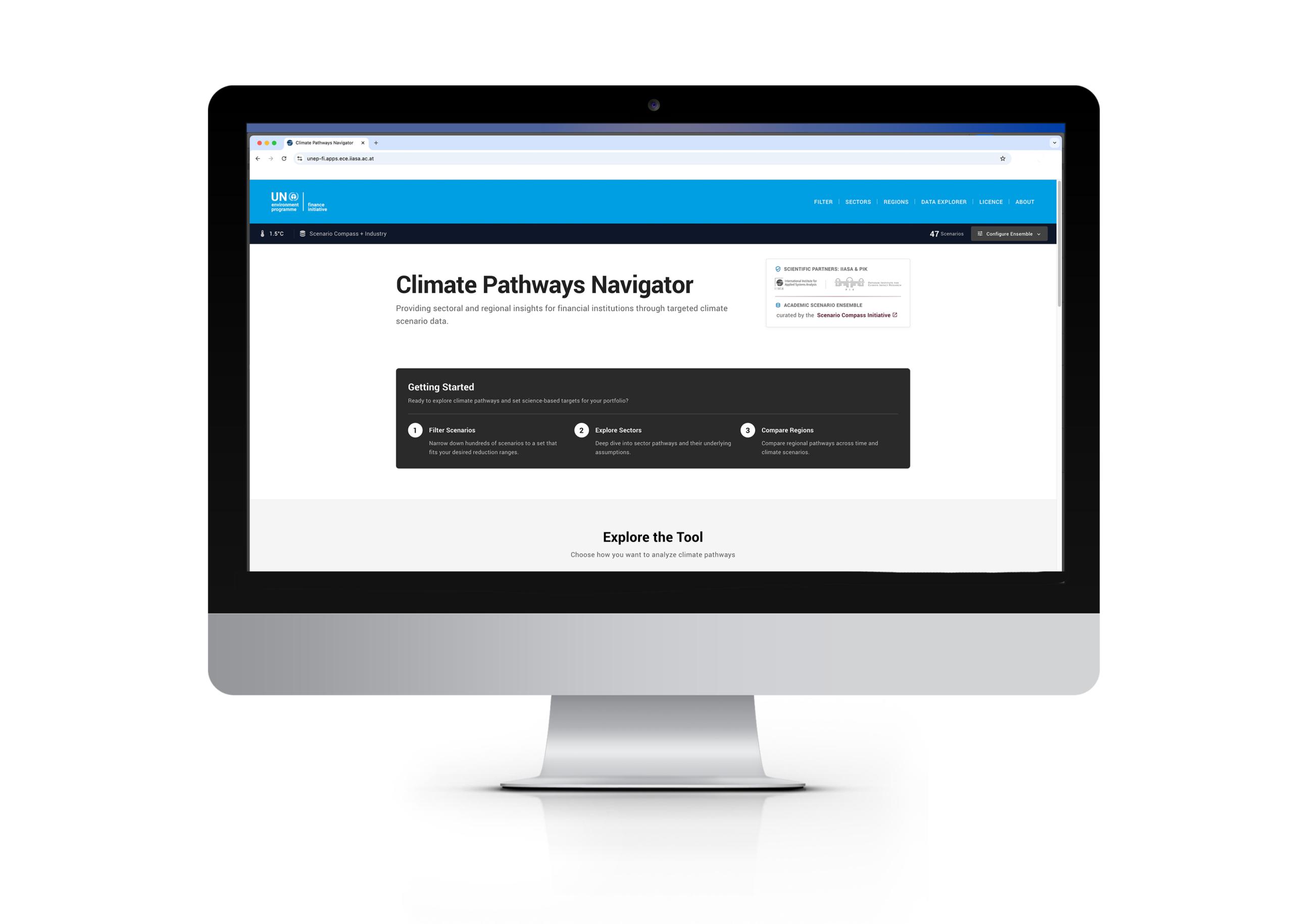
The UNEP FI Climate Pathways Navigator is a unique tool that gives financial institutions direct access to the climate scenario data they need to make informed, science-based decisions on their decarbonization pathways.
The tool helps financial institutions to set individual science-based targets, inform their transition plans and those of their clients and better engage clients and investees on climate action by having the right data available to them in one place.
Developed by UNEP FI in collaboration with banks, investors, insurers, and export credit agencies, the International Institute for Applied Systems Analysis (IIASA), and the Potsdam Institute for Climate Impact Research (PIK) it directly links to the Intergovernmental Panel on Climate Change (IPCC) scenarios database and those designed by industry. It cuts through hundreds of complex climate scenarios to make available the exact sectoral and regional data points financial institutions need, in one easy-to-use interface.
UNEP FI works with its members on how to mitigate and adapt to the commercial risks and opportunities they face due to climate change through the Principles for Responsible Banking (PRB) and Principles for Sustainable Insurance (PSI). This easy-to-use visual interface complements that work and addresses a critical need across the finance industry for practical, user-friendly climate analysis resources.
The tool is available at no cost to UNEP FI members and the broader financial community, governments, and policymakers.
Benefits of the tool
- Enables financial institutions to improve their target setting, find the right scenarios for transition planning, and make well-informed and science-based decisions on decarbonization pathways.
- Financial institutions can download data from one source and use in their existing systems.
- Compare sectoral pathways across key datapoints tailored for target-setting.
- Compare the same sector across regions; highlight divergent points and timing.
- Filter hundreds of scenarios in seconds to find those that align with your target decarbonization ranges and transition plans.
- The tool brings together Intergovernmental Panel on Climate Change (IPCC) scenarios as well as those designed by industry, as has never been done before, in one platform.
- Provides a common reference point for dialogue between financial institutions, corporates, governments, sector associations, and NGOs on how to enable the low-carbon transition.
Testimonials
Frequently Asked Questions
- Power
- Steel
- Cement
- Transport (with sub-sector clusters for road, shipping, and aviation)
- Buildings (residential and commercial)
The tool can provide data on the world, regional groupings (see list below) and multiple individual countries.
- Africa
- China+
- Europe
- India+
- Latin America
- Middle East
- North America
- Pacific OECD
- Reforming Economies
- Rest of Asia
IPCC 6th Assessment Report Scenarios (2022), Curated scenarios from the Scenario Compass Ensemble, and Sectoral Decarbonization Pathways developed by organizations such as the International Energy Agency, the One Earth Climate Model, or Mission Possible Partnership. Visit the About page for more information on available scenarios.
- Direct emissions: From fossil fuel combustion within each sector.
- Process emissions: Non-fossil fuel emissions arising from industrial processes, such as cement and steel production.
- Indirect emissions: Emissions from the production of electricity, heat, and hydrogen from fossil fuels, allocated to end-use sectors based on projected consumption.
Emissions are reported for CO₂ alone or for all greenhouse gases (Kyoto gases: CO₂, CH₄, N₂O, HFCs, PFCs, SF₆). Sectoral Decarbonization Pathways cover different scopes and gas combinations. For Systemic Climate Pathways, we have calculated multiple scope variations where underlying data is permitted.
All data is downloadable through the Data Explorer tab.
The categories are defined by the probability of returning to a given temperature by end of century:
- 1.5°C – 50% probability of returning to 1.5°C by end of century
- Below 2°C – Two-thirds chance of reaching 2°C by end of century
- Above 2°C – Less than one-third chance of reaching 2°C by end of century
The first two categories correspond to alignment with the Paris Agreement. The ‘above 2°C’ category is a grouping of scenarios defined by probability thresholds, not by a specific projected temperature outcome. It does not break down each scenario’s individual projected output.
Contact
To find out more about the tool, contact Jes Andrews, Co-Head of Climate at UNEP FI.