
Pitching in baseball may seem simple; however, it is full of intricacies and complex subjects. Getting the ball to move and spin in ways that induce weak contact or miss bats is key. The forces of gravity and physics offer an answer as to how pitchers are able to generate what appears like gravity-defying pitches.
Over the decades, the art of pitching has changed. In the early days of baseball, pitchers hurled baseballs as hard as they could at home plate, relying on sheer pitch speed alone to strike out batters. Present-day pitchers have not abandoned this emphasis on speed — many are capable of throwing a ball more than 100 miles per hour — but they have also added breaking pitches into their repertoires.
When a pitcher releases the ball, physics takes over. Jake Bennett, an associate professor in the University of Mississippi Department of Physics and Astronomy, broke down exactly what is happening in that half-second flight from the mound to home plate.
It starts with spin. The moment a ball leaves a pitcher’s hand, the rotation creates a pressure difference in the surrounding air, a phenomenon known as the Magnus force.
“The Magnus force on a fastball is actually upward, so that’s why a fastball looks like it goes up. It’s actually just not falling,” Bennett said. “It doesn’t follow a parabolic trajectory. It kind of stays straight.”
A curveball flips that same principle.
“(With) a curveball, the pitcher’s fingers kind of come over the side. You get a force that’s down and to the left, so a curveball follows that sort of trajectory,” Bennett said. “This comes from Bernoulli’s principle. As the ball is rotating this way, it’s also moving, so if it’s rotating and moving, the part of the ball that’s moving faster will get more vortices, more motion. (It will) get a different pressure differential, and that causes the ball to move.”
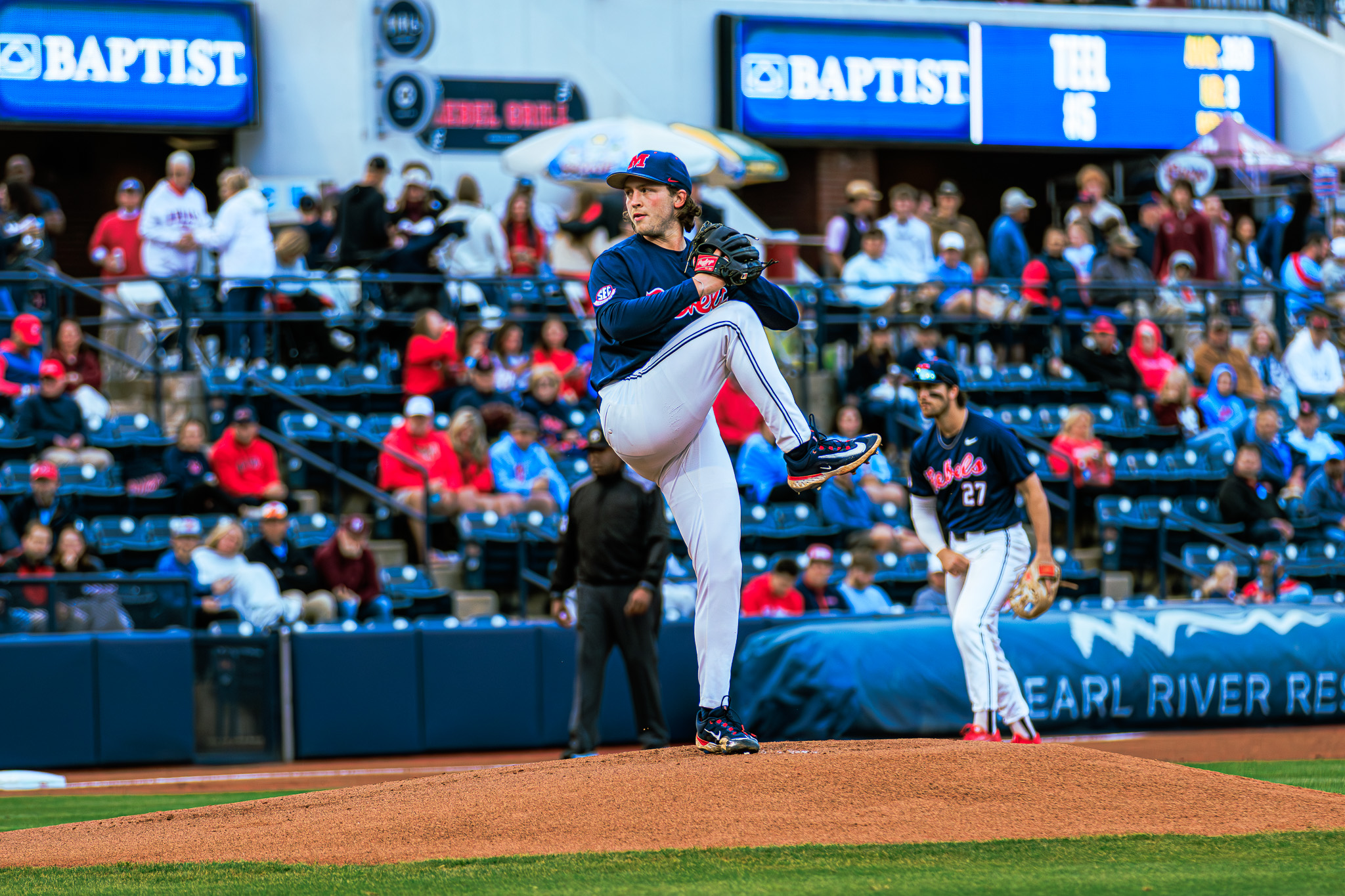
Bernoulli’s principle states that as the speed of a fluid (liquid or gas) increases, the pressure of that fluid decreases. In this case, the decrease in pressure in the air on one side of the ball, due to its rotation, causes a change in its trajectory.
Since the placement and pressure of the fingers work to spin the ball, the appearance of the ball as it approaches home plate can indicate to the batter how the pitch will move.
With a traditional curveball, the baseball has what appears to be a big red dot (created by the rapidly rotating laces) in its center as it leaves the pitcher’s hand. Despite all the advantages a pitcher builds through spin, a smart hitter can quickly read the pitch.
With this, throwing the right pitch is only half the battle. The other half is hiding it.
“A pitcher has to be able to change the spin and the motion of the ball by keeping the motion of his arm exactly the same,” Bennett said. “When it comes to the pitcher, what they really care about is, ‘How is my hand moving when the ball leaves it?’”
The seams also factor in. Baseballs used in Major League Baseball have flatter seams than baseballs used in amateur leagues, meaning major-league baseballs offer pitchers better grip and improved spin. At all levels, though, the torque required to whip the ball and generate spin is concentrated entirely at the elbow.
“All of that force is being centered right there on that pivot point where all my tendons are connected,” Bennett said. “Every force has an equal and opposite force. If I’m trying to whip my hand forward, my elbow is feeling that force.”
Indeed, prolonged pitching takes a toll on players. Torn ligaments in the elbow often require a procedure wherein that torn ligament is replaced with a tendon from another part of the body, known as Tommy John surgery. The procedure requires more than a year of recovery and is often career-altering. The surgery can improve pitchers, but it is also difficult to return to pre-surgery performance levels.
Pitchers are still at risk of suffering the same injury again. If this happens, a pitcher may be forced to retire.
While pitchers and coaches can use data and science to improve their skills, the most efficient pitch is the one that the batter is not prepared for.
The best pitch is entirely dependent on the situation of the game or who the batter is. The moment determines what pitch is needed. How many runners are on bases, the count or the batter are all factors in determining what will be thrown.
“The pitcher wants the batter to miss. So the perfect pitch is the one that the batter doesn’t expect,” Bennett said. “Sometimes you want the batter to make a connection, just in a way that he doesn’t want.”