
By Will Atwater
Delivering safe, reliable drinking water to customers’ homes is getting more expensive for water utilities that face aging pipes, needed treatment plant upgrades and mounting new pollution threats.
A recent national analysis from the American Water Works Association and a 2025 report from the NC Chamber Foundation warn that maintaining safe, reliable drinking water infrastructure will take massive investment in pipes and treatment plants, even as utilities and their customers are grappling with the costs of removing PFAS contamination from systems like those drawing on the Cape Fear River.
“Drinking water infrastructure underpins the health and economic vitality of our communities, but the cost of sustaining it is rising rapidly,” Heather Collins, the association’s president, said in a release.
Dana Magliola, senior director of infrastructure competitiveness for the NC Chamber Foundation, echoed Collins’ sentiment: “A unified, forward-looking approach is key to ensuring North Carolina’s water systems remain reliable, resilient, and ready for the state’s next phase of economic growth.”
What’s at stake for North Carolinians
In North Carolina, those costs are already visible.
In mountainous Haywood County, the Town of Canton, with fewer than 5,000 residents, is relying on state and federal aid to replace wastewater infrastructure that once depended on a shuttered paper mill. Canton’s Mayor Zeb Smathers told NC Health News that the town’s water system serves fewer than 10,000 customers when town and county ratepayers are counted together.
At the other end of the state, Cape Fear Public Utility Authority and other public water systems have spent millions on infrastructure and operations to remove PFAS from drinking water in the years since the so-called “forever chemicals” were found to be prevalent in Cape Fear River waters.
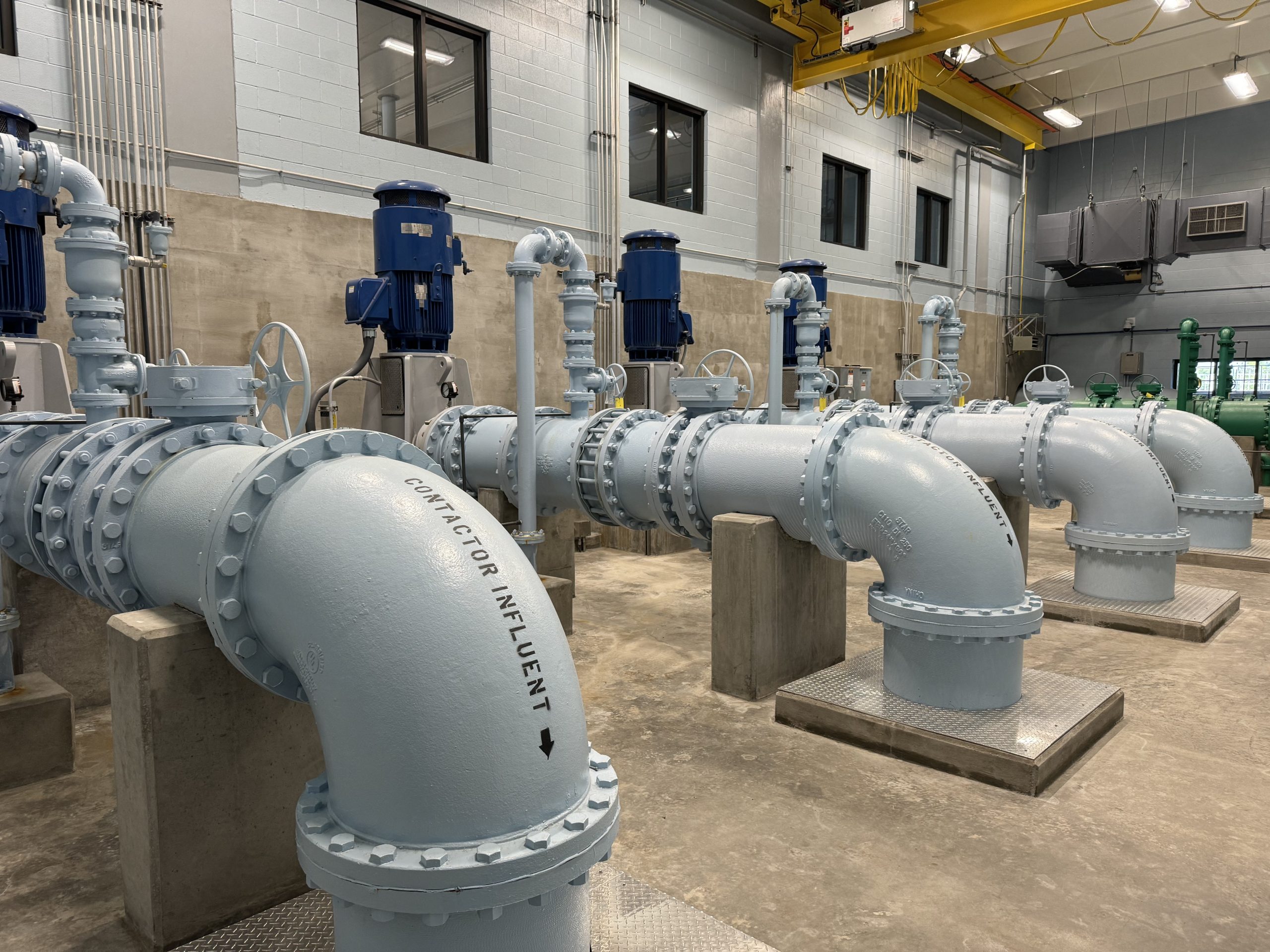
“As a reminder for North Carolina, prior to this report, the best information we had was we were looking at about $20 billion over the next 20 years for water and about $21 billion over the next 20 years for wastewater improvements — to simply replace the infrastructure we have,” said CFPUA’s Executive Director Kenneth Waldroup.
He added that once additional water quality regulations are considered, such as meeting new federal maximum contaminant levels for PFAS, the costs to municipal water systems can soar.
“Cape Fear Public Utility Authority is a living example of that,” he said. “We’ve invested more than $80 million to date in infrastructure and operational costs to remove per- and polyfluoroalkyl substances (PFAS).”
Under a national rule finalized by the Biden administration’s EPA, public water systems now have three years to test for a suite of PFAS chemicals and report the results, and five years to bring levels into line with new federal limits if contamination is found. That means utilities across the country must quickly decide whether to install pricey technologies that can keep PFAS out of customers’ taps, such as granular activated carbon filters, ion exchange systems, membrane treatment or other, newer, techniques.
Utilities also need to figure out how to pay for it.
The rule sets enforceable limits for six individual PFAS: 4 parts per trillion for PFOA and PFOS, 10 parts per trillion for PFNA, PFHxS and GenX chemicals, and a separate “hazard index” standard that applies when mixtures of several PFAS, including PFBS, are found together.
For residents along the Cape Fear River, those regulations are aimed at a contamination problem they have lived with for years. GenX and other PFAS from the Chemours facility outside of Fayetteville have been detected in the river and in CFPUA’s drinking water system, prompting large blood‑testing studies that found people in the Cape Fear basin carry higher levels of these chemicals than the typical U.S. resident.
Since PFAS contamination in the Cape Fear River first drew public attention, similar chemicals have been detected in drinking water supplies across North Carolina, including in several rural fire stations that rely on well water. In those communities, contamination is likely tied to years of training and emergency response with older firefighting foams that contained PFAS, adding another layer of cost and concern for small systems that have far fewer resources than a utility serving hundreds of thousands of customers, like CFPUA.
Scientists have linked long‑term exposure to certain PFAS in drinking water to increased risks of kidney and testicular cancers, higher cholesterol, signs of liver and thyroid problems, immune system effects including reduced response to vaccines, and pregnancy‑related complications like hypertension and preeclampsia.
Small water systems
More than 5,000 regulated public water utilities serve millions of North Carolinians. The majority of those customers get their drinking water from small systems that primarily serve towns and rural areas, according to state environmental data.
Canton illustrates what can happen when a community’s water system is closely tied to a single major industry. For decades, the paper mill owned by Pactiv Evergreen — a major employer and the town’s primary water ratepayer — helped anchor the system. When the mill, which had operated in Canton for more than a century, closed in 2023, the community lost about 900 jobs and millions of dollars in labor income for western North Carolina, according to a Dogwood Health Trust impact study.
To help the town recover, Canton has received nearly $100 million in federal and state support, including funding to purchase the mill property and build a new wastewater treatment plant, Mayor Smathers said. Even so, customer fees have increased to cover the roughly $140,000 a month the town now pays for treatment that was once paid for largely by Pactiv Evergreen.
This cost was referenced in a letter that Town Manager Lisa Stinnett posted in 2025 to explain water rate increases.
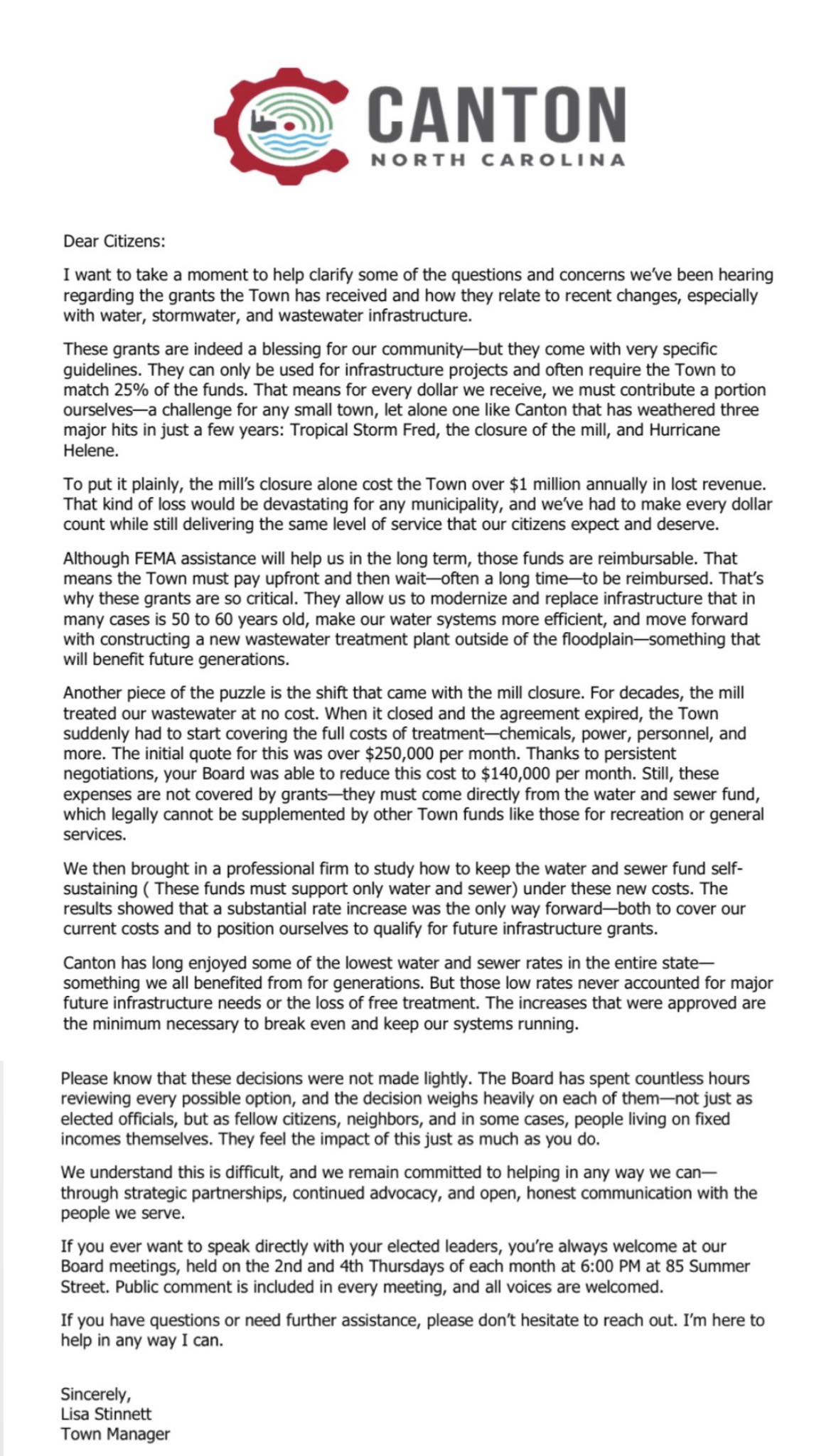
“For decades, the mill treated our wastewater at no cost,” Stinnett wrote. “When it closed and the agreement expired, the town suddenly had to start covering the full costs of treatment — chemicals, power, personnel, and more. The initial quote for this was over $250,000 per month. Thanks to persistent negotiations, your board was able to reduce this cost to $140,000 per month. Still, these expenses are not covered by grants — they must come directly from the water and sewer fund.”
The financial burden faced by the town of Canton as it continues to recover from Tropical Storm Fred in 2021 and the remnants of Hurricane Helene, on top of the closing of the paper mill, reflects pressures felt by the nation’s small water systems.
A North Carolina Department of Environmental Quality spokesperson told NC Health News in an email that every water and sewer system in North Carolina is wrestling with aging infrastructure, but small-town utilities like Canton feel it most because they have fewer customers to spread costs to.
“The State Water Infrastructure Authority and the Local Government Commission have designated 160 local government water and sewer systems as distressed,” the spokesperson said. They added that the majority of them are small systems, which qualifies them for extra technical help and grants through the Division of Water Infrastructure’s Viable Utilities and other programs.
“The need for small utilities is disproportionate to the infrastructure funding they [require],” said Jane Clements, chief executive officer of One Water Econ, a consulting firm who contributed to the American Water Works Association report. “So that burden is going to fall on fewer people.”
This <a target=”_blank” href=”https://www.northcarolinahealthnews.org/2026/04/02/rising-costs-small-water-systems-north-carolina/”>article</a> first appeared on <a target=”_blank” href=”https://www.northcarolinahealthnews.org”>North Carolina Health News</a> and is republished here under a <a target=”_blank” href=”https://creativecommons.org/licenses/by-nd/4.0/”>Creative Commons Attribution-NoDerivatives 4.0 International License</a>.<img src=”https://i0.wp.com/www.northcarolinahealthnews.org/wp-content/uploads/2021/10/cropped-favicon02.jpg?fit=150%2C150&ssl=1″ style=”width:1em;height:1em;margin-left:10px;”>
<img id=”republication-tracker-tool-source” src=”https://www.northcarolinahealthnews.org/?republication-pixel=true&post=67020″ style=”width:1px;height:1px;”><script> PARSELY = { autotrack: false, onload: function() { PARSELY.beacon.trackPageView({ url: “https://www.northcarolinahealthnews.org/2026/04/02/rising-costs-small-water-systems-north-carolina/”, urlref: window.location.href }); } } </script> <script id=”parsely-cfg” src=”//cdn.parsely.com/keys/northcarolinahealthnews.org/p.js”></script>