
In this week’s Luxury Briefing, I interview designer Susan Fang ahead of her Shanghai Fashion Week show, as local presenting brands focus on a variety of growth strategies. Also, an HSBC forecast for 2026 luxury growth; executive moves at Carven, Valentino and Kering; and news to know. For comments or tips, email me at zofia@glossy.co
Shanghai Fashion Week ran from March 25 to April 1, drawing a stronger international turnout than in recent seasons. International buyers and editors returned to the event, where changes were visible in both the schedule and how brands approached the week.
Western brands leveraged the opportunity, with outside access becoming increasingly more difficult without an on-the-ground presence. The event highlight was Maison Margiela’s show — its first outside Paris, on April 1. Held in an industrial shipping container dock on the outskirts of Shanghai, the show combined “Artisanal” couture and ready-to-wear looks for the first time under creative director Glenn Martens. More than 70 looks were transported from Paris to Shanghai, including pieces constructed from beeswax and porcelain elements.
Around 20% of the Artisanal collection was made available for purchase on the brand’s website after the show. The brand also paired the runway with a series of archive exhibitions across Shanghai, Beijing, Chengdu and Shenzhen. And it ran alongside a WeChat Mini Program giving local audiences access to videos, interviews and behind-the-scenes content.
According to WWD, the show drew attention beyond the usual industry crowd. The activation came as the brand continues to gain momentum within OTB Group, with sales up 8.4% in 2025. According to a brand statement, the Shanghai show was part of a broader push to build Margiela’s presence in China, combining its runway show with exhibitions to introduce the brand’s identity to a wider local audience and lay the groundwork for future growth.
Chinese consumers still account for roughly 23% of global luxury demand, according to data from investment management company Bernstein, making the region critical to any recovery across the sector. But that demand has become harder to capture, especially for Western brands. A prolonged real estate downturn has weighed on household wealth, particularly among younger consumers who are saving more and spending more cautiously.
“Consumers trade up to more desirable brands if they can pay top dollar, or they trade down to more compellingly priced ‘bridge’ and ‘premium’ brands if they cannot,” said Bernstein luxury analyst Luca Solca.
For domestic brands, that environment is opening up space. “There’s a lot of what you could call soft replicating,” said consultant and curator Gemma A. Williams, who works with luxury brands on their China presence. “Brands are offering something that feels familiar, in terms of design language, but with better pricing and accessibility. For customers, that becomes a very real alternative because they can stay on trend, spend less and still feel like they’re buying into something with design credibility.”
Williams pointed to Chinese brands like Icicle, Urban Revivo and Songmont, which have recently expanded internationally. “In the last 12 months, we are really seeing the development of Chinese brands on a global scale,” she said. “There are more names that are actively expanding, opening spaces or building visibility abroad. But it is happening at a much slower pace than people expected a few years ago.”
Meanwhile, other Chinese brands, like sportswear brands Anta and Li-Ning, are building visibility through retail, partnerships and marketing initiatives, according to Williams.
For her part, Chinese designerSusan Fang has built her namesake brand by focusing on two markets, the U.K. and China, regularly debuting collections at London Fashion Week while returning to Shanghai Fashion Week to stay connected to her domestic audience and retail partners. The dual-market approach reflects a broader industry reality for fashion brands: China remains a critical growth market, but demand can be uneven, prompting brands to balance a global presence with on-the-ground engagement.
“Nike was through the China internal brand partnerships team, and Casetify was also through the China team, but it became a global collaboration,” she said, discussing her recent collaborations. “But Melissa [shoes] was from the global team.”
“We don’t have that much budget to do marketing,” Fang said. “So collaborations help us experiment, but they also help support the business and bring more visibility.” Other collaboration partners in recent years have included Apple, on iPhone cases, as well as Nike and & Other Stories, which enabled global distribution.
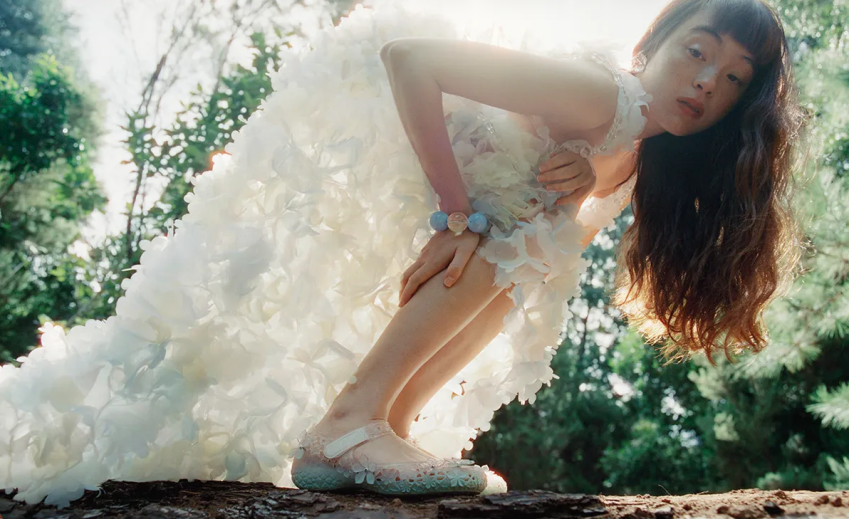
More recently, Fang has expanded into bridal dresses after customers began purchasing her colorful, embellished showpieces as wedding dresses four years ago. “I never expected that, but it made me realize that what we are doing can exist in [special occasion] moments like that, as well.”
Other Chinese designers — including Feng Chen Wang, Samuel Gui Yang, Guo Pei and Lan Yu — are also leaning into categories like bridal, accessories and ready-to-wear, which are more likely to sell than runway pieces.
In addition, Fang has reduced the size of her collections. “Before, I was making maybe 200 pieces per collection, and not all of them would even appear in the show,” she said. “Now I try to control it more, so we can improve the quality and really focus on what works.” This season, she made 100 SKUs — joining other Chinese brands that are tightening assortments in a more cautious market.
Despite staging shows at Shanghai Fashion Week for several seasons, the brand’s performance is uneven across markets. Fang said the brand is currently seeing stronger growth in Korea and Japan than in China, where demand has become less predictable. In Asia, the brand works with a tight group of wholesale partners, including Shanghai-based Labelhood, as well as craft-focused retailers like Cocktail in Beijing and Hong Kong.
“There’s always been this idea that [as a Chinese brand] you need global recognition [via a fashion capital’s Fashion Week or global activations],” Williams said. “But many designers don’t necessarily need it anymore. The cost of showing abroad is very high, and there are opportunities closer to home where they can commercialize much faster.”
Still, she added, “When international guests come to Shanghai for the first time, they are genuinely surprised by the level of innovation and sophistication. That reaction happens again and again.”
That’s where moments like the Margiela show come in. “It definitely brings a really positive halo effect to the schedule,” Fang said. “But it’s still quite contained. There needs to be a group of multiple Western brands to really build that international pull.”
Other Western brands — from Moncler and Vivienne Westwood to Paul Smith and Rick Owens — have used Shanghai Fashion Week in the past for activations and events.
Luxury’s comeback call, or wishful thinking?
HSBC is taking a more confident stance on luxury heading into the second quarter, even as the macro backdrop remains shaky. In a note from March 30, analyst Anne-Laure Bismuth said the industry’s next phase of growth will come down to brands themselves. She pointed to “an injection of product creativity” and “more attractive price points” as key drivers of renewed demand for luxury.
The bank expects final first-quarter organic sales to show 5.5% growth, after increasing 5% in the fourth, with Moncler set to lead. Kering, LVMH and Burberry are also expected to improve sequentially.
HSBC has cut its full-year 2026 growth forecast for luxury to 5.9%, reflecting weaker demand in Europe and the Middle East. Still, it’s holding Buy ratings on most of the sector, calling Hermès “the safe place to be,” while flagging continued jewelry strength at Richemont.
Executive moves
- Mark Thomas is leaving his role as design director of Carven after one year, with the Icicle Group-owned label yet to name a successor.
- Kering’s musical chairs keep going. Teejana Beenessreesingh has exited as CEO of DoDo, Kering’s entry-level jewellery label, after less than a year, with Kering folding the role into Sabina Belli’s remit as CEO of jewelry brand Pomellato. The move comes as CEO Luca de Meo restructures the group. In March, he created a dedicated jewellery unit under COO Jean-Marc Duplaix. And broader leadership changes go on too, including Bartolomeo Rongone’s recent move from Bottega Veneta to lead Moncler.
- Valentino has appointed Antonio Achille as chief operating and transformation officer, a newly created role overseeing industrial, digital and technology functions, reporting to CEO Riccardo Bellini. Valentino is navigating a tougher period, with recent declines in revenue and profit and ongoing restructuring efforts.
News to know
- Saks Global has secured $500 million in exit financing from bondholders and expects to emerge from Chapter 11 this summer. CEO Geoffroy van Raemdonck said in a note to press that the company continues to stabilize operations and rebuild brand partnerships.
- U.S. retail sales rose 0.6% in February, with clothing sales up 2% month-on-month and 6% year-on-year, according to data from the U.S. Census Bureau. However, economists caution that the figures predate the Iran war and may not reflect weakening consumer sentiment.
- Kering has struck a €1.1 billion ($1.2 billion) real estate deal with Qatari investment Al-Mirqab Group, selling an 80% stake in its Via Monte Napoleone building in Milan as part of efforts to reduce debt under CEO Luca de Meo.
- The Iran war is disrupting high-margin Middle East sales for luxury carmakers including Rolls-Royce Motor Cars, Ferrari and Bentley, according to Reuters. Dealerships are closing, deliveries are paused, and demand is dropping despite the region’s outsized profitability.
- A shortage of high-end retail space is slowing luxury expansion in India, according to Reuters. Demand is rising, but brands like LVMH, Kering and Richemont face limited access to premium malls.
Listen in
On this week’s episode of the Glossy Podcast, senior fashion reporter Danny Parisi and international reporter Zofia Zwieglinska speak with Achim Berg about how escalating conflict in the Middle East is impacting fashion and luxury. A month into the crisis, brands are contending with disrupted tourism, weaker store traffic and rising cost pressures, adding strain to a sector already facing a broader slowdown. Listen here.
Read on Glossy
Concerns abound with new AI shopping agents. PVH gets an earnings boost from “Love Story”. Mejuri is building on its Puzzle collection.