
“Trees are such an amazing living entity absorbing and collecting water and seeking ways to thrive in [their] own ecosystem.”
—Anonymous visitor reflecting on the 2025 WILDLAND exhibition at the Westmont Ridley-Tree Museum of Art in Santa Barbara, Calif.
Earth system science involves studying multiple lines of evidence with a variety of technologies, from satellites to isotopic tracers to numerical models, to bring different pieces of a complicated story together. The complexity of this science can be confusing, overwhelming, and alienating, sometimes even for scientists themselves.
Communicating this complexity in ways that make sense to people often defies conventional scientific depictions of data and results, suggesting the need for alternative ways to view and present research.
Artists have long been masters of discovery, finding creative ways to reframe and reenvision all manner of subjects, including scientific ones. But artists aren’t just interested in making the finished products of science more accessible; they are also excited by opportunities to work directly with scientists. By engaging with each other, artists and scientists can extend the reach of their individual abilities to explore new ground.
WILDLAND: Ethan Turpin’s Collaborations on Fire and Water, an exhibition that opened in January 2025 at the Westmont Ridley-Tree Museum of Art in Santa Barbara, Calif., represented another powerful example of the cobenefits of art-science partnerships. The exhibition explored fire and water in the local landscape through lenses spanning spatial scales from tree roots to watersheds, and timescales from minutes to decades.
The exhibition drew visitors grappling in real time with personal impacts of wildfire.
The location and timing of WILDLAND provided salient context for the exhibition’s focus—even more so than originally anticipated. On the dry, windy evening of 13 November 2008, campfire embers blew into the air and ignited a wildfire near the scenic campus of Westmont College, northwest of Los Angeles. The fire burned 210 homes and required a thousand Westmont students, faculty, and staff to shelter in place overnight in the school’s gymnasium. The art museum had opened just months prior, and its forward-thinking, fire-resilient design helped it survive the blaze.
WILDLAND, installed a little over 16 years after the 2008 fire and featuring accompanying text and photography that referenced the museum’s history, dramatically reawakened memories of the event. Opening the same week that the deadly Eaton and Palisades fires devastated Los Angeles, the exhibition also drew visitors grappling in real time with personal impacts of wildfire and a desire to better understand extreme conditions in their landscape.
Key pieces represented 10 years of evolving collaboration between the two of us—an artist (Ethan Turpin) and an ecohydrologist (Naomi Tague)—and with many other natural, computer, and social scientists and practitioners. Here we offer a window into the science behind the exhibition and share insights we have learned in our practice that may help other art-science collaborations in Earth system science and beyond.
The Scenes and Science of WILDLAND
Water is a fundamental component of landscapes, inextricably entwined with other elements such as climate, vegetation, geology, and perhaps most viscerally, fire. The WILDLAND exhibition’s works focused on providing new perspectives on how these elements interact in the landscapes people inhabit.
Entering the museum galleries, visitors were immersed in video footage captured within burning woodlands and time-lapse sequences of postfire regrowth, all spatially contrasted with life-size projections showing water pathways along hillslopes and through trees. The exhibit took viewers from aerial viewpoints down to the surface of woodlands and below, connecting different processes and scales. Works titled Tree Water and Future Mountain, as well as a series of watercolor paintings, particularly highlighted our art-science collaboration.
Motivation for Tree Water came from the National Science Foundation Critical Zone Collaborative Network’s Dynamic Water project and from other investigations of the sources and pathways of water that plants use for transpiration. In the Dynamic Water project, observations of sap flow and isotopic tracers within plants, soil, and groundwater, as well as hydrologic models, have been used to hypothesize about the spatial and temporal patterns of plant water use.
These hypotheses differentiate between local and upslope water as well as between “old” water that may have been stored for multiple years and “new” water from recent rainfall [Graup et al., 2022]. Evidence that plants may sometimes use old, stored water can shift how we think about plant sensitivity to climate variation and change. Tree Water is an abstracted representation of this ongoing scientific conversation.
Walking through this abstract forest offered a new view of the unseen world of water and provided an intuitive sense of the complexities of tracking water sources.
In Tree Water, Ethan filmed the movement of paint along prewetted flow paths on paper, which was tilted when the paint was applied to mimic gravity drainage in nature. Filming multiple realizations of the flow paths’ development allowed him to create a “forest” in the museum space. For nonscientists, walking through this abstract forest offered a new view of the unseen world of water and provided an intuitive sense of the complexities of tracking water sources in space and time. For scientists, it was a reminder that their conceptual models are just that: models of a very complex process of mixing of old and new water downslope, here evoked by the mixing of dark and light paint pigments.
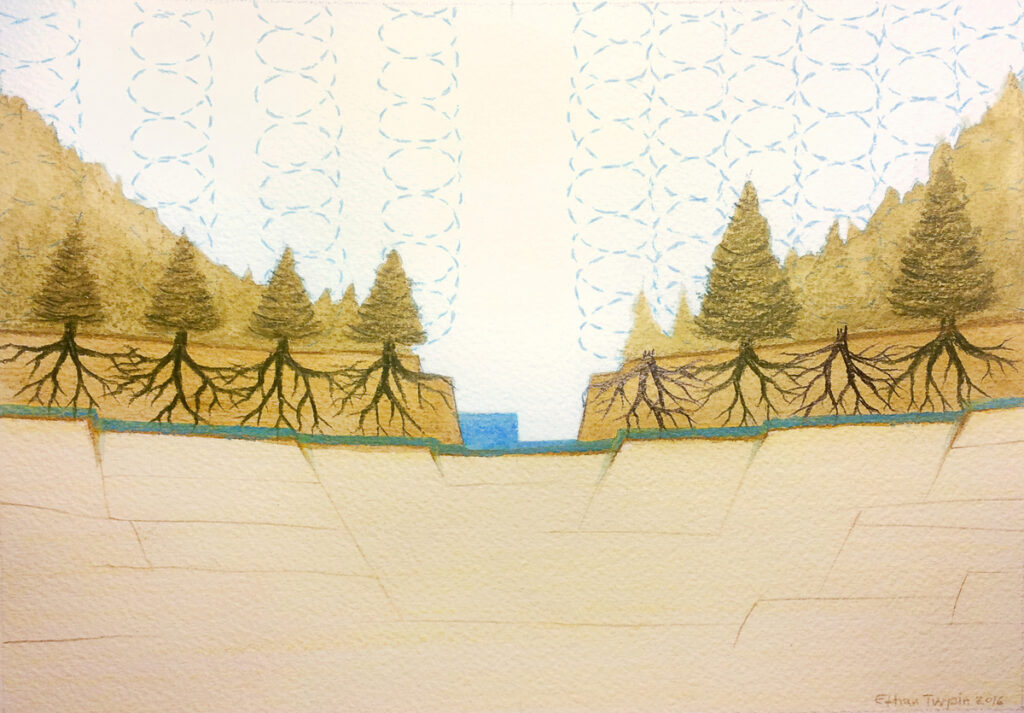
The imagery in the watercolor series and in Future Mountain, an interactive video installation, is closer to traditional science illustration, although expressed in different ways. The watercolors depict deep and shallow tree roots, forest thinning, and different streamflow levels to show how rooting depth can determine whether streamflow increases or decreases following thinning, portraying conclusions from an ecohydrology study [Tague and Moritz, 2019].
Future Mountain is much more complex and directly visualizes the multidimensional output of the RHESSys (Regional Hydro-Ecologic Simulation System) Earth system model. With Future Mountain, users can set parameters and observe how patterns in snowmelt, carbon sequestration, fire severity, and other factors vary in space and time across watersheds, as well as with interannual climate variation and climate warming. A goal of the work was to help the public grapple with why the effects of climate change are not always evident in individual years and why some locations, even in the same watershed, are more climate sensitive than others.
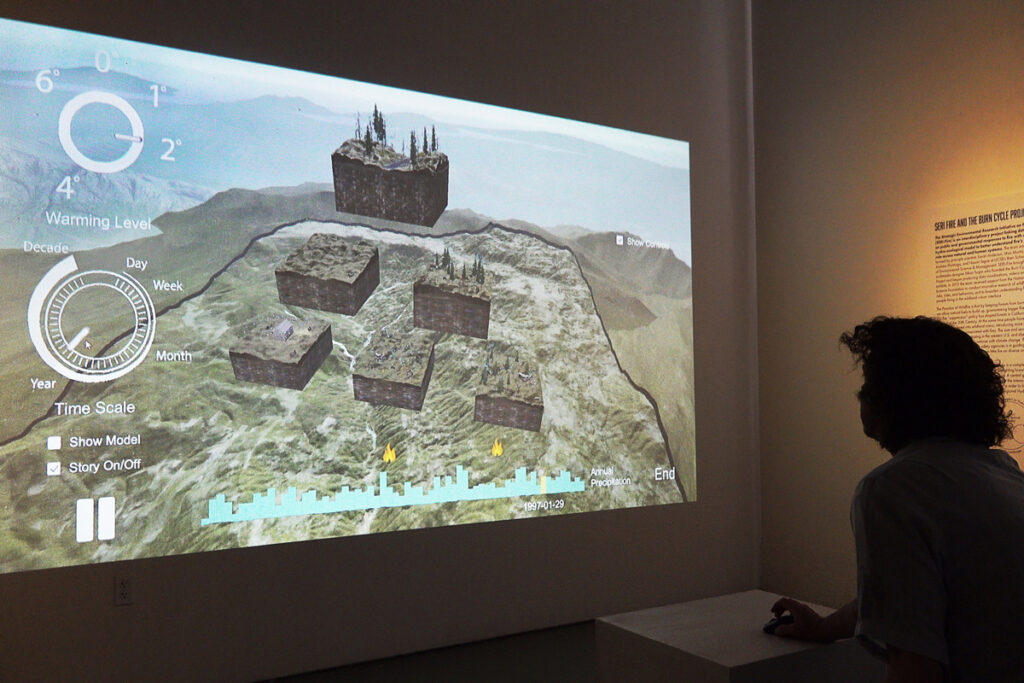
Relative to Tree Water, Future Mountain is a more direct form of science communication about Earth systems—one with which most scientists are more familiar. Putting these pieces together with the straightforward depictions in the watercolors exemplifies a range of art-science approaches that span from realistic illustrations of scientific conclusions or hypotheses to more abstract but visually engaging (and perhaps more artistically interesting) pieces that echo how scientists “see” the environment.
An Evocative Experience
Of 1,943 counted visitors to WILDLAND, a small proportion (43) filled out a written survey that we distributed to understand viewers’ engagement with and response to the exhibition. One survey question simply asked whether the respondent learned anything from it.
Some respondents reflected on fire and water, noting they enjoyed visualizing “water and fire moving through the landscapes at different timescales,” and that they “learned more about how fires impact regrowth and how water travels through the ground and trees.”
Another visitor commented that they’d learned that “Natural systems are singularly in sync, yet highly complex, dynamic, and living expressions of feedback.” It was satisfying for us that some viewers’ responses suggested we were able to at least hint at some of the more complex interactions involved in understanding fire-water-vegetation interactions.
Several respondents related the exhibition to the Los Angeles fires, which had ignited just 2 days before WILDLAND’s opening, with emotional directness:
- “My childhood home burned down in the Altadena [Eaton] fire, so it has been close to home.”
- “I will remember how the LA fires were happening at the same time, which was stressful, but how nice it was to be in community for this.”
- “It’s all a bit much for some of us with Fire trauma but also wonderful to be reminded of nature…[its] beautiful recovery. We all need time to heal.”
- “Healing takes time, and that’s shown in nature. The water exhibit was extremely informative.”
A general sense emerged from viewers’ feedback that seeing the effects of fire, the recovery of plants afterward, and the movement of water through landscapes together in one space was especially meaningful.
A general sense emerged from viewers’ feedback that seeing the effects of fire, the recovery of plants afterward, and the movement of water through landscapes together in one space was especially meaningful, offering perspective on even the most extreme cycles in the land.
The thoughts jotted down in the survey reflected ideas that people were motivated to express fresh from their experience with the art-science material. Beyond what was put down in writing, we had many impactful conversations and nonverbal interactions with people during the exhibition’s run. One person even wrote that they would most remember their “personal discussions with people included at the exhibit,” which revealed “surprising new ways to think on a broad land scale.” Both the memories of these dialogues and the anonymous survey responses have become part of an iterative process as we create new works.
The Future Mountain team will use what it learned from viewer feedback to create game quests that help guide user exploration and to expand the interactive exhibit to include other landscapes, such as the oak woodlands and chaparral of the Santa Barbara coastal range. Future installations of Tree Water will continue to provide an artistic lens on how actual trees just outside exhibit spaces, including in orchards and wild habitats, receive and use water. A planned coarse-scale, bird’s-eye version will incorporate connections of river systems to these habitats in which flow paths are seen from above. A possible fine-scale version may depict roots accessing water in soil aggregates and macropores, again offering different perspectives on the movement and role of water in landscapes.
Listening and Learning in an Art-Science Collaboration
The spectrum of science communication in WILDLAND, from the more abstract to the more realistic representations of biophysical processes, emerged through many hours of conversation.
The spectrum of science communication in WILDLAND, from the more abstract to the more realistic representations of biophysical processes, emerged through many hours of conversation. This substantial investment of time was important for creating works that were at once scientifically and artistically meaningful and that resonated with museumgoers.
By dedicating adequate time for our collaboration, Naomi could “open the box” of ecohydrology for Ethan. She provided insight into what ecohydrologists focus on in their research and why; how they connect processes across different time and space scales (e.g., relating stomatal functioning in leaves to the redistribution of water by hillslope drainage); how they combine physical observations with models to simulate and test hypotheses about real-world conditions; and how both theory and modeling involve choices to simplify and make sense of a complex world.
Equally important was time that Ethan spent bringing Naomi into the world of the artist, which involves so much more than illustration. Artists must balance maintaining scientific credibility with engaging audiences emotionally and aesthetically. Artists are concerned with innovation and with the technical practicalities of implementing an idea, concerns that parallel but can be radically different from those in science.
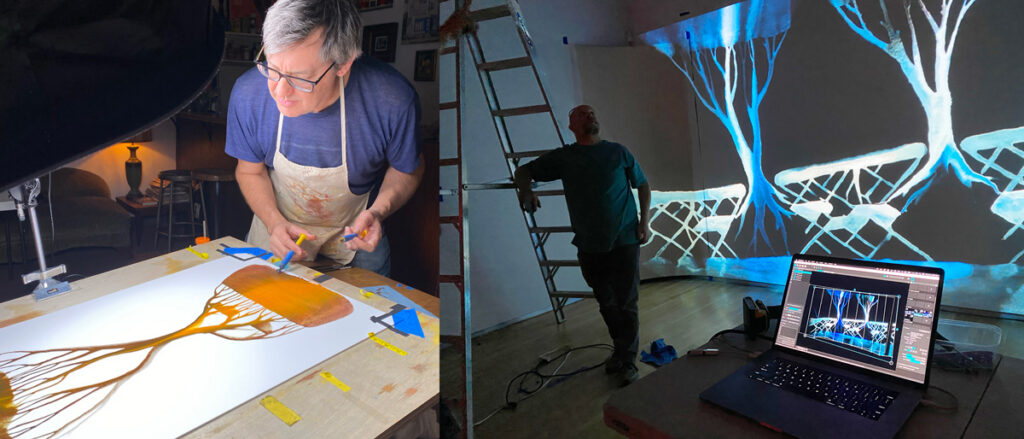
Tree Water was innovative artistically in its use of media; it was also technically challenging to create and to install in the museum space. Similarly, modeling where trees source their water represents scientific innovation, but it can be technically challenging to depict accurately because of uncertainty in rooting patterns and subsurface flow paths.
Artists also think about presentation and curation in ways that scientists sometimes overlook. Deciding how to place pieces in the WILDLAND exhibition was an important part of our collaborative process, with Ethan sharing preliminary drafts and motivations for the layout and Naomi learning to think about spatially sequencing pieces to provide visitors with a coherent experience. This process included decisions, for example, about how best to pair the contemplative Tree Water with the more intellectual Future Mountain.
In addition to investing time, we found that active listening was vital for the collaboration to be mutually fulfilling. This listening allowed each of us to reflect on how the other person’s ideas might influence our own perspectives. We also learned how to describe our ideas so that the other person could understand and participate in them. For scientists and artists alike, such reflection can reveal previously unseen dimensions in nature and inspire new insights. For example, in representing vegetation in Future Mountain, Naomi realized the importance of thinking about the diversity of ways that trees turn carbon allocation into tree architecture (i.e., the patterns of branches, leaves, and stems) to create forests that intuitively look and feel right to users.
The effort to listen and learn about each other’s perspectives, and the willingness to balance the sometimes different goals of an artist and a scientist, led to a richer collaborative experience for us personally. From the feedback we received, it also seemingly resulted in a rich emotional and educational experience for the public who visited WILDLAND. The exhibition’s pieces offered something more than science-based information about Earth systems—they inspired new ways of connecting with our natural surroundings and seeing interactions among the water, vegetation, geology, fire, and other elements of the landscapes in which we live.
Acknowledgments
For additional information about the science, art, and creators of the WILDLAND exhibition, please visit the following websites: tagueteamlab.org, burncycleproject.com, and ethanturpin.com.
References
Graup, L. J., et al. (2022), Subsurface lateral flows buffer riparian water stress against snow drought, J. Geophys. Res. Biogeosci., 127(12), e2022JG006980, https://doi.org/10.1029/2022JG006980.
Tague, C. L., and M. A. Moritz (2019), Plant accessible water storage capacity and tree-scale root interactions determine how forest density reductions alter forest water use and productivity, Front. For. Global Change, 2, 36, https://doi.org/10.3389/ffgc.2019.00036.
Author Information
Christina (Naomi) Tague ([email protected]), University of California, Santa Barbara; and Ethan Turpin ([email protected]), Independent visual artist, Santa Barbara, Calif.