
2026 Editor’s Choice Award Winner
I’m writing this review during the crowd funding campaign for the 3rd printing and latest expansion to the game. So, spoiler: the game is pretty good and clearly in demand. However, if we rewind a few years to when I backed the 1st edition of the game, I was very skeptical that a relatively unknown publisher, Bad Crow Games, could deliver on a tabletop experience that did the PC game justice. I’m happy to say they did indeed deliver, continued to deliver, and show no sign of slowing up. Let me tell you why Company of Heroes has become one of my all-time favorite games and why Bad Crow Games will have my support forever.
Company of Heroes (COH from here on out) walks and talks like a war game, but it’s really a board game. You might be thinking, “this guy doesn’t know what he’s talking about, war games are board games” right about now, but before you click away, I promise I have a point.
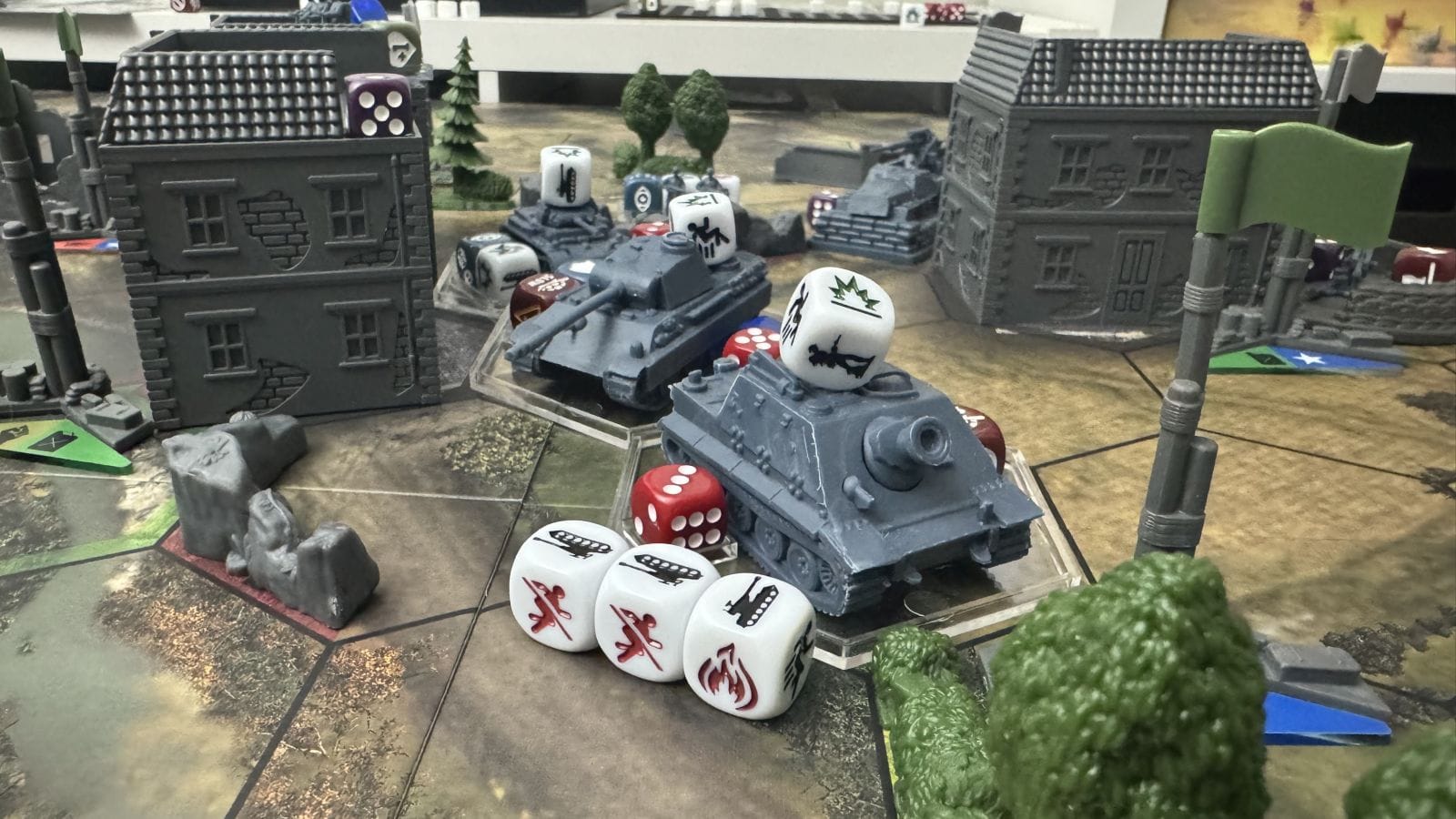
When I think of war games, I think of little tiny unit chits and endless lookup tables dissecting the minutia of the effect of humidity on bullet velocity when it rains in France, and rolls to-hit followed by rolls for cover, followed by rolls for morale, followed by giving up and going home. I also think they are dreadfully boring and not fun at all. (Yes, yes, you are allowed to like them, I’m sure I’m wrong.) Anyway, I happen to still be keenly interested in WW2, as any stereotypical middle aged man should be, and love the more “boardgameified” take on them.
COH abstracts enough of the detail to be streamlined and snappy, while also providing deep, tactical decision making that gives me the crunch and feeling of control missing from something overly abstracted like Memoir ’44. It’s lands right in the sweet spot between an easy-to-play board game and a complex war game.
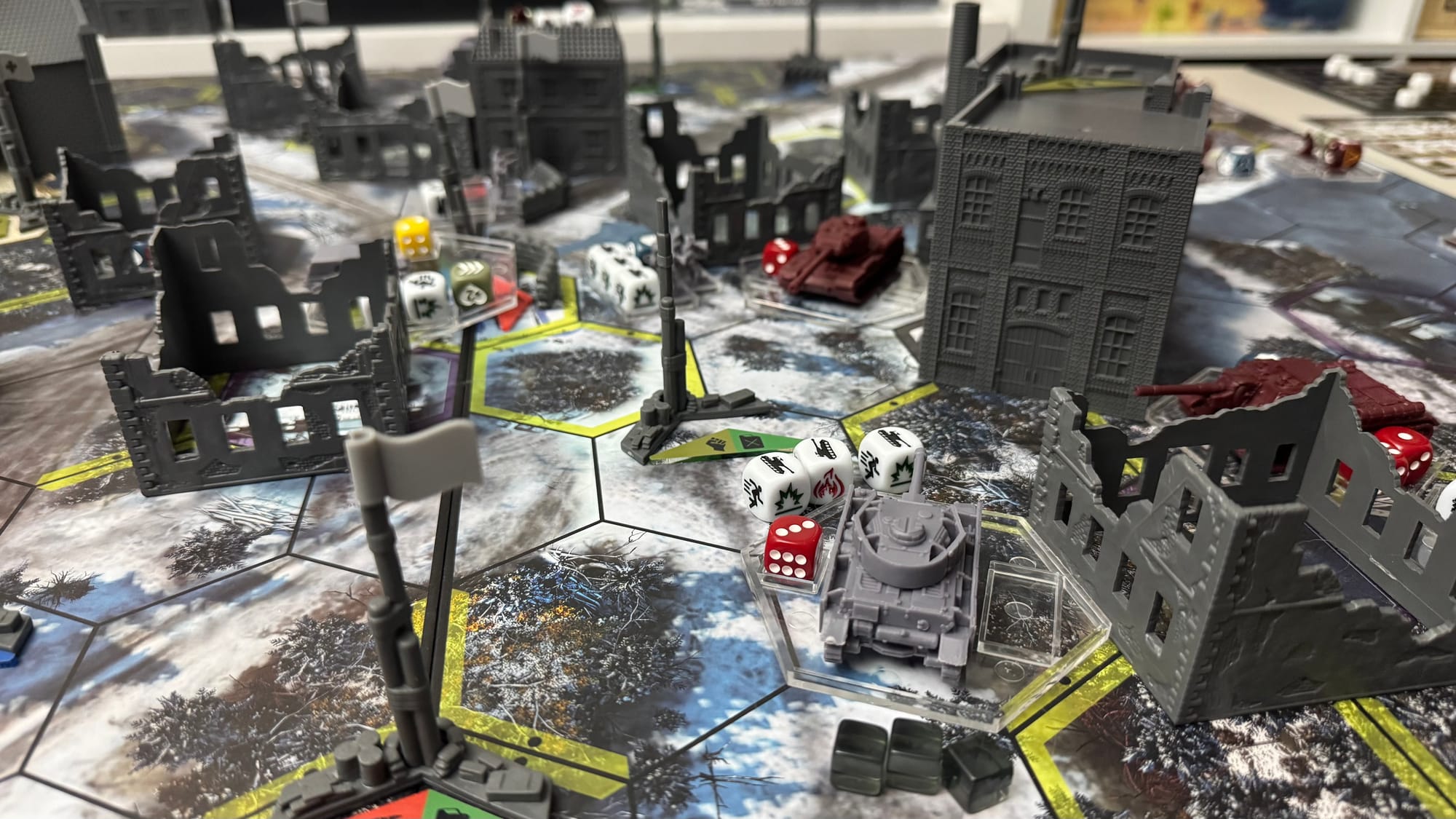
Ok, so how does the game actually play? Great question.
COH can be played 1-6 players, but 1v1 is my primary way of playing. Once you pick a map and army for each player, the game is split into 3 phases: Maneuver, Combat, and Clean up. You’ll check for victory at the end of each round, and continue round after round until someone triggers the end of the game.
In the Maneuver phase, the designers have taken a simple “I go, you go” concept, but added a clever twist. Each player gets a variable number of orders to assign to units. The number depends on an Operations card that is drawn at the start of the round. Only one player gets to know the exact number of orders available, while the other gets a range. For example, the card might say “4”, but the other player only gets to know it’s between “3-5”. This variable order system was added in the 2nd Edition rules and was a great addition. Without it, the second player has a bit of an advantage by going last and being able to wait and react to key moves with their last orders. Now that they don’t know exactly how many orders they will get, they have to make hard decisions. Do I make that move now and show my plan, or try to hold off and risk running out of orders this round? This system adds an incredible amount of tension to each turn and introduces the possibility of fun mind games from the player who knows the true turn limit each round.
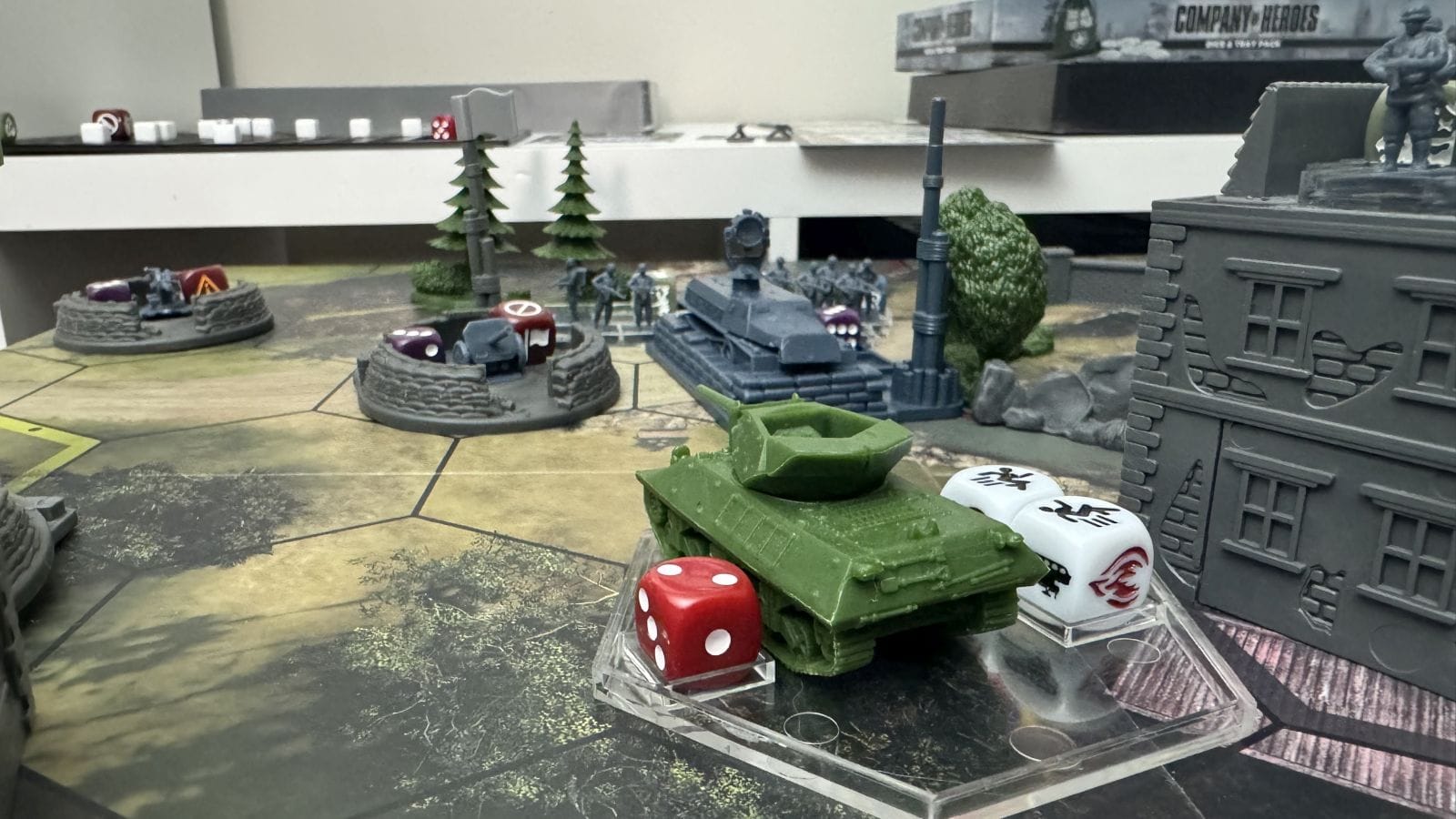
After all of the movement is done, each player gets an opportunity to retreat infantry. Combat in COH can be brutal; losing a unit is costly, and they’re time-consuming to replace, so retreating is often a good option. Wounded units can be healed, but a dead unit is… well, dead. Plus, dead units give the other player a victory point, so they’re best avoided. For fans of the video game, retreats are a core element ported directly into the board game.
After retreats are performed, any unit that has sight and range to an enemy can assign damage. The damage system is largely deterministic with some dice rolling added in for things like cover and armor. There is a very basic table (yes, I know I was hating on the tables earlier) that shows what type of damage each unit is susceptible to and if they have any defense against it.
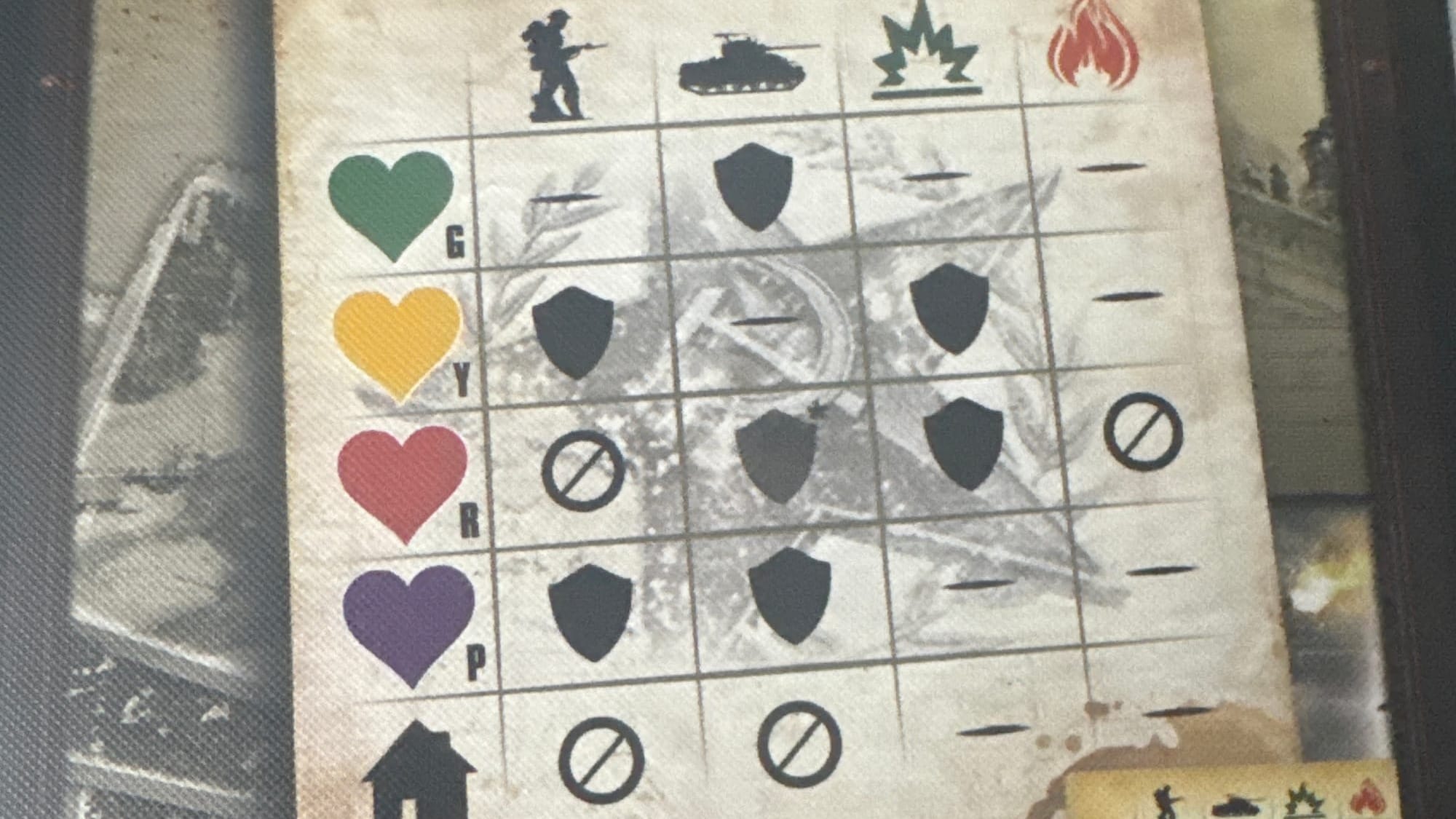
For example, two infantry units shooting at each other with no cover will both automatically score hits. You want to attack a tank with your infantry? Yeah, that’s not going to work, tanks don’t even have a chance to take anti-infantry damage. Come back with some explosives, buddy. Because it is deterministic, most damage can be assigned quickly, and combat is a breeze. However, things like cover, armor, or high explosives introduce some randomness to the equation. These allow you to roll some of the incoming damage and try to avoid it.
Since you know what type of damage each unit can dish out and what it can be affected by, the real meat of the game is in the tactical positioning of your units and the combination of effects. Forcing your opponent to retreat due to overwhelming force or countering unit types with different ones of your own are straight out of the video game. Holed up in a building with an MG covering a control point? It sure would be nasty if someone brought a flamethrower over there.
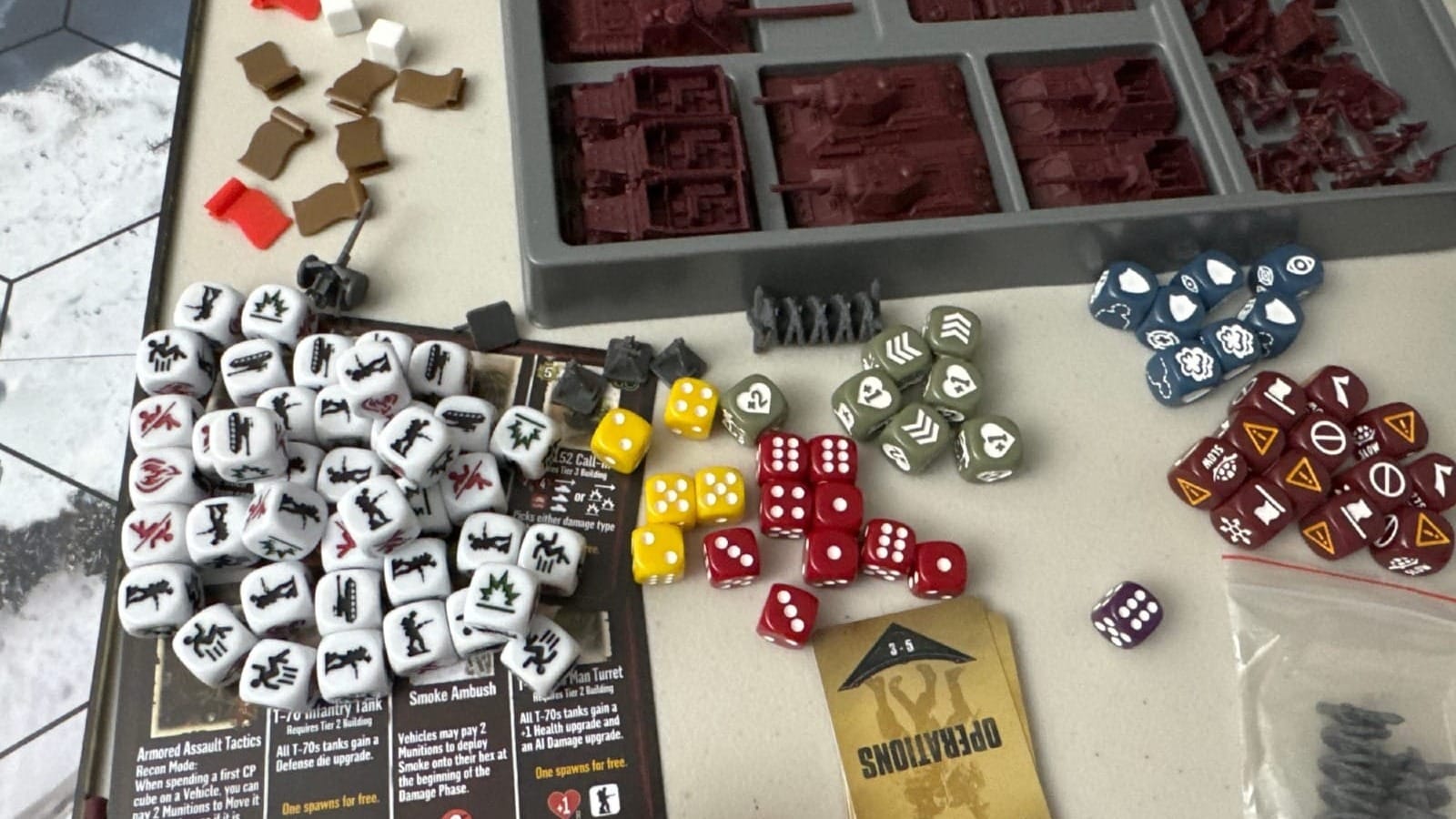
The deterministic combat is what elevates this game to Editor’s Choice status. The game feels a lot like Chess with hand grenades. I can form a battle plan that takes advantage of the terrain, unit types, and commander effects that is sure to work, or I can take a risk and rely on some of the random elements, like explosive damage to shore up my weak spots or stop a stronger advance from my opponent. Sometimes I might put a unit in a position where I know it is going to die, but it’s the critical piece I need to stop the enemy from securing a capture point, or to spot a unit that has been giving me trouble and allow my longer range guys to take it out. The system creates a battlefield of choices that feel impactful, rather than a series of controlled random chances that may or may not pay off. You get to decide how much randomness you want to rely on.
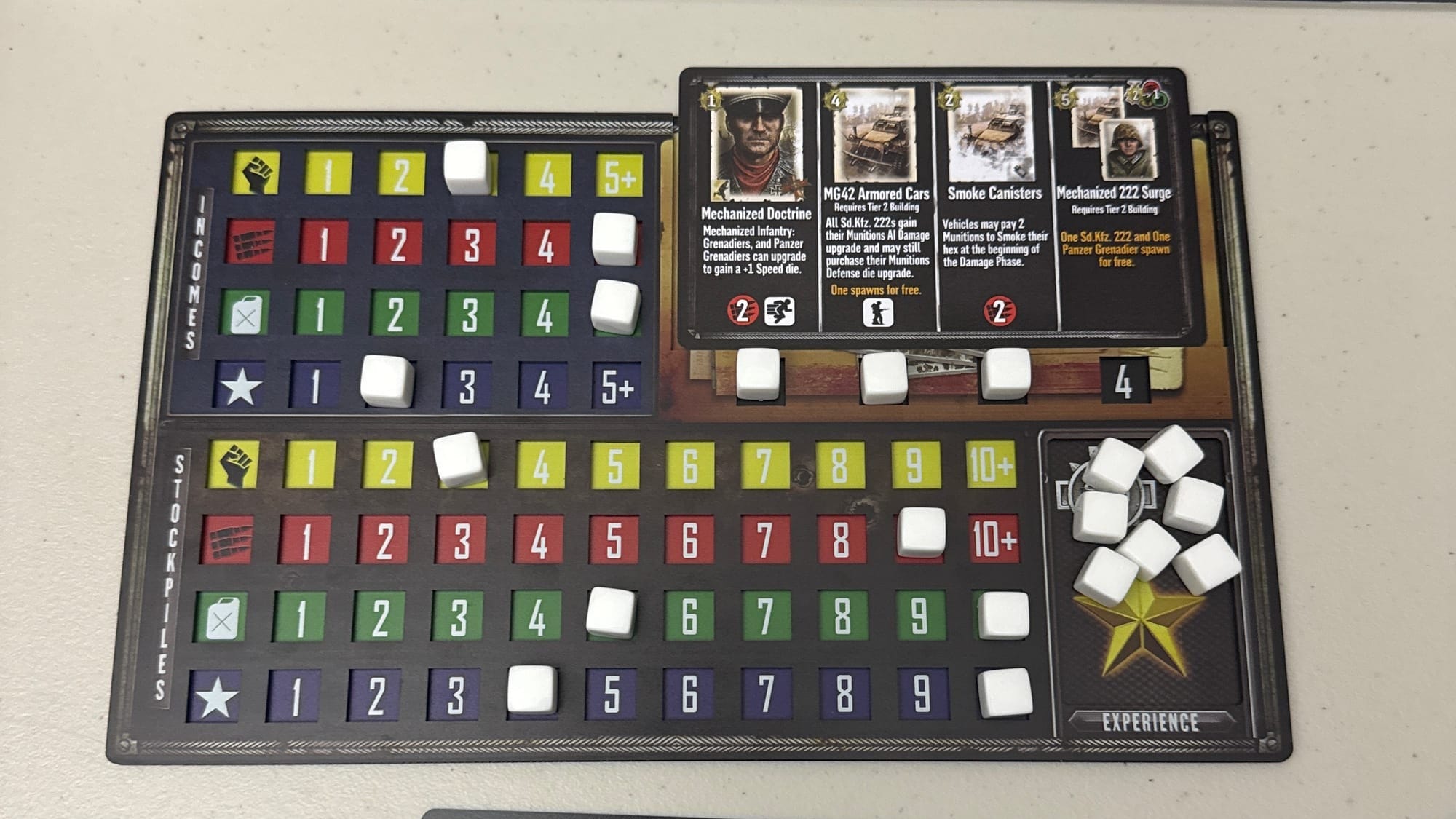
After all the bloodshed, it’s time to assess the state of the battlefield. Control of resource and victory points is determined, resources are assigned, and new units are purchased. Like in the video game, your economy is as important as your ability to kill things. Manpower, munitions, fuel, and victory points are all up for grabs on the map. Your strategy needs to incorporate securing key resource production while balancing victory points if you have any hope of winning the game. The back and forth nature of fighting over capture points creates a narrative to the game that you’ll be talking back after it is over. “Remember when I pushed up the left flank and took out all of your fuel production? I really thought that was going to pay off, but I left the middle exposed and couldn’t hold onto the victory point locations.”
Besides the fun gameplay anecdotes, playing around capture points requires movement. Too often in war games, each side establishes its battle line and commences chucking dice for the next 2 hours while standing still. It’s as if Napoleon is still writing the rule books. COH demands movement and momentum. If you’re sitting still, you’re either not taking points or just waiting for the enemy artillery to get into position and ruin your day.
The gameplay is streamlined and fast, while still developing over the course of several hours. I don’t want to be here all day, but I also don’t want the game to end before I feel like I’ve really done anything. You really feel like you fought a battle by the end, but it flies by. You may need to be prepared to invest 2-4 hours into a game, but every turn is a blast. Of the 20+ games I have played so far, only one of them was a blowout. Every other game has been a battle to the end that could have gone either way.
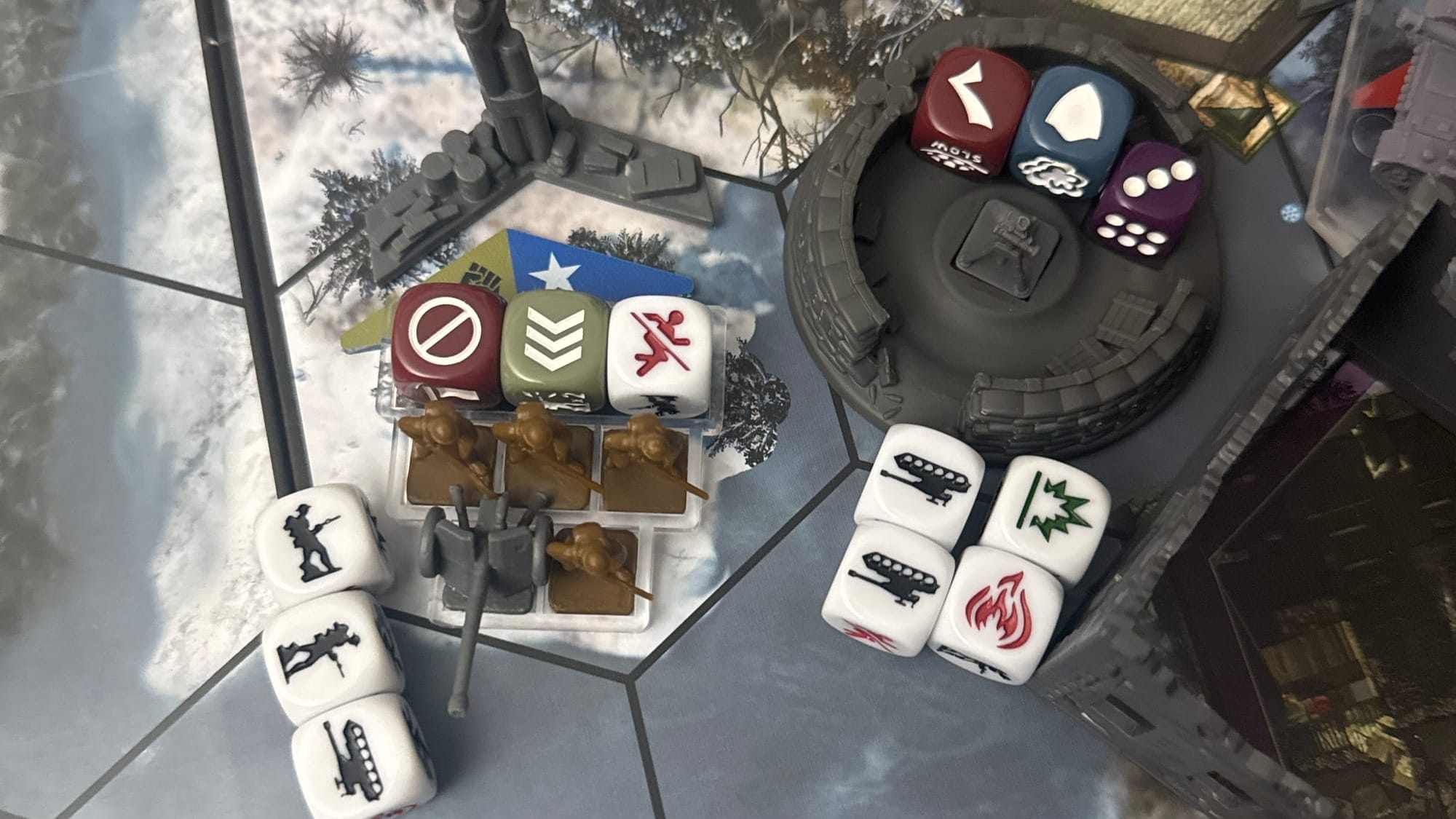
This game feels like the PC game. The folks at Bad Crow are clearly deeply passionate about the game and making sure they are delivering an experience that is faithful to the original video game while also working extremely well on the tabletop. The resource management is spot on. Unit counterplay is right off the screen.
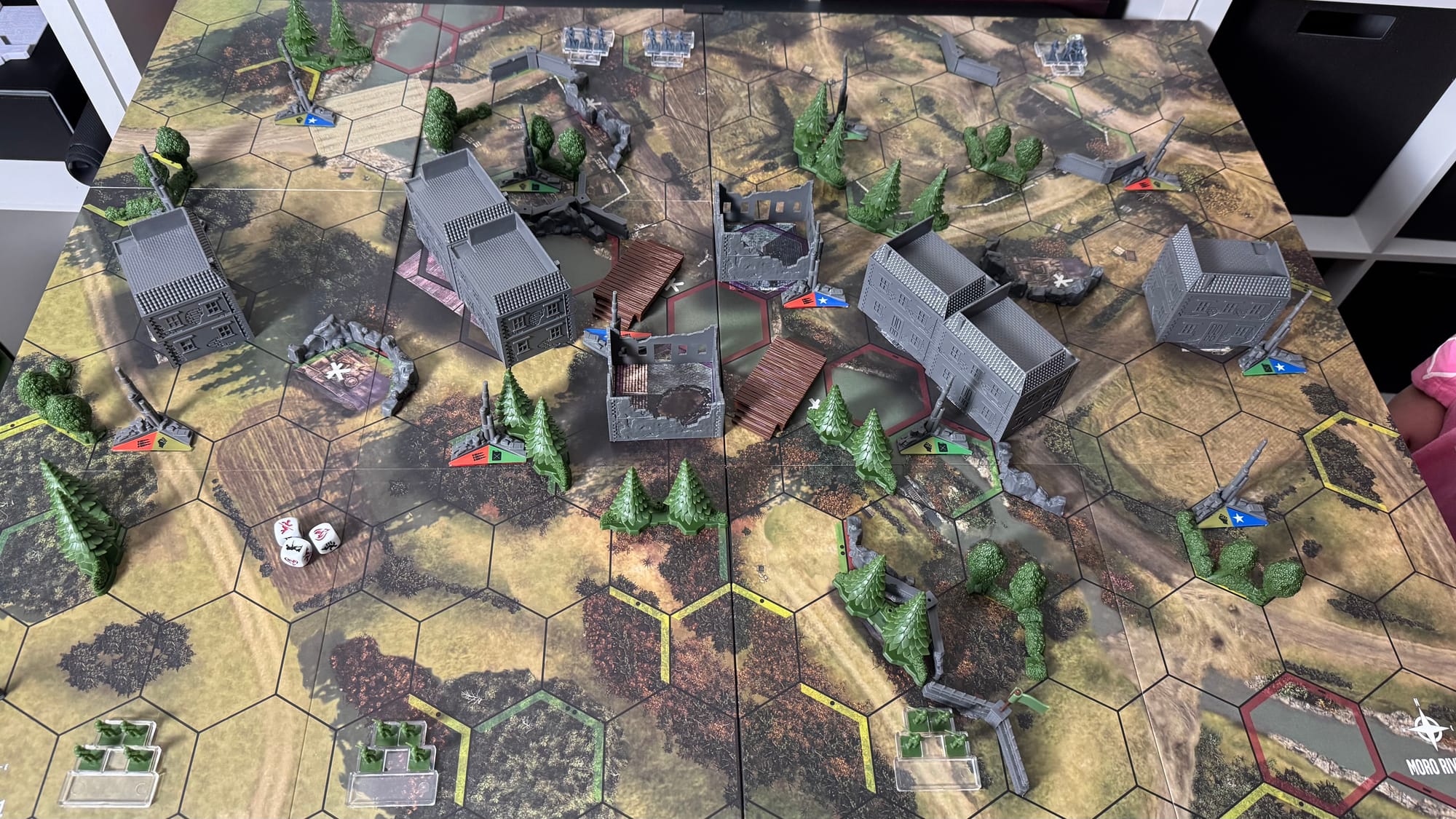
The toy factor is unbelievably good. Can you honestly say you don’t want to play with these little tanks? Really? Production value is high across the board. Linen-finish cards, custom dice, dozens of minis, 3d terrain, detailed boards—everything is top-notch. I’ve backed every campaign for this game personally, and I can tell you Bad Crow has gone through hell and back to deliver on their promises and make this game the best that it can be.
All of these fun toys do come at the cost of space. This game will go toe-to-toe with the biggest shelf and table hogs out there. I have the enormous War Crate taking up a big chunk of floor space, I’ve abandoned all of the cardboard boxes to condense everything as much as possible, and I still have two boxes of terrain spilling over onto another shelf. Granted, I do have an extra 2-player set on top of all the other content, so your mileage may vary. The War Crate is great to try and contain everything in one big box, but the game could really benefit from some improved modular organization to make set-up easier and bring all of the faction pieces together rather than split between their Core units in one tray and Special Units mixed across multiple other boxes
Speaking of Bad Crow Games, they are one of the best to ever do it. They navigated the Covid shutdown, the very unfortunate death of their founder, and most recently, the tariffs. Anything bad you’ve heard of happening in the last 5 years related to crowdfunding campaigns has happened to BCG. They have emerged on the other side with a product that exceeds expectations. The amount of content I’ve received for FREE due to stretch goals on their campaigns is mind boggling. I’m honestly not sure how they do it when other companies are delivering way less content for higher prices.
I will never turn down an opportunity to play more COH. In fact, I love it so much, a friend and I, who both own the game, keep it set up for weeks at a time and play game after game over discord. It’s everything I want in a tactical WW2 game. Sure, there may be small rules I would personally change, but taken as a whole, it’s pretty darn near perfect.
Review Guidelines
100
Company of Heroes: 2nd Edition
Phenomenal
COH sits in the perfect middle ground of complexity and fun. The decision space is way more interesting and intense than something like Memoir 44, but still light enough not to take all day and an encyclopedia of rules and lookup tables like the war-games of old.
Pros
- Faithful adaptation of the video game.
- All the WW2 action and none of the stuffiness of a traditional war game.
- Deep tactical decision making.
Cons
- Storage isn’t great. A more unified storage solution to organize the large amount of content would be nice.
This review is based on a copy provided by the reviewer.