
“Project Hail Mary” is a modern sci-fi hit that explores how a sun might die and how the human race could find a way to survive in that hypothetical scenario. In the film, fictional microorganisms called “astrophage” are feeding on the sun and causing it to dim, which will result in the Earth’s temperature cooling to a catastrophic degree unless humanity finds a way to reverse the dimming effect. Science teacher Ryland Grace (portrayed by Ryan Gosling) is sent on a one-way deep-space mission to study Tau Ceti, the only sun that is not dimming despite the presence of astrophage.
Sci-fi movies like “Project Hail Mary” are known for delivering tense drama with realistic science to back it all up. In an article for ScienceNews, molecular biology researcher Tina Hesman Saey and earth science reporter Carolyn Gramling discussed the accuracy of the film’s concepts. According to Saey, it actually would be possible for microbes like the astrophage to live in space.
Single-celled organisms are able to live in extreme temperatures and can even survive high radiation or crushing pressure. Saey admits, “I don’t know of any organisms that could live in both the extreme heat and cold, not to mention survive in a vacuum and Venus’ intense atmospheric pressure and getting blasted by solar radiation. But if any organism can do it, it’s a microbe.”
What did Project Hail Mary get wrong?
Carolyn Gramling commented on how rapidly the astrophage in “Project Hail Mary” caused the sun to dim. She explains that the real sun sees a luminosity increase of 10 percent every billion years, while the fictional astrophage are causing it to dim at a rate of 10% in 30 years. It’s an astonishingly fast pace that beggars belief. “But sci-fi likes to speed things up for dramatic effect,” Gramling concedes.
NASA sees a bright future for space exploration, but its experts also stress the limitations of traveling beyond Earth’s atmosphere. The current long-duration spaceflight record in NASA is 371 days, compared to the four years that Ryland Grace had been traveling at the start of the film. After this amount of time, a person would experience extremely detrimental effects. For example, it only takes five months in space for an astronaut to lose 40% of their muscle and 12% of their bone mass.
NASA also made a point to correct a quote from the film in which a character said that his spacecraft would “await instructions from the Deep Space Network.” According to NASA, the real-life DSN never stops communicating with its spacecraft, suggesting that there would be no need to await instructions. Despite various nitpicks, though, “Project Hail Mary” is a thoughtful exploration that gets startlingly close to a reality that isn’t entirely far-fetched. And there’s a very good explanation for how it manages to achieve that.
Project Hail Mary was written by a true sci-fi savant
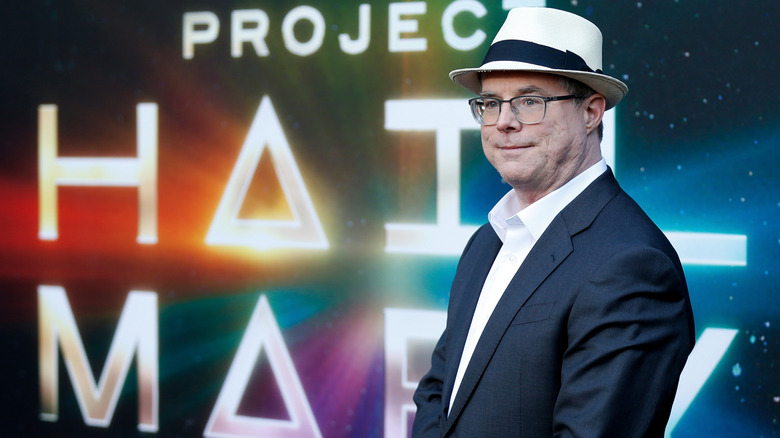
The “Project Hail Mary” film is based on the novel of the same name by author Andy Weir. Perhaps best known for writing “The Martian,” Weir is undoubtedly a titan of the sci-fi genre. The original “Project Hail Mary” novel was a finalist for the 2022 Hugo Award, which honors sci-fi excellence. Weir proclaims himself as “a lifelong space nerd and a devoted hobbyist of such subjects as relativistic physics, orbital mechanics, and the history of manned spaceflight,” according to Penguin Random House. Suffice it to say, he’s a knowledgeable sci-fi author who cares about scientific accuracy.
Tina Hesman Saey spoke to Weir before the ScienceNews article about “Project Hail Mary” and gained some valuable insight. “Andy Weir told me that algae and mold were the inspiration for astrophage,” Saey said. “He envisioned these microbes soaking up energy from the sun and then using that energy to propel themselves through space.” Saey shared another quote from her conversation with Weir: “Like 99.999 percent of the awesomeness that is life can be found in a single-celled organism. The rest of it is just cells cooperating.”
This paints a picture of an imaginative creator who combines scientific inspiration with storytelling talent. You only need to suspend your disbelief a little bit to see that the 2026 “Project Hail Mary” film kicks off the year well, building on the best sci-fi movies of 2025.