
FILLING A GAP:
The researchers said the mammals were known to live around Japan before going extinct, but their presence near Taiwan was not known before
-
By Rachel Lin and Jonathan Chin / Staff reporter, with staff writer
A team of Taiwanese and Japanese scientists has identified sea lion fossils in waters around Taiwan proper in a breakthrough discovery that raises new questions.
The team, which includes Tsai Cheng-hsiu (蔡政修), an associate professor of life sciences at National Taiwan University (NTU), and Naoki Kohno, a researcher at the National Museum of Nature and Science in Tokyo, found fossilized remains of Zalophus japonicus, an extinct species of sea lion, the university said in a statement yesterday.
The mammals once lived in the seas surrounding Japan before being hunted into extinction by humans, but their presence near Taiwan proper had not been known until now, it said.
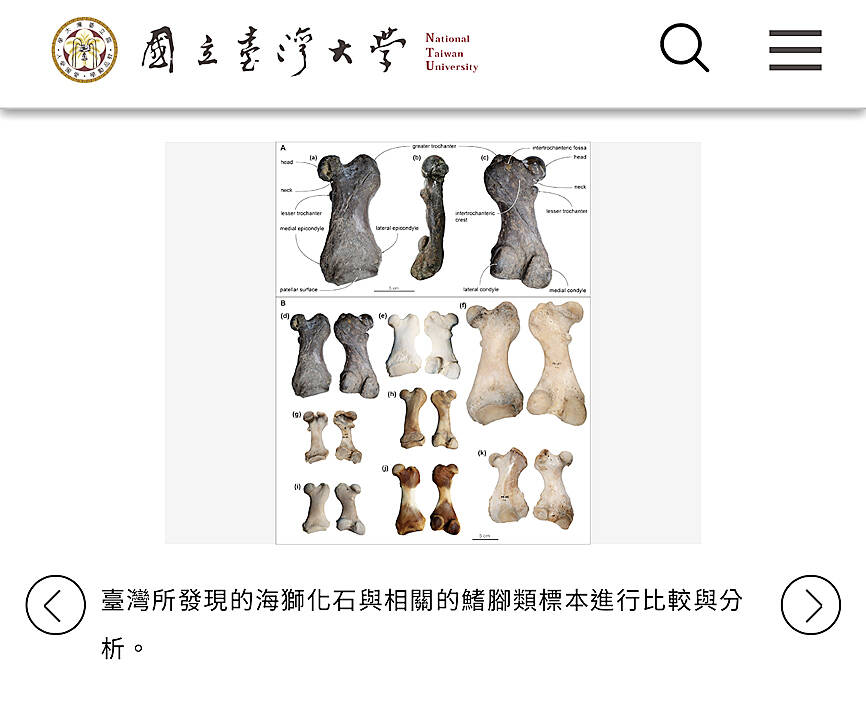
Photo: Screen grab from National Taiwan University’s Web site
The discovery fills a gap in Taiwan’s paleontological record, which already includes rich evidence of massive prehistoric whales that helped the global scientific community track evolutionary changes in whale species size, the university said.
However, fossils of seals and sea lions had not been found before in the region, even though there was no reason they would not have inhabited the west Pacific, the university said.
The Tainan Fossils and Mineral Museum provided the study with the fossil samples, which are now in the NTU collection, the university said.
The research demonstrates that maritime mammals of the pinniped clade existed in the seas surrounding Taiwan proper during the Pleistocene, and that a separate extinction event, distinct from that occurring in the Sea of Japan, had occurred, the university said.
The presence of Zalophus japonicus around Taiwan proper aligns with global fossil evidence pointing to the spread of sea lions to low-latitude regions such as the Galapagos and California, it said.
The find resolves a gap in Taiwan’s research into prehistoric seals and sea lions, and provides potential clues for explaining the Pleistocene mass extinction, Tsai said.
The study — “The Southernmost Zalophus in the Western North Pacific: The First Pinniped (Carnivora, Pinnipedia) fossil from Taiwan” — was published in the Journal of Vertebrate Paleontology on March 16.