
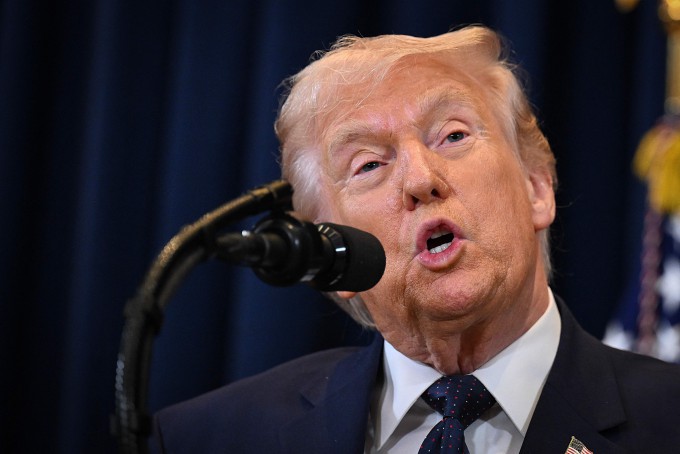
The Trump administration has proposed a plan to significantly cut the budgets of major science agencies like the NSF and EPA. AFP via Yonhap News
The U.S. Donald Trump administration has proposed deep cuts to the budgets of major science agencies for the second consecutive year. The proposal includes cuts across the fields of health, space, and the environment, including a reduction of up to 55% for the National Science Foundation (NSF) budget.
According to a report in the journal Nature on the 4th (local time), next year’s federal spending plan includes not only deep cuts to the budgets of major science agencies but also a provision prohibiting the use of federal funds for some academic journal subscription and publication fees.
Whether the cuts will actually be implemented remains uncertain, as Congress holds the authority to finalize the budget. In its budget review for 2026, Congress rejected the administration’s proposed cuts and restored a significant portion of the budget for programs targeted for elimination.
The core of the plan is to cut the budgets of research institutions in the health, space, and environmental sectors. The National Science Foundation (NSF) and the Environmental Protection Agency (EPA) would be hit hardest, with their 2027 budgets reduced by more than 50% compared to current levels. The National Institutes of Health (NIH) budget would decrease by 13%.
The budget document states that it will maintain support for quantum information and artificial intelligence research to “ensure the United States remains at the forefront of these fields.” However, according to the American Association for the Advancement of Science (AAAS), while applied research budgets for the Department of Defense and the Department of Energy would increase, the NSF’s basic research budgets for quantum and AI would be cut by 37% and 32%, respectively.
The White House plans to cut the NSF budget by about 55% to $4 billion (approximately 6.04 trillion won). The budget for social sciences and economics research departments would be entirely eliminated, and the Social, Behavioral, and Economic Sciences (SBE) directorate would be disbanded. Research funding related to administration priorities such as behavioral and cognitive sciences would be maintained, and the affected staff would be reassigned to other departments.
The budget for the National Oceanic and Atmospheric Administration’s (NOAA) Office of Oceanic and Atmospheric Research would also be entirely cut. Three of the 27 institutes and centers under the NIH—those responsible for minority health and health disparities research, international research, and alternative medicine—would be closed. The National Aeronautics and Space Administration (NASA) would see its total budget cut by 23% and its science budget by 47%, with more than 40 projects terminated.
Casey Dreier, Director of Space Policy at The Planetary Society, warned that this is an “extinction-level event for the science community,” adding, “It will be impossible for NASA to maintain its position as the world leader in space exploration.”
A provision related to publication costs also draws attention. It would prohibit the use of federal funds for expensive journal subscriptions and high publication fees unless required by federal statute or pre-approved. However, the criteria for ‘expensive’ or ‘excessively high,’ and the specific journals targeted, were not specified.
Caroline Sutton, CEO of the International Association of Scientific, Technical and Medical Publishers (STM), reacted with “bewilderment.” She criticized that now, when research integrity is challenged by AI misuse and global threats, is “the worst possible time to be cutting support for high-quality, verified scientific information.”
Elsevier, one of the world’s largest academic publishers, stated, “We already support open access models that allow anyone to read papers for free, so we can respond to this regulation without issue.”
Copyright ⓒ DongA Science. All rights reserved.