
By mid-2010s, fashion was stuck between identities. Skinny jeans still clung to the last threads of the early 2010s, yet people had begun pairing them with oversized drop-shoulder sweatshirts, platform sneakers, wide-brimmed hats, and sunglasses at dusk, as if assembling outfits from mismatched decades on instinct alone. Full-sleeve shirts hung untucked for no apparent reason; mom jeans returned only to collide with ultra-wide trousers; velvet chokers met slip dresses; and athleisure hoodies fought for space with boho lace kimonos. Instagram minimalism polished the world into identical palettes of white tees and white trainers, while streetwear surged without fully arriving, and the 90s revival sat awkwardly beside Y2K fragments that lacked vocabulary or vision. The result was a landscape without an anchor, an era borrowing from everywhere yet belonging nowhere. Fashion needed a reset, a nostalgia with direction, and a pop-culture catalyst strong enough to unify an entire generation’s visual language. The trigger arrived from a fictional Indiana town, wrapped in corduroy, windbreakers, ringer tees, and plaid. When Stranger Things landed in 2016, it did infinitely more than tell a supernatural story. It transported an unsteady, identity-seeking fashion generation into a fully formed universe, the early ’80s to early ’90s transition, built with obsessive research, meticulous sourcing, and an aesthetic clarity that real-world trends desperately lacked. The silhouettes were wider, the colours warmer, the textures tactile again. Stranger Things didn’t simply revive the ’80s; it reintroduced a fashion language rooted in character, subculture, regional realism, and emotional memory. And suddenly, ’80s fashion, something that should have been competing with the dominant Y2K revival, didn’t just trend. It took over.
The costume brain trust: How the ’80s were rebuilt stitch by stitch
The visual precision of Stranger Things comes from a costume department that treats the 1980s as an archaeological site rather than a moodboard. Across seasons, the team has remained rigorous in its methods, beginning with Kimberly Adams and Malgosia Turzanska, who established the show’s early vocabulary: catalog realism, suburban modesty, and silhouettes that accurately reflect the early years of the decade. Amy Parris’s arrival in Season 3 brought an even deeper level of research. She sifted through vintage catalogues, tracked down original deadstock, and searched thrift stores, resale warehouses, and small-town basements across the Midwest to build wardrobes that belonged to Hawkins, Indiana, rather than a generic version of the era. Fabric and construction guided every decision. The team prioritised period-correct materials, cotton jerseys with the right softness, stiff early-’80s denim, nylon windbreakers with a brittle crinkle, and polyester blends that held colour in a distinctly retro way. Reproduction fabrics rarely behaved correctly, so garments were chosen or rebuilt with the seam finishes, thread weights, zips, and buttons typical of the decade. Small details, such as collar shapes or waistband elastic, signalled the exact year being portrayed. Colour worked as an unobtrusive timeline. The children’s wardrobes focused on dusty primaries and sun-worn tones, Adults drifted toward browns, olives, burgundies, and practical neutrals that echoed middle-American wardrobes in the early ’80s. As the story moved into 1985–1986, brighter teals, purples, and neon accents appeared, reflecting how trends trickled slowly into conservative towns rather than arriving all at once. Hair and grooming followed the same rulebook. Kids had uneven fringes and soft shags that looked trimmed at home. Steve Harrington’s sculpted swoop relied on mousse and hot tools typical of the time, while Nancy Wheeler’s feathered layers echoed teen magazine trends rather than runway styling. Hopper’s beard growth, Joyce’s slightly frizzed curls, and Max’s sun-faded waves reinforced lifestyle and class rather than fashion aspiration. Everything was rooted in regional truth. Hawkins was not a style capital; wardrobes were built around limited budgets, catalogue orders, sand pieces worn repeatedly until they softened. Characters didn’t chase trends. Their clothes aged, faded, and accumulated history. That specificity made the fashion feel lived-in, not costume-y, and that’s precisely why it translated into mainstream style instead of merely nostalgic cosplay.
The fiits that became cultural currency
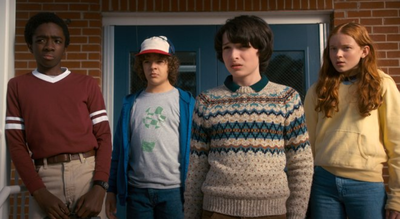
The children of Stranger Things became style references not because their wardrobes were aspirational, but because they were built with textbook Midwestern logic. The costume team sourced heavily from JCPenney, Sears, Montgomery Ward, and early L.L. Bean catalogues, giving the boys a look shaped by budgets, practicality, and hand-me-down continuity rather than by trend cycles. Mike Wheeler’s ringer tees and striped long sleeves were layered under canvas jackets and windbreakers cut slightly too big, paired with muted denim that underscored his quiet, introspective temperament. His brown corduroy jacket from Season 1, plain, functional, almost forgettable, became a coveted resale item once the series aired. Dustin Henderson’s wardrobe moved in the opposite direction. Graphic tees, novelty prints, colour-blocked parkas, and his rotation of trucker caps created a version of 1980s geek culture that blended RadioShack earnestness with a cheerful, camp-counsellor sensibility. Lucas Sinclair’s camo bandanas, sherpa-lined denim jackets, and heavy flannels leaned into rugged textures common in outdoorsy catalogue shopping, grounding him in a realism that never felt styled.Will Byers, meanwhile, lived in quilted vests, soft plaid shirts, and warm earth tones, the visual shorthand for Midwestern childhood reduced to cotton, nylon, and the quiet resilience of a boy perpetually caught between worlds. None of these pieces were designed to inspire a fashion movement. Yet as audiences drifted away from the digital polish of 2015’s homogenous feed-driven aesthetics, these lived-in silhouettes felt strangely refreshing. They reminded viewers of texture, imperfection, and clothes chosen for life instead of optics. Eleven became the show’s shape-shifting style cipher. Her early appearance, a pink Peter Pan collar dress layered under a blue windbreaker, was pulled from vintage children’s wear suppliers and intentionally styled with an awkward, almost ceremonial stiffness to emphasise her unfamiliarity with the human world. By Season 3, her wardrobe exploded into mall culture: high-waist paper-bag shorts, geometric print button-downs, saturated colours, scrunchies, and the buoyant confidence of a teenager discovering agency. Amy Parris sourced many of these pieces from private collectors and deadstock warehouses, adjusting each item to maintain period-correct silhouettes. The result was an aesthetic that moved swiftly into real life, sparking patterned shirts, cinched waists, and summer-camp palettes across both fast fashion and independent brands. Steve Harrington’s arc from self-absorbed jock to dependable hero came with its own kind of costume iconography. The Scoops Ahoy sailor uniform, worn with an earnest lack of vanity, became one of the show’s most recognisable looks, a nostalgic nod to mall-chain uniforms of the ’80s that, almost immediately, turned into a Halloween and college-fest staple. The outfit resonated because it embraced the slightly absurd theatricality of mall culture while still grounding Steve in the world of part-time jobs and food-court adolescence. Nancy Wheeler offered a different kind of style reference altogether. Her Fair Isle sweaters, pleated skirts, sherpa-lined coats, puffed sleeves, and softly feathered hair captured the subtle shift between late ’70s bohemian ease and early ’80s preppy neatness. It was a transitional wardrobe built from familiar catalogue shapes, and it quickly became a Pinterest moodboard staple because it felt both nostalgic and surprisingly wearable. Max Mayfield arrived with the skate-rat energy that had been missing from the group’s visual language. Her striped tees, hoodies, track jackets, and battered trainers carried the influence of Thrasher kids, early Vans culture, and tomboy mall brands that dominated suburban youth style. In Season 4, her palette deepened, picking up grunge-adjacent tones that mirrored her emotional weight. But one piece rose above all others online: the blue athletic sweatshirt she wears in one of the show’s most pivotal moments. Its nostalgic high collar and contrast woven tape across the chest and sleeves turned it into an instant cultural artefact, revived across fan edits, vintage searches, and independent recreations within hours of the episode’s release. Together, these characters created a style ecosystem built on specificity, regional accuracy, and lived-in wear. Their clothes were not curated to look fashionable. They were built to look real, and that realism became their power.
The revival we didn’t see coming, and why Y2K never stood a chance
Stranger Things grounded its aesthetic in the real shopping habits of 1980s America, catalog silhouettes, deadstock cottons, thrifted denim, and the kind of quietly worn pieces you’d pull from a Midwestern attic rather than a costume rail. Its designers combed Atlanta thrift stores, private vintage archives in Los Angeles and New York, and even decades-old mail-order stock to find fabrics and cuts with genuine age. Etsy and eBay sellers with rare catalog items became essential sources, supplying pieces that carried the small imperfections and softened textures modern reproductions can’t fake. That level of specificity, those boxy shoulders, elastic waists, weighty knits, kept the clothes from drifting into nostalgic cosplay, which is precisely why they slipped so effortlessly into mainstream fashion.At the same time, the cultural appetite was shifting. Y2K, though loudly resurrected, couldn’t fully take hold because it never actually felt “revival-era.” It was still too close, too present in memory and in closets, with its glossy sensibility lingering on social feeds. Add to that a chaotic moment where trend cycles spun faster than taste could settle, and the result was a fashion landscape full of micro-aesthetics with no emotional anchor. People knew they didn’t want more Y2K, but they didn’t yet know what they did want.Stranger Things answered that uncertainty with coherence, a world, a mood, a narrative. And that clarity is exactly what makes its influence feel newly relevant again in 2025.
The long tail: Why ’80s fashion still dominates in 2025
Season 5 pushes Stranger Things into late 1987, right against the early-’90s shift, and its return is already nudging the fashion cycle. The reason the aesthetic still lands in 2025 is simple: the industry never fully moved on from ’80s foundations. High-street and fast-fashion labels—from H&M and Zara to Uniqlo and Pull&Bear, continue to lean on roomy denim, power shoulders, varsity cuts, windbreakers, and bold primaries because they align neatly with today’s comfort-first silhouettes. These shapes aren’t treated as retro novelties but as reliable wardrobe architecture. In that sense, late-’80s proportions never really disappeared; they just kept evolving in the background. Season 5 doesn’t resurrect them so much as switch the lights back on. Part of that longevity comes from the world outside the show. Fashion in 2025 isn’t in the identity crisis of 2015. Consumers are savvier, tastes are more deliberate, and trend adoption is slower. Yet the landscape is full: Gorpcore now sits beside a revived workwear scene built on Carhartt jackets, softened denim, visible mending, and the deliberately scruffy “performative construction worker” aesthetic. Alongside it runs the old-money oatmeal palette, matcha-latte minimalism, and the Silverlake-meets-Midwestern emo uniform: vintage band tees tucked into 501s, beat-up Chucks, canvas totes printed with indie-bookstore logos or feminist literature quotes, often weighed down by a retro vinyl record or two, and the soft, sun-bleached ease of West Coast creatives who drift between coffee shops, writers’ rooms, and thrift stores on Sunset. Add the persistent Y2K offshoots, low-rise denim, baby tees, glossy wraparound sunglasses, and the 2025 wardrobe landscape feels crowded rather than chaotic. That’s why Stranger Things still matters. By returning with a late-’80s palette that naturally bleeds into early-’90s ease, it offers a cohesive visual world at a time when fashion is more fragmented than confused. The mainstream may once again follow its gravitational pull, even if the fashion-literate won’t be as easily swayed. The question is whether 1987’s magic can still cut through in a decade that thinks it already knows itself.