
Background
Rice cultivation plays a central role in India’s food security and rural economy, with over 51 million hectares under paddy cultivation. At the same time, flooded rice fields are a major source of methane emissions due to the anaerobic decomposition of organic matter. According to India’s Fourth Biennial Update Report, paddy cultivation emitted approximately 3.2 million tons of methane in 2020, accounting for around 23% of agricultural methane emissions, making rice cultivation an important focus area for climate action.
Methane mitigation in rice offers a rare convergence of climate, water, and livelihood benefits. Unlike carbon dioxide, methane has a relatively short atmospheric lifetime of about 12 years but a much higher warming potential (GWP20: 83; GWP100: 21). This means that rapid reductions can significantly slow near-term warming, complementing longer-term decarbonization efforts.
This work builds on CPI’s engagement under Mobilizing Sustainable Finance for Methane Abatement in India (MASFMA), an initiative supported by the Global Methane Hub (GMH). Within the broader MASFMA program, India’s workstream was expected to focus primarily on agriculture-related methane emissions from inundated rice cultivation and livestock.
To address these gaps, we conducted extensive stakeholder consultations across rice cultivation and livestock systems, complemented by an expert survey and a review of existing literature. These insights are being used to develop a white paper “Transforming Paddy Cultivation: Sustainable Solutions for Methane Reduction in India,” which will present an evidence-based overview of mitigation pathways, implementation barriers, and financing challenges.
Existing evidence suggests that sustainable rice cultivation practices can significantly reduce methane emissions while delivering co-benefits such as water savings, cost reductions, and productivity gains. For example, direct-seeded rice (DSR), under certain conditions, have been found to reduce methane emissions by up to 40% while lowering irrigation demand and cultivation costs. Alternate wetting and drying (AWD) can reduce emissions by 30-70%, depending on soil and water conditions, while the system of rice intensification (SRI) has demonstrated improved yields alongside reduced water and seed use in several pilot settings.
Despite this strong technical potential, large-scale adoption remains limited. Field-level transitions are constrained by behavioral inertia, perceptions of income risk, delayed subsidy delivery, limited technical capacity, and the absence of methane-specific financial incentives. Stakeholder consultations indicate that the challenge is not only technological readiness but also misalignment between finance, policy incentives, and implementation capacity.
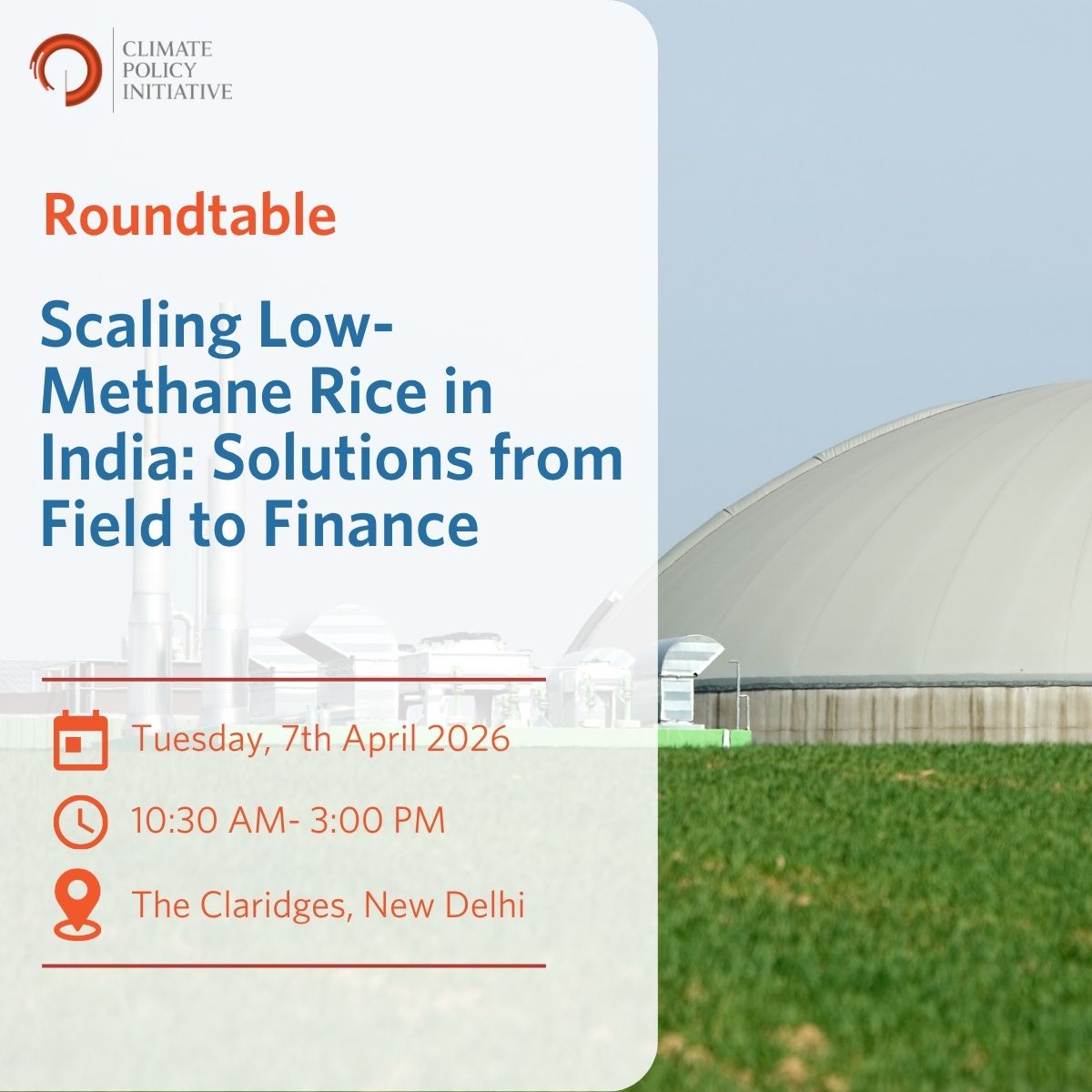
Building on this work, we are convening a closed-door roundtable on methane mitigation pathways in sustainable rice cultivation on 7 April 2026. The discussion will bring together policymakers, financial institutions, technical experts, civil society organizations, and implementation partners to explore financing gaps, MRV readiness, and institutional pathways required to scale methane mitigation in rice. Insights from the discussion will complement the learnings emerging out of the stakeholder discussions and the survey and will be integrated into the white paper.
Objective
This roundtable aims to move the conversation on methane mitigation in rice cultivation from intent to implementation. It will bring together key stakeholders to identify the real barriers to scaling, explore financing approaches suited for smallholder farmers, and clarify what credible monitoring, reporting and verification (MRV) systems should look like from a policy and lender perspective. The discussion will also examine how existing agricultural schemes can better integrate methane outcomes and align practical priorities for the next phase of action.