
Materials scientists say they’ve taken nearly 300-year-old toxic waste—a stockpile of spherical lead bullets from the 16th and 17th centuries, tainted with carbon residue, metal impurities, and the dull patina of oxidization—and transformed it into a critical component for solar panels.
And not just any solar panels, but perovskite solar panels: one of the most cost-effective and energy-efficient forms of solar power on the market today.
Researchers with Germany’s Jülich Research Centre in Erlangen said their new technique “upcycles” highly contaminated lead bullets into high-purity, commercial-grade lead iodide, a compound needed in bulk to manufacture the best of these perovskite solar cells. The team’s results produced solar panels capable of converting sunlight into electricity at a competitive 21% efficiency. For context, topline perovskite solar cells made with more pristine starting ingredients currently harvest energy at just a little bit over 27% efficiency.
“Perovskite solar cells rely on high-purity lead iodide,” physicist and study coauthor Ian Marius Peters, said in a post on LinkedIn sharing the study, “but lead is both toxic and resource-intensive to mine and refine.”
“Millions of tons of lead already exist in waste streams that remain underutilized,” Peters added. “This work shows that toxic legacy waste can become a resource for clean energy.”
Get the lead out
Peters and his colleagues selected this pile of time-ravaged ammunition from Renaissance-era muskets and arquebuses primarily as a proof of concept for their new method. According to their new study, published this March in the journal Cell Reports Physical Science, they bought the “musket-ball fragments” (like you would, probably) from someone on eBay. The bullets, they wrote, were intentionally chosen as “an exceptionally challenging model feedstock” for manufacturing high-purity lead iodide. They did this, in other words, expressly to prove that their process would work even on really dirty old lead filled with chemical impurities.
Their upcycling method has two essential steps. First, two electrodes made out of the smelted and reshaped lead bullets were dipped into a mixture of acetonitrile solvent and dissolved iodine with an electrical current coursing through this liquid bath. The process, according to the team, produced lead iodide at remarkably high purity. The team also noted that this new method had ecological benefits too, limiting chemical use and producing less lead-contaminated wastewater.
In the second step, this mustard yellow and highly pure lead iodide powder was then used to grow perovskite crystals via a technique known as inverse-temperature crystallization—which uses heat, rather than cold, to induce the right formation of molecules and crystalline shapes.
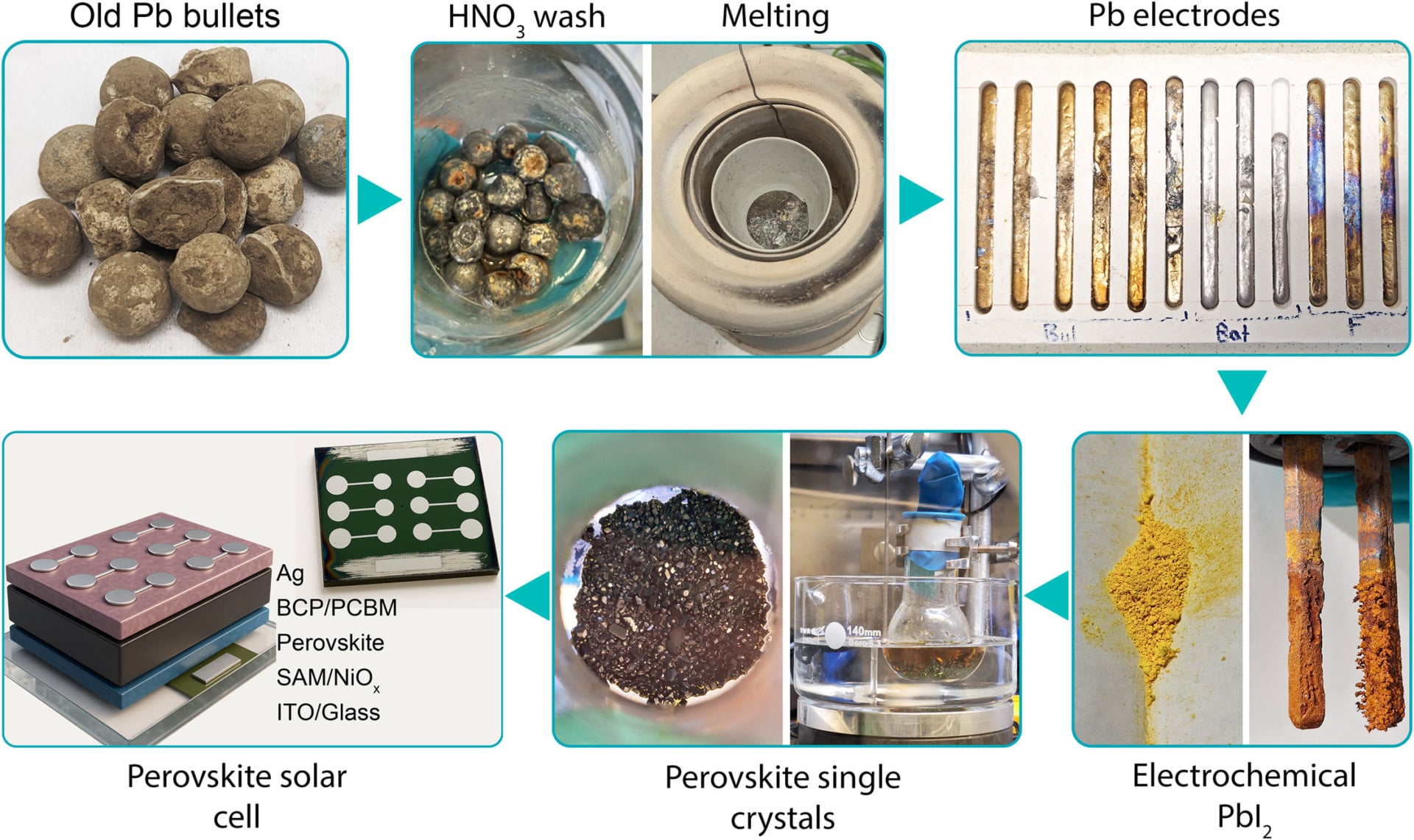
According to Peters, this low-cost refinement method yielded perovskite solar cells that were “statistically indistinguishable from devices made with commercial 5N precursors.” (5N here is industry jargon for a material with 99.999% purity. If you can believe it, and I will admit that I’m having trouble myself, 5N is short for “five nines.”)
Closing the loop
The researchers said that they pursued this project as a means of capturing the “estimated 30%–40% of lead waste” that is effectively abandoned at the end of its industrial life cycle. An entirely new system, akin to the efficient recycling of lead-acid car batteries, would be needed to help boost production of perovskite solar cells (PSCs).
“Sustainable lead sourcing is imperative for scaling PSCs,” the authors wrote.
Perovskites are a broad category of solar cells—and they don’t necessarily need lead in their crystalline structure to function—but it has been these lead-based versions that have proven to be the most efficient at converting sunlight into electricity.
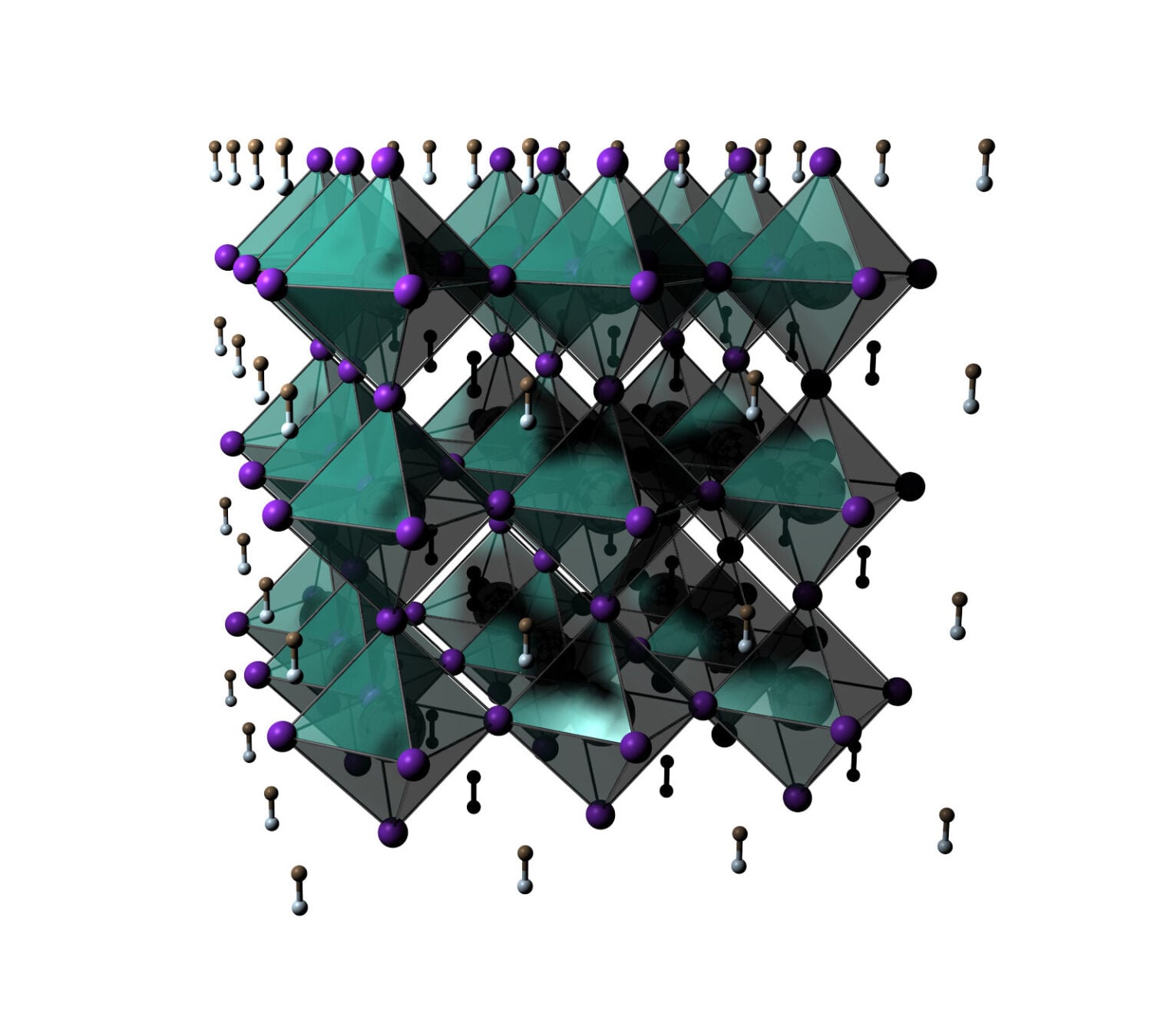
“Consistently over time, the lead-based devices continue to improve in their performance,” Tonio Buonassisi, director of MIT’s Photovoltaics Research Laboratory, told MIT News in 2022, “none of the other compositions got close in terms of electronic performance.”
According to Buonassisi, lead halide perovskites solar cells have been the primary focus for perovskite researchers for over a decade. Among the material’s many benefits over traditional silicon-based solar panels, perovskites can be easily woven into fabric-like solar cells, made of incredibly lightweight and flexible polymer materials. Perovskites can be blended to make hybrid perovskite-silicon solar panels too, where they have achieved impressive 36% efficiencies, greater than either alone.
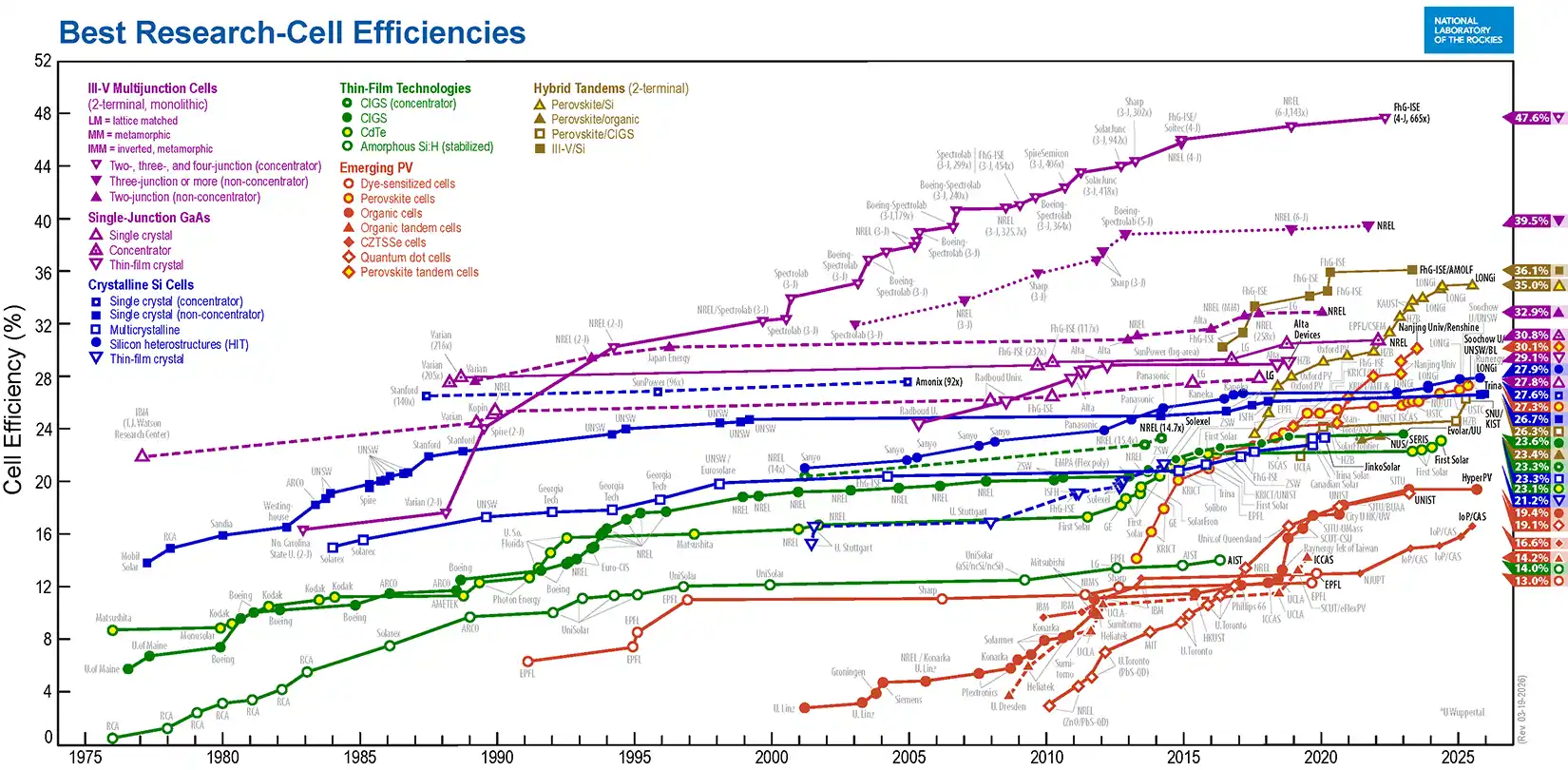
“You can mix and match atoms and molecules into the structure,” Buonassisi noted. “Perovskites are highly tunable, like a build-your-own-adventure type of crystal structure.”