
The decision is part of a broader restructuring of the university’s 460 academic programs, according to an April 1 letter sent to faculty and students.
Lois Agnew, Vice Chancellor, Provost, and Chief Academic Officer, stated in the letter that the move aims to create a university model that is “more focused, more distinctive and more aligned with student demand.”
The university, ranked among the top 75 universities in the U.S. according to the 2026 U.S. News & World Report rankings, noted a significant imbalance in its academic offerings, reporting that a small core of 34% of programs drives 80% of all student enrollments. Conversely, the remaining two-thirds of programs account for only 20% of the student body.
Of the 93 programs slated for closure or suspension, 55 currently have no enrolled students, and 28 are advanced certificate programs.
 |
|
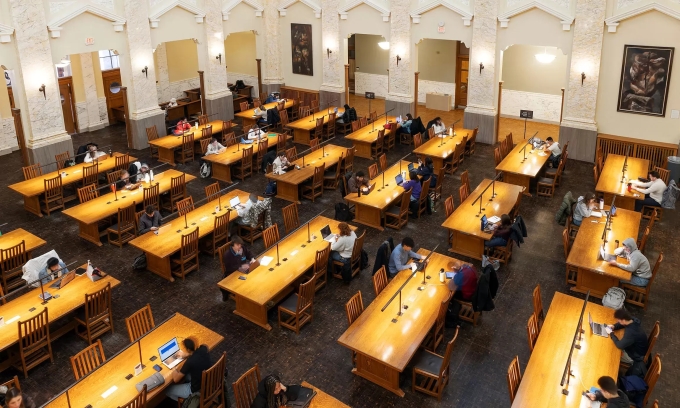
The Carnegie Library at Syracuse University. Photo courtesy of the university |
University spokesperson Sarah Scalese noted that out of more than 20,000 students at Syracuse, the cuts will impact only 258 individuals, representing roughly 1.2% of the total student population.
Addressing the impacted students, the university stated, “Every student currently enrolled in an affected program will have the opportunity to complete their degree. Some will do so this spring.”
Agnew also wrote that she wanted “to emphasize this was not a cost-cutting exercise, and it was not aimed at eliminating departments or people,” adding that “no positions have been identified for elimination.”
While the full list of cuts has not been officially released, university data indicates that many of the affected programs are in the humanities and arts.
According to Forbes, this includes undergraduate degrees in classics, fine arts, several foreign languages, painting, music composition, and music performance. For example, undergraduate degrees in Classical Civilization, German, Italian, Middle Eastern Studies, and Modern Jewish Studies will no longer be offered.
Students will also no longer be able to major separately in Ceramics, Jewelry and Metalsmithing, Sculpture, or Painting. Instead, these disciplines will be consolidated under a single Bachelor of Fine Arts (BFA) degree.
“Maintaining twice as many academic programs as peer institutions is not a sign of strength — it shows we were slow to reassess our situation,” Scalese told The New York Times.
However, the plan has sparked opposition from faculty members, many of whom fear that shrinking humanities programs will erode the university’s identity and intellectual diversity. Herb Ruffin, an associate professor of African American Studies, told The Times that social sciences are increasingly being treated merely as general education courses. He described the arts and sciences faculty as being in a state of revolt, noting that they are deeply unhappy with the current situation.
The restructuring comes as Syracuse faces financial challenges, largely due to a sharp decline in international students who typically pay full tuition. The share of new international students has dropped from 12% to 5% over the past two years, heavily driven by visa barriers.
Syracuse’s move reflects a broader trend across U.S. higher education. Universities nationwide are shifting their focus to align with a growing student preference for degrees that offer clear, high-paying career paths. According to an American Enterprise Institute analysis released last September, this trend has led administrators to scale back humanities programs in response to changing market demands.
Just last month, the University of North Texas announced it would close or consolidate 85 academic programs as it tries to reduce a projected $45 million budget deficit. That decision follows actions at dozens of other major universities to pare down their academic offerings and limit admissions in select graduate programs.
Montclair State University recently closed 15 humanities and social science programs, while the University of North Carolina is planning to shut down six geography research centers.
Similarly, the University of Chicago stopped admitting PhD students in nearly all humanities fields last year.
Labor market data underscores this shift.
According to the National Association of Colleges and Employers, social science graduates are expected to earn an average starting salary of $66,200 this year, down nearly 2% from last year, marking the only category to experience a decline.
Computer science graduates should expect a starting salary of $81,500, up 7% from 2025, making it the highest among surveyed majors.
Finance graduates are the most sought-after, with demand exceeding 60%.