
Feel like there is something unique missing from your accessories collection? A handbag made from lab-grown T-Rex leather was unveiled at Art Zoo Museum in Amsterdam last week, displayed alongside a life-sized Tyrannosaurus rex.

Scientists, creatives, and designers collaborated to create the material using reconstructed dinosaur collagen without harming animals.
advertisement

The material follows the 2025 announcement to create T-Rex leather by VML, The Organoid Company, and Lab-Grown Leather Ltd., a group company of BSF Enterprise PLC. The companies have been developing the material for future availability to luxury brands.

A one-of-a-kind handbag was designed by Enfin Levé. Founded by Polish designer Michal Hadas, the label creates garments and accessories for men and women.
advertisement

The exhibition will run for six weeks at Art Zoo Museum. After the exhibition, the handbag will be auctioned and sold to the highest bidder.
T-Rex leather is the outcome of a unique scientific collaboration between VML, The Organoid Company and Lab-Grown Leather Ltd., created to demonstrate that the future of luxury leather need not rely on animals being killed for their hides.
T-Rex leather was developed through collaboration between VML, The Organoid Company and Lab-Grown Leather Ltd. The process began with fossilized T.rex collagen sequences. Using computational biology and AI modelling, scientists reconstructed genetic information to form a collagen blueprint. Synthesized DNA was inserted into a carrier cell line, and engineered cells were cultivated using Lab-Grown Leather’s Advanced Tissue Engineering Platform and integrated into its Elemental-X product stream.
The scaffold-free approach allows cells to create their own structure, resulting in a material structurally identical to leather. The material is described as durable, repairable, biodegradable and traceable, and produced without animal slaughter, deforestation or chromium-heavy tanning processes.
Enfin Levé used the material to create the handbag. T-Rex leather will continue to be produced and made available to brands and designers. Initial applications will focus on luxury accessories, with plans to extend into fashion, automotive and other material sectors.
“Our proprietary advanced tissue engineering platform has once again proven its versatility,” said Professor Che Connon, Lab-Grown Leather.
“By collaborating with VML and The Organoid Company, we’re unlocking the potential to engineer leather from prehistoric species, starting with the formidable T-Rex. This venture showcases the power of cell-based technology to create materials that are both innovative and ethically sound.”
Thomas Mitchell, CEO of The Organoid Company, added: “This project demonstrates how genome and protein engineering can create entirely new classes of biomaterials. By reconstructing and optimizing ancient protein sequences, we’ve designed T-Rex leather inspired by prehistoric biology and cloned it into a custom-engineered cell line. It’s a bold example of synthetic biology extending beyond medicine into sustainable material innovation.”
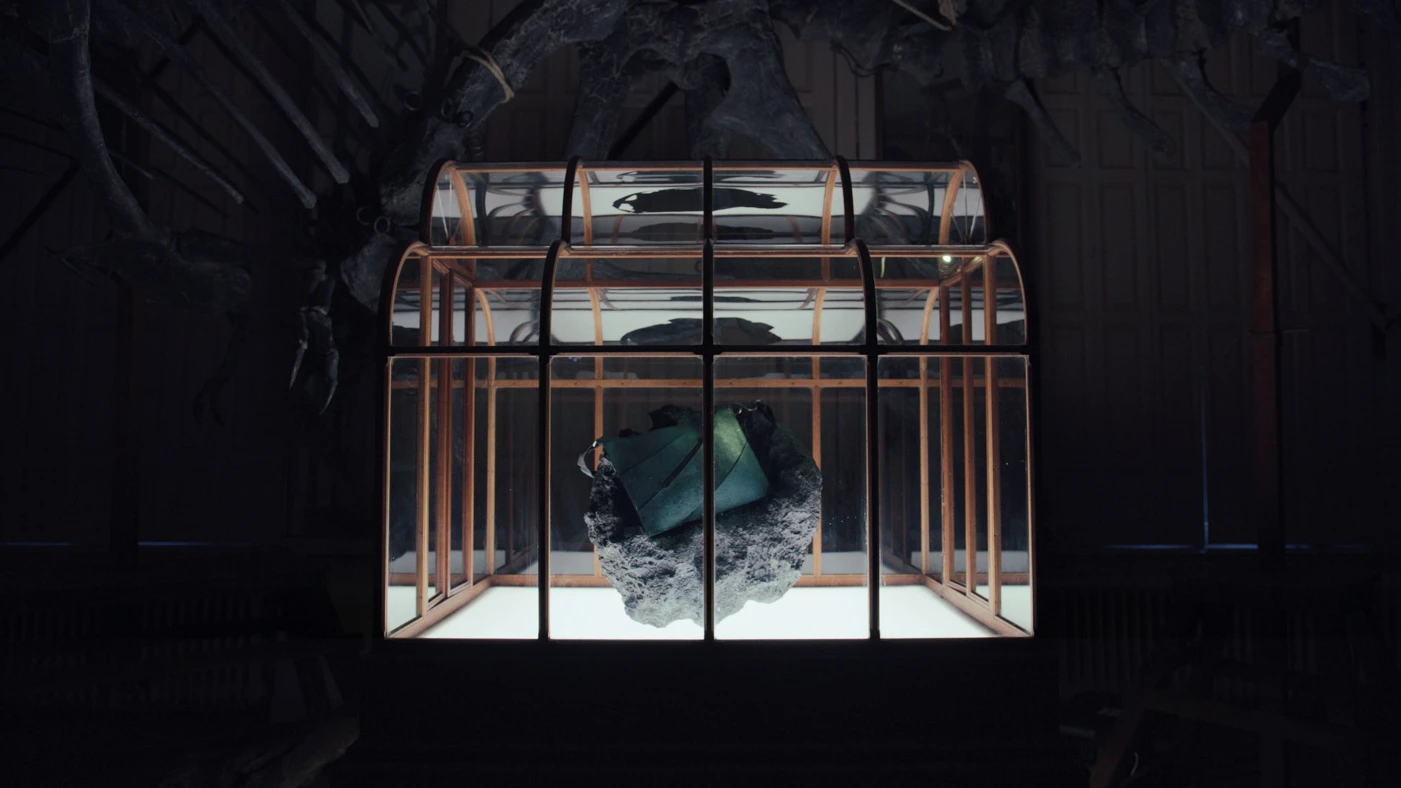
“With T-Rex leather we’re harnessing the biology of the past to create the luxury materials of the future. The stark reality is that lab-grown leather hasn’t yet convinced the luxury world,” said Bas Korsten, Global Chief Creative Officer, Innovation & CCO EMEA at VML.
“Why? Because it feels like an imitation. We knew we had to do something radically different. Not a substitute, but something entirely new. So we went back 66 million years in time. The result is a material that doesn’t copy the past but reimagines it. Seeing it realised as a luxury object is a powerful milestone in shaping a new category of sustainable luxury.”

Michal Hadas, Founder and Lead Designer at Enfin Levé, said: “Enfin Levé has always designed through material behaviour and construction logic. With T-Rex leather, the goal wasn’t to impose a conventional luxury object, but to understand how it behaves – where it resists, how it holds tension, and how that could shape the design. It has a distinct character and responds unlike any leather we’ve worked with. The final bag follows that logic, letting the material define the object rather than forcing it into familiar codes of luxury.”