
Last month, climate scientist and author Kate Marvel resigned from her position at NASA’s Goddard Institute for Space Studies, where she had spent more than a decade studying a warming world. In her resignation letter, she cited the Trump administration’s attacks on the field.
“I anticipated that our work would be questioned,” she wrote, “but only because its implications were politically inconvenient. I never expected that science itself would come under attack.”
Marvel joins more than 10,000 professionals with doctoral degrees in the sciences who have left the federal workforce since President Trump took office in January 2025: a period that has seen the administration evict the Goddard Institute from its historic home on the Columbia University campus, dissolve the U.S. Global Change Research Program, dismiss the nearly 400 authors of the next National Climate Assessment, and repeal the legal foundation for federal regulation of greenhouse gases.
Grist spoke with Marvel about what she left behind, who fills the vacuum, and why spite might be the most underrated climate emotion.
Q. Your resignation letter says, “I’m leaving because I want to tell the truth.” What truth couldn’t you tell inside NASA that you can tell now? Are we talking about a distinction between scientific truth-telling and political speech?
A. I think it was scientific truth-telling. I’m not claiming to be some sort of apolitical creature of pure light who has no opinions or values. I’m a human being; of course I have political opinions. But I also feel like nobody cares about my political opinions because I don’t have any particular expertise. I can complain about the administration, but so what? There are tons of people who can complain more eloquently or with a more informed perspective than me.
I didn’t leave because I wanted to complain about politics. I left because we were not supposed to talk to the press about our science. If that’s the case, then what is the point of NASA? What is the point of studying the world and finding out things if you can’t then tell the public what you found? That was very frustrating for me.
Q. You told Scientific American that there was no single push over the edge in terms of leaving NASA. But I’m curious about how you think about that decision. In some sense, you study feedback loops for a living. Did the departures of other scientists make it easier or harder for you to leave? And does that dynamic worry you?
A. I thought really hard about this exit–voice–loyalty framework: How do you do the most good when the organization you’re part of is doing something wrong? I think it really depends on what your role in the organization is. There are people in NASA who absolutely are most effective when they stay: people who have supervisory responsibilities; people who understand the intricacies of budgets and political appointments. If I had had one of those roles, I would have stayed, and I think that would have been the right choice.
But my role was to do research. I wanted to do research on the Earth as a whole. And it’s not our fault that when we study the Earth, we see it changing, right? Climate change is this big deal that’s happening to the planet that we study. I came to the conclusion that the right path for me was to try to do the research in an environment where I could do it and I could talk about it.
“There is quite a lot of self-censorship. A lot of, ‘This proposal is definitely not going to be funded if I say the C-word in it.’”
Q. Something like 10,000 STEM PhDs have left the federal workforce over the last year, to say nothing of the dissolution of the U.S. Global Change Research Program and the dismantling of the National Climate Assessment. With respect to the people who are still there: Can you share whether the work is being censored? Are people self-censoring? What does a federal climate scientist’s day actually look like right now?
A. Well, that’s one of the problems: I don’t really know, because we were evicted from our building. We are no longer all working together. We no longer have space to exchange ideas. I don’t know what the vast majority of my colleagues were doing, because I would only see them on a Zoom call a couple times a week.
I think people were trying to continue to do their work. But because there was no clear guidance about what we should be doing, it was basically: You pick something that you think needs to be done and you just do it. And there’s no coherence to that.
There is quite a lot of self-censorship. A lot of, “This proposal is definitely not going to be funded if I say the C-word in it.” There was a whole bunch of unbelievable verbal gymnastics; people deploying phrases like “multi-decadal Earth system predictability” or whatever. And this happened in the first Trump term, too.
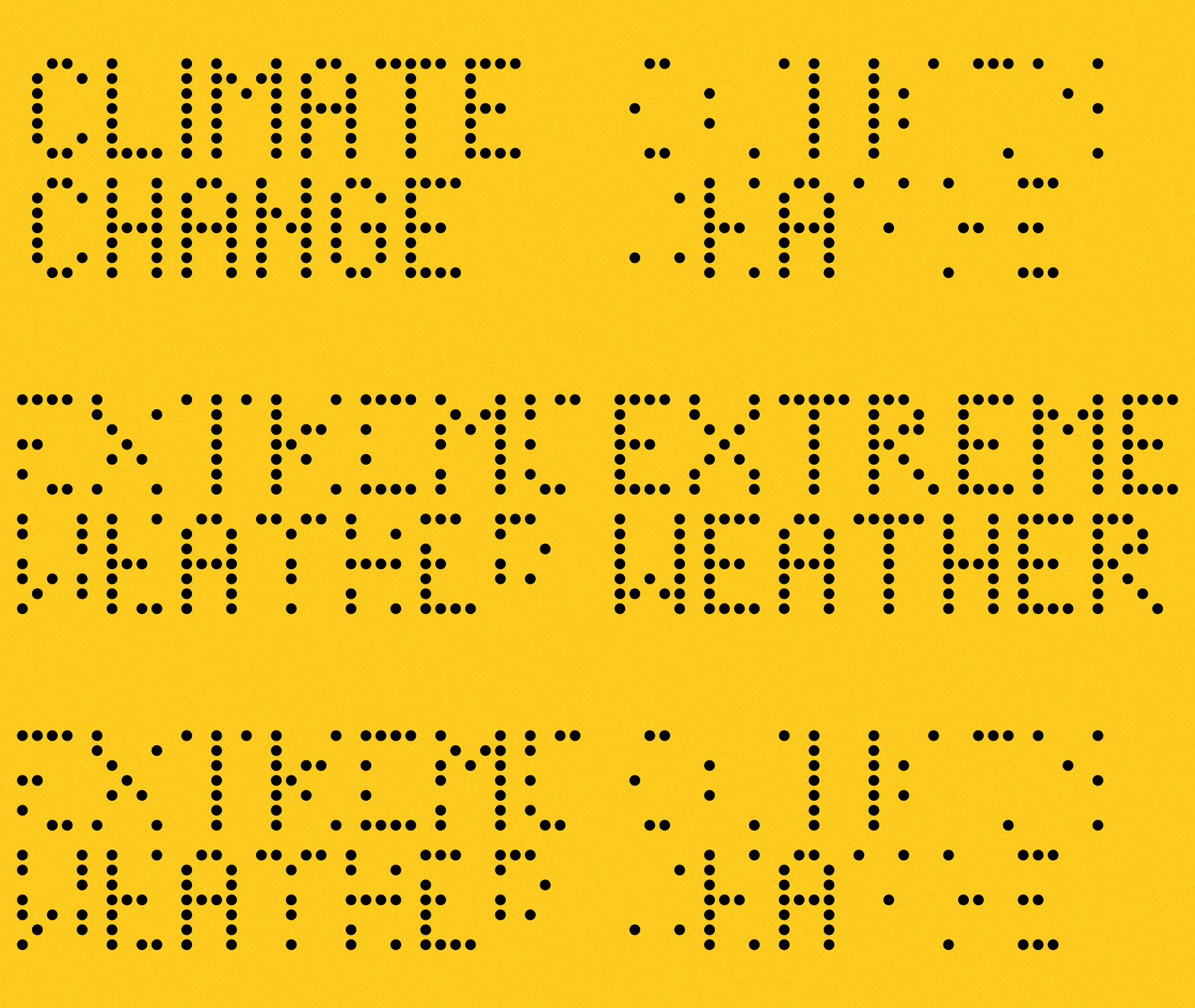
Q. Some colleagues and I just published an analysis of the National Science Foundation grants database as a means of illustrating how researchers are describing their work these days. You basically see phrases like “climate change,” “global warming” — all the standard descriptors — drop off a cliff as of 2025, and then substitution phrases like “extreme weather” spike by 60 or 70 percent.
A. Yeah. And the thing is, the Earth has very much changed and continues to change. It’s not like the physics of greenhouse gases are like, “Oh, there’s a new administration — we’re just going to work in totally different ways.” That’s not how it happens.
I actually think my colleagues were and are extremely careful about not getting out over their skis. You don’t have a lot of NASA researchers going out there and saying, “Here’s the policy I’d like to see,” while wearing their NASA hat. Nobody was doing that. People were saying, “Here is what the physics says we should expect in the future if emissions continue to climb or don’t zero out.” The implications of the situation are inconvenient. And I actually think reasonable people can differ on the right policy response. But the administration wasn’t going after a policy response. It was going after the underlying reality itself.
Q. And now the U.S. has withdrawn from basically every multilateral attempt at addressing that reality: the United Nations Framework Convention on Climate Change, the Paris Agreement, the Intergovernmental Panel on Climate Change. Yet climate modeling is a global enterprise. It requires global data, global validation, global cooperation. What does it mean for the science when the country that built most of these modeling centers cuts itself off from the international infrastructure that makes the models work?
A. It’s not great. Because physics is universal, and other countries have physicists, the work will continue. People will continue to understand the Earth, continue to understand what it means. But to lose this leadership — to lose the ability to really shape the narrative, to guide the research, to be major players — is just short-sighted and really silly.
For so long, the U.S. has really punched above our weight population-wise. We’ve had the most well-funded science program. We’ve been able to attract the smartest people from all over the world. We’ve been able to be stable and say, “Here are the institutions that we have that can plan ahead and do big, exciting, amazing things.” And now we’re losing all of that. Maybe some other country will pick up the slack. But then disproportionate benefits will accrue to that country as opposed to us.
“You want to get the science out there for everybody to use. Because your salary is not dependent on selling something.”
Q. So who fills the vacuum? When our trusted public institutions can’t do this work, who does? Should we be worried about whose models end up informing those decisions?
A. I think we should 100 percent be totally freaked out about that. When you’ve got publicly funded science, the motivations are completely different. You want to write papers that are good, that your colleagues think are good, that get lots of citations. You want to structure your proposed research so that the peer reviewers are going to think: This is feasible, and if it works, it’s going to teach us a lot. You want to get the science out there for everybody to use. Because your salary is not dependent on selling something, you just have very different incentives.
Q. I saw you had a grant proposal to model the effects of solar radiation management on plant growth; not to advocate for geoengineering, but to generate evidence that policymakers would need to understand the landscape. And the proposal went nowhere. Meanwhile, private actors and other governments are moving forward on geoengineering research with arguably far less transparency.
A. If we leave these questions to the private sector, there are just very different incentives and motivations. We’re talking about whether we should deliberately block the sun to modify the climate. That is an incredibly big and scary question! Having a trusted arbiter — somebody saying, “Look, we’re not taking a position on this whatsoever, but here’s what the science says” — that’s incredibly valuable. And I’m really worried that we’re losing that.
Q. As I understand it, your recent work has been on carbon-cycle feedback. That’s arguably one of the most consequential unknowns in all of climate science. Can you help me understand what’s at stake?
A. It’s important to draw a distinction between two kinds of feedback. Physical climate feedbacks are about what happens to the planet for a given level of carbon dioxide in the atmosphere. Clouds changing, ice melting, more water vapor; those are relatively well understood. But there’s a deeper question: Of the carbon dioxide that human beings emit, how much of it actually stays in the atmosphere to drive those changes? That’s carbon-cycle feedback.
Right now, the biosphere is great. It’s taking out about half of human-emitted carbon dioxide. Which is awesome! Thank you, plants. Thank you, trees. Thank you, plankton. But there’s no guarantee that’s going to continue into the future, because it’s incredibly hard to take carbon dioxide out of the atmosphere when you’re on fire.
Understanding how much of any given future ton of emissions is going to hang around in the atmosphere is really important. And it’s something we really don’t know very well, because it’s a merging of so many different areas of science. You’re asking, “What does an individual plant do? What does a plant growing in a forest ecosystem do? How does that feed back onto local weather? How does that feed back onto global climate change?” You need expertise in plant biology, ecology, meteorology, climate science. It’s a very thorny question, and it’s one that we’re not going to be able to solve without teams of people.
Q. And meanwhile, those teams of people are shrinking. In fact, one of the things that haunts me is that the organ we use to do the research, the human brain, is itself being altered by the phenomenon under study. Heat degrades working memory and executive function. Chronic stress reshapes the hippocampus. Wildfire smoke exposure has neuroinflammatory effects. You yourself have written about running world-ending simulations and the emotional weight of that work. Do you ever think about whether the conditions of doing climate science in 2026 are affecting the quality of the science itself?
A. Oh, 100 percent. People are like, “What are we doing?” If nobody is going to listen to us, if we’re just going to be the scientist in disaster movies who exists to be ignored and then gets killed in the first big set piece, what are we doing here?
There is a lot of frustration. A lot of, “It’s not our fault that this is politicized!” We just told you what was happening and then everybody got mad at us. If you read that New York Times article on my resignation, some guy I’ve never met who’s calling me “Kate” — I guess we’re on first-name terms, guy I’ve never met — he’s saying it’s all the scientists’ fault. I don’t think it is, man. And to be blamed for as much just feels bad.
We are trained to be introspective. We are trained to always think: Oh my gosh, that’s a mistake; can I fix this mistake? But that means we also probably waste a lot of mental energy thinking, “What did we do wrong?” when maybe we didn’t do anything that wrong.
“I don’t think we solve this without getting mad. I don’t think we rebuild science without getting mad.”
Q. Your book, Human Nature: Nine Ways to Feel About Our Changing Planet, is organized around some of these feelings. You argue that climate scientists are allowed to have feelings about the planet they study and that perhaps the rest of us should, too. That’s the opposite of a norm in science that says feelings are noise as opposed to signal. How do you think about the relationship between emotional honesty and scientific credibility?
A. The book came out at a weird time. Look who’s in charge. Look how they act. I don’t ever want anybody to call me emotional ever again. If you look at how these guys are acting, nobody should ever have imposter syndrome ever again.
For me, there is no contrast, no tension, between being a human being and being open about your values and emotions and what you would like to see in the world, and at the same time, getting the math right. I think it’s lying when we pretend that we are perfectly objective and unhuman. We’re not. But at the same time, we do have a responsibility to look at the data, to change our minds where necessary, and to get the numbers right.
I have historically struggled a lot with anger. I don’t let myself feel angry. It feels bad. It’s my least favorite emotion. But I don’t think we solve this without getting mad. I don’t think we rebuild science without getting mad.
Look, I think spite is actually a great motivation to not give up. You look at who wants you to despair, who wants you to say, “Well, we’re going to take the L on this one.” Look at those people. Do you like those people? Do you want to make those people happy? Absolutely not.
Oh, you want me to despair? Fuck you.
That is an emotional response! The decision to not give up, to keep doing your work, to keep speaking out, to keep fighting, to really make sure that the pendulum swings back and swings back hard. You need an emotional, human reason to do that. It’s not enough just to say, “Well, the objective science says that this is the proper course of action.” You have to actually deeply believe it.
Q. What would you tell early-career climate scientists right now who are trying to figure out whether there’s a future for them in this field in the United States? And what does the scientific community owe the people who stayed inside the federal government?
A. If you left the federal government, thank you. If you stayed in the federal government, thank you. If you are an early-career scientist trying to hang on, thank you. If you are an early-career scientist who’s like, “My talents are wasted here, I’m going to do something else useful,” thank you. There is no one proper course of action here. It’s chaos. We all have to navigate these turbulencies as well as possible. If you found a lifeboat, take it. If you’re trying to rebuild the ship, great. Let’s all help each other to the extent that we can.
The early-career thing is really the most depressing and enraging aspect of this whole mess. Look, I’ll be fine. I shoot my mouth off all the time. I have other things to do. But it’s the early-career people. It’s the undergrads who aren’t going to go to grad school now. It’s the grad students who aren’t going to get postdocs. The postdocs who aren’t going to get permanent jobs. That sucks, and it’s just not acceptable. People like me who are a little more senior really have to listen. How do we make sure that we can continue? How do we make sure that we can rebuild? And how do we make sure that when we rebuild, it is better; that the people coming in are going to have a better, more productive experience than we did?
Q. You’re a climate modeler. Most climate modelers I know aren’t particularly optimistic. What does your crystal ball say about the state of climate science ten years from now?
A. People are mad. You’ve taken people who would have happily hung out in their offices or their labs and never engaged and never done anything other than publish papers that maybe twelve people in the world read. You’ve taken this big mass of nerds and you’ve pissed them off. And then you’ve pissed off more than the nerds. I think there really is this groundswell of: “No, you will not let you get away with this. We will not let you destroy this.” So it will not be destroyed.
In terms of optimism: What is the other option? Is it giving up? Yes, Mr. Trump, you’ve won; yes, Mr. Vought, Project 2025 was a great idea all along? I don’t want to do that. I can’t do that. I think we’re better than that.
This conversation has been edited for length and clarity.