
The latest Nebraska Snapshot from the University of Nebraska–Lincoln’s Bureau of Sociological Research shows a decline in Nebraskans’ overall financial satisfaction since 2020, and for some, more difficulty paying bills.
The Nebraska Snapshot is developed from data gathered from the Nebraska Annual Social Indicators Survey, a survey of Nebraska adults.
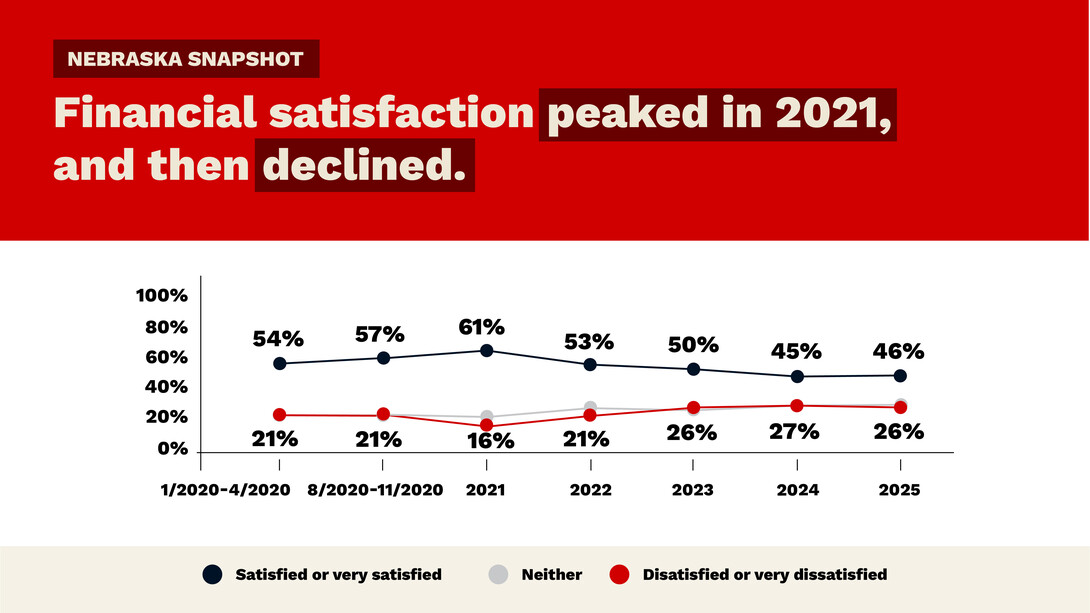
Despite the COVID-19 pandemic causing economic uncertainty, financial satisfaction among respondents was higher in 2020 and 2021 than the following years, possibly due to stimulus payments, enhanced business protections and child tax credits provided by Congressional relief efforts.
In 2025 NASIS survey responses, less than half of adults (46%) said they were satisfied or very satisfied, down from 61% in 2021 and 54% in 2020, while the share who said they were dissatisfied or very dissatisfied rose from 21% in 2020 and 2021 to 26% in 2025.
Similarly, more Nebraskans are reporting difficulty paying their bills in 2025, compared to 2020 and 2021. Half of Nebraskans surveyed in 2025 said they have no difficulty at all, but 29% reported a great deal, quite a bit or some difficulty, and 21% reported having a little difficulty paying bills. In 2021, only 18% responded they had a great deal, quite a bit or some difficulty paying their bills.
Nebraskans’ responses are in line with national trends. Analytics firms Gallup and Ipsos recently reported that 51% of Americans feel comfortable with their economic situation, but a majority — 62% — believe the economy is getting worse.
The largest disparities in financial comfort in 2025 among Nebraskans existed along age, educational and racial demographics.
Only 33% of respondents ages 19 to 44 reported being satisfied with their financial situation, compared with 49% of those ages 45 to 64 and 59% of Nebraskans 65 and older. Younger adults were also more likely to struggle financially: Only 36% of respondents ages 19 to 44 reported no difficulty paying bills, while nearly two-thirds (64%) of those 65 and up reported no difficulty.
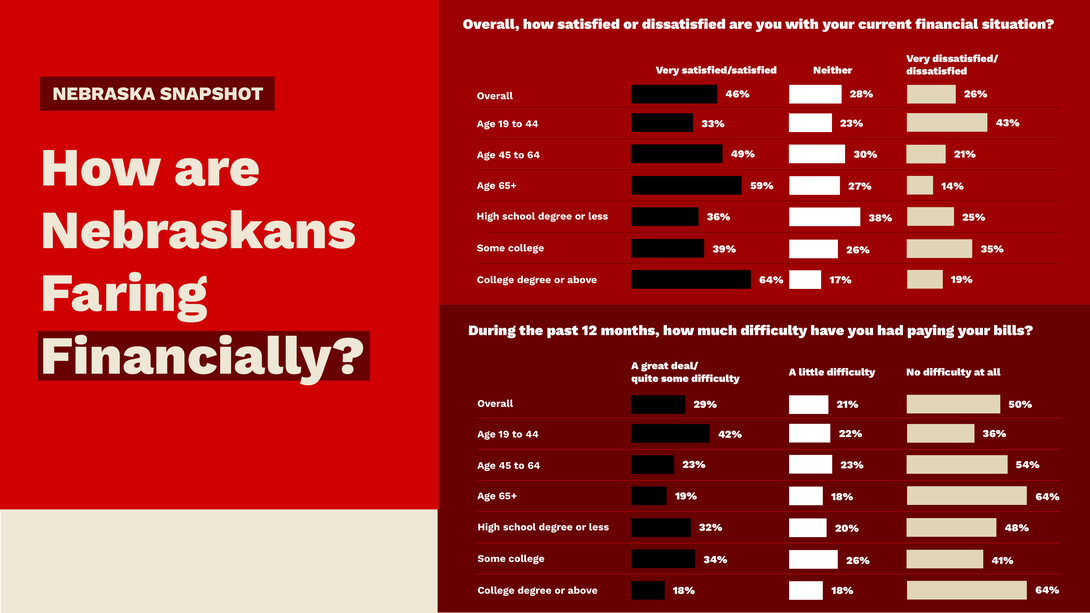
Education showed a similar divide. A little more than a third of respondents with a high school diploma or less reported financial satisfaction, compared with 64% of those with a college degree or higher. Those without a four-year degree were also significantly more likely to report difficulty paying bills.
People of color reported lower financial satisfaction and greater difficulty paying bills than white respondents. About 27% said they were satisfied or very satisfied with their financial situation, compared with 48% of white respondents. In addition, 69% of people of color reported at least a little difficulty paying bills, compared with 48% of white respondents.
Slight differences were found between men and women, too. Women had more difficulty than men paying their bills, with 33% of women reporting some to a great deal of difficulty and 23% of men reporting the same.
NASIS is used by researchers, state entities and policymakers, but also includes a core questionnaire that delves into demographics, quality of life measures, educational attainment and community satisfaction, among other variables. These core questions inform the Nebraska Snapshot series. Previous topics covered by Nebraska Snapshots included internet access, finances and how Nebraskans feel about their health.
All Nebraska Snapshots are available online. To include research questions on the next NASIS administration, email bosr@unl.edu.