
Photo-Illustration: Vulture; Photos: Getty Images
It has been triumphantly reported this year that two country artists, both women, topped American single and album charts in the same week: At the beginning of March, Alabama singer-songwriter Ella Langley’s pedal-steel-kissed breakup anthem, “Choosin’ Texas,” surged past Bruno Mars and Taylor Swift hits on Billboard’s “Hot 100” (and has led the chart for five weeks); concurrently, Georgia emo cowgirl Megan Moroney’s alternatingly bubbly and maudlin country-pop opus, Cloud 9, debuted at No. 1 on the “Billboard 200.” The tandem feat is a massive milestone for women in country music, a first in almost 70 years of tracking. We never witnessed anything like it even at the peak of multiplatinum female stars like Shania Twain, Faith Hill, and LeAnn Rimes in the ’90s and aughts. We get to see it now because the genre’s base has expanded faster than ever before with country having lost much of its turn-of-the-century stigma as the music of white rural America. Both Langley and Moroney build community around the emotions we share, not the racialized geographical fixations, prescribed gender roles, and get-off-my-lawn posturing of songs like South Carolinian Lee Brice’s defensive and antagonistic recent single, “Country Nowadays”: “Try to be a real good husband, a real good daddy, a real good man / But because I have my morals and a small-town point of view / You assume that you don’t like me means that I don’t like you, too.”
Increasingly, it seems audiences and artists would like to pry the conservative signifiers off southern and Middle American culture, which exists in the shadow of a larger battle to define the true character of America happening on ICE-occupied city streets. But, crucially, these artists aren’t necessarily moving to the left. They recognize the appeal of the political middle — liberal enough to draw new fans but conservative enough not to offend the old guard. This is a stark contrast from what we’ve observed since Trump 2.0’s infancy. Last year began with a stream of notable country acts collaborating with Donald Trump — Billy Ray Cyrus, Rascal Flatts, Carrie Underwood, and others sang at inauguration events — and it ended with Miranda Lambert and Vince Gill performing at the president’s Kennedy Center Honors.
The overconfidence of the pro-Trump push in country music pre- and postelection is backfiring on many of its most enthusiastic emissaries. Kid Rock, Jason Aldean, Brantley Gilbert, Nate Smith, Cody Johnson, and others have pledged allegiance to an ailing movement. Recently, Smith said he’s focusing more on “unity” over his “political stance” after talking to a fan who was upset he wore a MAGA hat at his concert last fall. The faith-based jingoism of February’s Turning Point Super Bowl halftime special, where Rock, Gilbert, and Brice performed, was the joke of the internet. That same month, the washed-up Kid Rock and the still commercially viable Aldean’s upcoming Rock the Country festival tour came under scrutiny from country fans as well as detractors intense enough to chase a handful of artists, including Morgan Wade and Carter Faith, off the tour. Shrewder artists on the rise are pivoting to the center. Langley is still playing Rock the Country (for the second time, as is Lambert) but eschewing party affiliation. A shirt she wore in 2020 that encouraged fans to vote for country music over Democrats or Republicans is all the clarity we have on her political beliefs. Last year, Moroney (who is not playing the festival) told Rolling Stone she loves indiscriminately, showing respect to her family all over the political spectrum while not placing herself anywhere on it. Reluctance to commit to a binary political persuasion also fuels the feisty remarks and damage-control campaigns of Oklahoma’s Zach Bryan and the pressure on Tennessee crossover folk-pop star and rapper Jelly Roll to honor his Grammys promise to state his position on ICE.

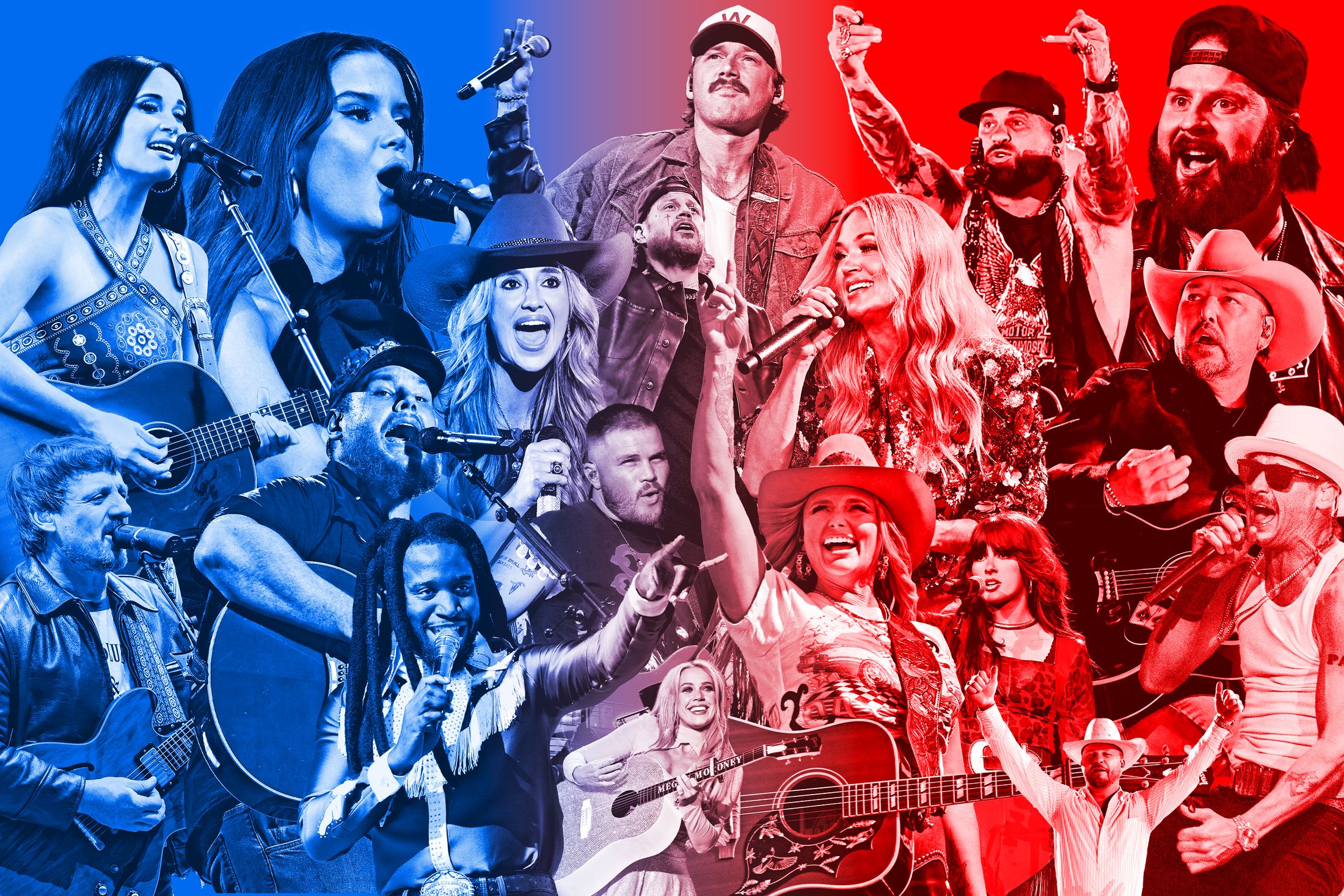
Liberal: Kacey Musgraves, Maren Morris, and Sturgill Simpson.
These stories reveal an approach beginning to cement: These artists don’t necessarily have a reserved rural listener in mind. In the wake of the rightward trend that set in after the aggressively accessible bro-country craze of the 2010s, more and more performers would like to be widely accommodating and vaguely uncategorizable. These considerations are paying off as handsomely as genuflecting to government power used to (and often still does). Bryan’s music hasn’t gotten a lot of country-radio play, but his most recent album, January’s With Heaven on Top, and his 2023 self-titled one both debuted at No. 1 on the “Billboard 200.” The disconnect — platinum hits deemed too folky or rock-tinged to fly on rustic-hodgepodge radio stations — suggests this business is something other than a meritocracy. Bryan fights to stay likable enough to keep his appeal broad and often overqualifies what could seem like implicitly left-leaning positions. His recent song “Bad News” looked like a jab at ICE when he teased it in October and incurred the wrath of then–Homeland Security Secretary Kristi Noem, who said she was “extremely disappointed” in the song. But he chimed in quickly to say that using “Bad News” “as a weapon is only proving how devastatingly divided we all are.” Bryan’s provocations never cut to the quick like Springsteen, whose sound he gets compared to, or caustic Navy-frigate import Sturgill Simpson, whose recent disco-country banger, “Make America Fuk Again,” announces he’s “got that Hunter Biden energy.” (That rebellious spirit has been rewarded: Simpson’s new album debuted at No. 3 on “The Billboard 200” without being made available on streaming.)

Unclear: Shaboozey, Luke Combs, Lainey Wilson, Zach Bryan, and Megan Moroney.
Bryan straddling the political center reflects the disjointed desires of a nation that polls consistently inconsistent on issues, one that in 2024 yearned for both universal health care and the removal of hardworking longtime residents. But when Jelly Roll dodged a question about immigration at the Grammys, where ICE OUT pins were everywhere, he played to an older mentality. That night, he called himself a “dumb redneck” who shouldn’t be consulted on such matters. He wants what Reba McEntire has: the ability to shake Bad Bunny’s hand on-camera at that same ceremony and have the gesture reverberate as a message of love. But the politically demure country giants of the ’80s and ’90s weren’t targeting as much of America as someone like Jelly Roll; the evenhanded “Jesus is not owned by one political party” line in his Grammy acceptance speech failed to build the ideological bridges he might’ve had in mind. He hasn’t given a clear answer on where he stands on ICE in two months, but he has had time to put out a song for the World Cup and square off with Randy Orton on WWE SmackDown. He’s not figuring out the parameters of a confusing worldview in public.

Playing the Fence (But Coded Red): Morgan Wallen, Carrie Underwood, Ella Langley, Miranda Lambert, and Jelly Roll.
Shying away from criticizing government officials is ultimately just country’s spin on respectability politics. It’s kneeling to power regardless of nobility. Pandering to a one-dimensional Americana, the way Aldean did with 2023’s “Try That in a Small Town,” placates a resilient, still-huge base pining for simpler times. Jelly Roll found out in December on The Joe Rogan Experience that he would be inducted into the Grand Ole Opry and said nothing before the ceremony in March that would ruffle conservative Nashville feathers on the way. Morgan Wallen neither embraces nor denounces MAGA, achieving a similar political slipperiness. There are opportunities and jukebox futures at stake. This makes it all the more striking that the humble Shaboozey, whose meteoric “A Bar Song (Tipsy)” ran the “Hot 100” in 2024 after he guested on Beyoncé’s Cowboy Carter, spoke out in defense of immigrant families like his own while accepting his first trophy (for a song with Jelly Roll) at the Grammys. Shaboozey is engaged in a more careful tightrope walk than Bryan, challenging Nashville tradition but evading the notion that it makes him a liberal. (And racial dynamics are constantly at play whenever he sticks his neck out. He caught hell after the American Music Awards last year from conservative country fans for his uneasy laugh when co-presenter Moroney said the Carter Family “basically invented country music” and used the fuss to highlight Black country progenitors like DeFord Bailey.) Shaboozey doesn’t identify as a poli-sci expert but could still acknowledge human-rights catastrophes. Jelly Roll claims immigration is above his pay grade, but there are chapters he could’ve consulted in the literal Bible he waved on the Grammys stage that condemn the mistreatment of foreigners.

MAGA: Brantley Gilbert, Nate Smith, Jason Aldean, Kid Rock, and Cody Johnson.
There’s a common thread among all these artists. Few in this generation care to draw smoke like the Chicks, Maren Morris, and Kacey Musgraves, whose unsubtle aw-shucks liberalism made them lightning rods in country. Bryan and Jelly Roll split hairs to keep from being objectively at odds with the government (and a White House social team that loves a celebrity opponent). But they also know that appeasing state interests is a red line for a growing swath of the planet. Many of today’s mainstream-country stars are seeking a life more like Dolly Parton’s — she’s someone whose politics boil down to a love so resolutely unpartisan that people who hate each other respect Dolly equally. She’s a guiding light for the self-described heavily moderate Luke Combs, the North Carolina singer-songwriter and “Hot Country Songs” regular who thrives on not seeming “liberal enough for liberals” or “conservative enough for conservatives.” He rejects the left-wing label he’s received for his support of Black Lives Matter and 2024’s sweetly pro-LGBTQ+ “Whoever You Turn Out to Be”; he doesn’t think standing against bigotry should communicate political orientation. Country is still very much ideologically entangled with MAGA and its pipe dream of a return to the 1950s. But the savviest country stars are able to argue for basic respect for others while brushing off whatever political coding comes with it.