
The discussion about what to feed beef cattle throughout the year is among the most important conversations for the operation. For many, silage is a consideration.
Galen Erickson, Ph.D., Nebraska Cattle Industry Professor of Animal Science and Beef Feedlot Extension Specialist, University of Nebraska-Lincoln, is a fan of silage – if it’s put up correctly.
“Production is somewhat dependent on the operation,” Erickson said. “It’s about timing and what fits the annual production system on the land. There are different considerations for cow-calf, backgrounders or feedlot. The type of animal being fed matters, but the silage put out is usually dictated by land resources and timing.”
Erickson says one factor for incorporating silage is that the producer will likely feed it to cattle onsite or close by. “There’s a lot of moisture in it and it isn’t something you can harvest then decide later what to do with it,” he said. “Once it’s put up as silage, there’s a good chance it will be fed to your own cattle.”
Corn silage is the most widely grown silage crop, with alfalfa haylage or other kinds of haylage close behind. It’s also becoming popular to ensile small grains, including cover crops such as rye for ryelage.
Double cropping is an option depending on location. In Nebraska, the most common approach is to grow corn for silage, then plant rye following corn silage harvest.
“The next spring, around May, harvest the rye for silage,” Erickson said. “Follow it with either soybeans or another short corn crop. You’ll probably get three crops every two years.”
Silage can go from being a good economical choice to a very poor choice. “Number one criteria is packing correctly at the right density,” Erickson said. “That’s usually related to the second most important part, which is correct moisture. Sometimes silages are put up too wet, which is more of a risk in most operations than putting it up too dry.”
More subtle but important aspects include how fast the silage can be fed to keep the face fresh and minimize oxygen exposure. Erickson says the goal with every step in making silage is to prevent air – from packing to time of feeding, as well as the size of the area where silage is removed.
A critical factor for producing good corn silage is field moisture. Erickson suggests harvest moisture for corn silage at 38% Dry matter (DM) or 62% moisture.
“We’ve evaluated silage between 35% and 42% DM, but the optimum is around 38% at harvest,” Erickson said. “It will naturally get about one percentage unit wetter, so it’s at 37%.” Silage harvest timing also depends on field conditions at time of harvest and weather.
“Silage can get too dry, but what happens more frequently is starting harvest at 30% or 32% DM,” Erickson said. “You’re hauling a lot of water unnecessarily if you’re harvesting it that wet and I don’t believe the plant is optimized for harvest at that level. We recommend trying to slow people down. Silage can be too dry, but the tendency is too wet.”
Silage leachate can occur when silage is excessively wet at harvest. Leachate from bunkers, upright silos or bags becomes an environmental concern and can threaten surface and groundwater quality due to its high biochemical oxygen demand. The high acid content of leachate poses a danger to aquatic life.
While there are several options for storing silage, bunkers are the most common and economical for most operations. Some producers use upright storage if that is what’s available on the farm. Upright silos should be inspected for signs of pitting and other deterioration prior to use, and unloaders should be in good working condition.
Plastic silage bags are a good option for a smaller operation that can’t feed enough daily to remove a certain amount of silage from the face at each feeding. Bags should be stored on a firm, smooth surface to prevent sharp rocks or stubble from creating holes. Bag management includes frequent inspections for holes and immediate repairs to exclude oxygen.
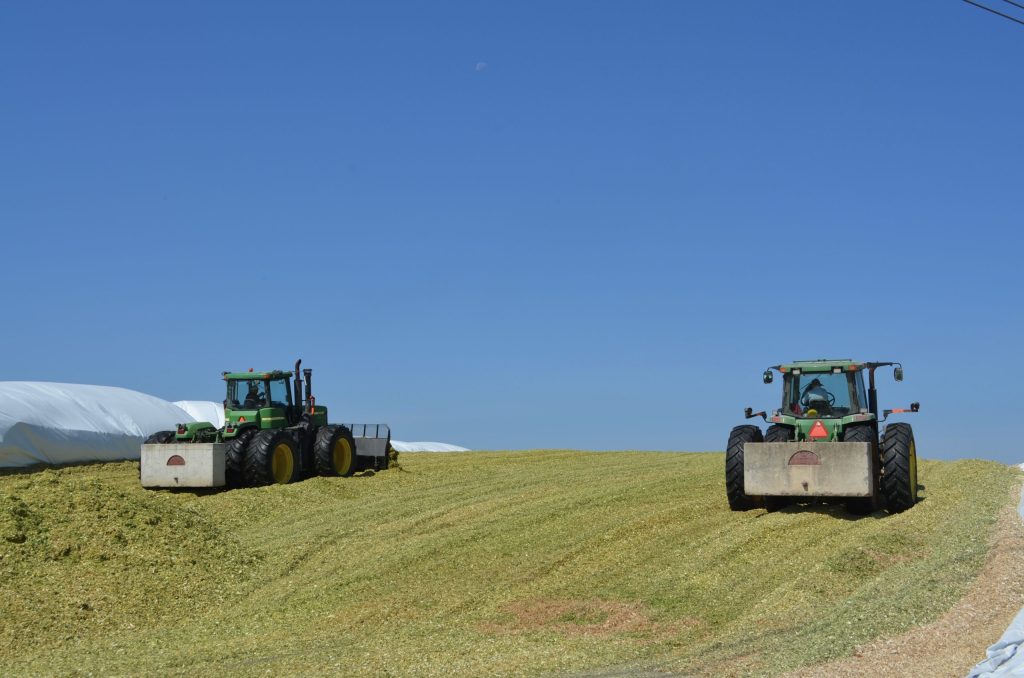
Bunkers should be packed properly to ensure good quality feed out. In some cases, delivery rate from the field results in packing tractors not having sufficient time to pack before subsequent layers are added. Chopped forage from the field should be spread thinly across the packed surface, about six to 12 inches, prior to further packing. Packing tractors should be heavy according to university guidelines. Having more than one packing tractor helps keep the process moving and promotes sufficient density. One common mistake is uneven packing across the surface, especially at the edges, which can promote poor fermentation and create a dangerous collapse risk during feed out.
Bunkers should always be covered to preserve quality silage. “The data are very clear on shrink losses and exposure to oxygen when we put up silage,” Erickson said. “There are lot of excellent cover opportunities for bunker storage.”
Bunker-stored silage is best removed for feeding with a silage facer. This improves quality and reduces spoilage by limiting oxygen exposure. Eliminating excess air prevents heating and minimizes dry matter loss.
Erickson suggests density testing after packing. “The best way to know that is doing density testing after packing,” Erickson said. “There are good recommendations for corn silage – a good number is 15 to 16 pounds of dry matter per cubic foot.” Density testing can be done any time after packing; most common is testing throughout feeding from different areas of the face.
Many operations use custom harvesters, which saves capital for the producer but presents another challenge. “Custom harvesters provide a tremendous service,” Erickson said. “The challenge is speed of harvest, which is usually rapid, and harvest when the operator is available but perhaps silage isn’t at optimum quality stage.”
With some considerations, silage is suitable for any age group. “For beef cows, many times silages are too good of a feed to feed straight because there’s too much energy in it,” Erickson said. “You can limit feed silage to cows, but many beef producers don’t want to limit cows. We’ve done a lot of limit feeding programs, and they work great because we know the nutrients that went in.”
For those feeding silage to cows, Erickson suggests mixing it with a lower energy feed or forage such as crop residue or lower quality hay.
“For backgrounding calves, it’s an excellent feed, especially after newly weaned calves adjust to silage,” Erickson said. “If you have the land resources and capability to put up silage, it’s a tremendous way to background calves. However, the protein component is important.”
For the feedlot phase, silages are an excellent choice and one of the less expensive energy sources. Most years, a feeder should consider silage if they have the facilities to store it.
As he summarizes silage production, Erickson refers to the balancing act of good silage science. “Manage the field, optimize time of harvest and make sure it’s packed fast enough and sufficiently to keep up with harvest. Our goal is to learn what dairy operations do to produce excellent silage that make sense for beef operations.”
Nebraska State University, in cooperation with Lallemand Animal Nutrition, and Iowa State University, hold a biannual event ‘Silage for Beef Cattle.’ The next event will be June 18, 2026, at the Eastern Nebraska Research Center in Mead, Nebraska. Details will be available on the UNL website.
Erickson encourages producers who use silage to visit https://beef.unl.edu/beefwatch/silage-considerations/for comprehensive resources on silage for beef production systems.