
Social Security needs modest revenue increases and benefit cuts – not extreme borrowing.
Larry Fink of BlackRock, in the Annual Chairman’s Letter to Investors, just endorsed the proposal by Senators Cassidy (R-LA) and Kaine (D-VA) to create a trust fund with borrowed funds to solve Social Security’s financing problems.
This idea, which has been around for several years, has faced considerable pushback from experts. To date, however, the criticism has been quite polite, always starting with some comments about how lovely it was to see Senators tackling the challenge of fixing Social Security and the wonder of doing it on a bipartisan basis. With the financial leaders adding legitimacy to the proposal, the time has come to be very clear – the idea does virtually nothing to solve Social Security’s financial problems.
This is the Cassidy-Kaine proposal. Over the next 10 years, the federal government would borrow $1.5 trillion to finance a new Social Security trust fund. This new fund would be invested in equities and other risky assets and allowed to grow untouched for the next 75 years. At the same time, the federal government would borrow an additional $25 trillion to cover Social Security’s annual shortfalls. At the end of the 75-year accumulation period, the trust fund would repay the Treasury the principal and interest on the original borrowed amount. Any remaining proceeds – due to the difference between the rate on Treasuries and the anticipated return on risky investments – could be used to offset a tiny portion of the Treasury’s $25 trillion borrowing
To support their proposal with a real-world example, Senators Cassidy and Kaine point to the success of the Railroad Retirement Investment Trust, which holds a diversified portfolio of assets to ensure the payment of benefits to railroad workers. If equity investment were the issue, one could also point to the successful investment policies of the Canada Pension Plan and the Ontario Teachers’ Pension Plan.
The problem with these comparisons is that these other plans fund their financial investments with tax revenues or employee contributions, not borrowed funds. With the Cassidy-Kaine proposal, the only new money to support Social Security over the next 75 years is borrowing from the Treasury, with the expectation that some of this borrowing could be repaid at the end of the 75 years by the expected spread between the interest rate on Treasuries and the return on equities. And the higher expected returns on equities merely compensate for the risk that will be borne by the taxpayers – a huge and risky financial maneuver with very little payoff.
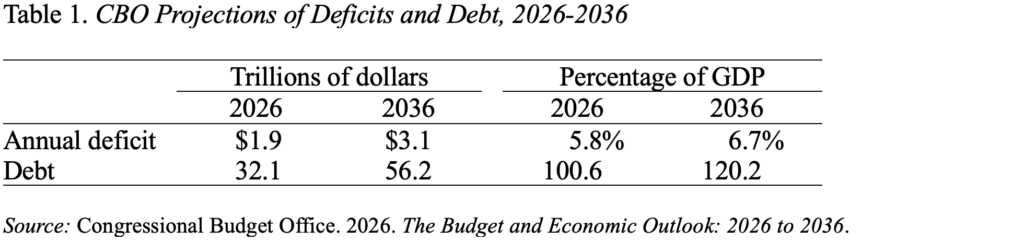
Moreover, the Cassidy-Kaine proposal would directly add $1.5 trillion to the nation’s deficits and debt, but, more importantly, require Social Security to add another $25 trillion in borrowing to cover annual shortfalls. How can anyone argue for more borrowing when we already have $32 trillion in debt, scheduled to rise to $56 trillion by 2036? As a share of our economy, the debt is projected to rise from 101 percent of GDP to 120 percent in 2036, levels we have never seen before (see Table 1). The best thing we could do for our fiscal situation is to restore balance to Social Security by putting together a package of modest revenue increases and benefit cuts.
In short, the Cassidy-Kaine proposal is a flight of fancy. We need Congress to pass a serious package that broadens the payroll tax base and raises the rate, and cuts benefits for the higher-paid who live forever. These changes would not only stabilize Social Security’s finances but would take a first step to restore sanity to our fiscal situation. My best guess is that Senators Cassidy and Kaine themselves – being the intelligent and diligent legislators they are – would prefer a serious approach and offer this proposal simply to move their colleagues to action.