
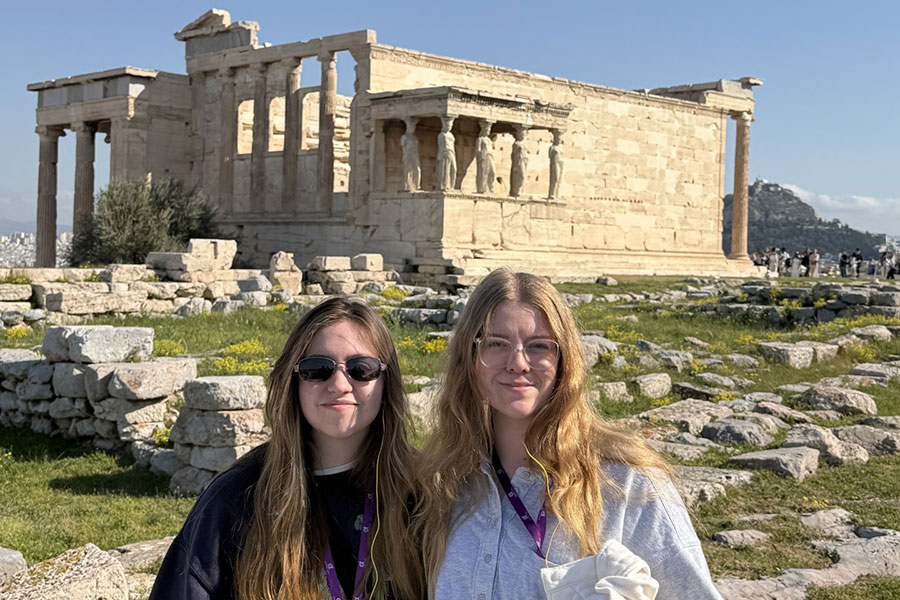
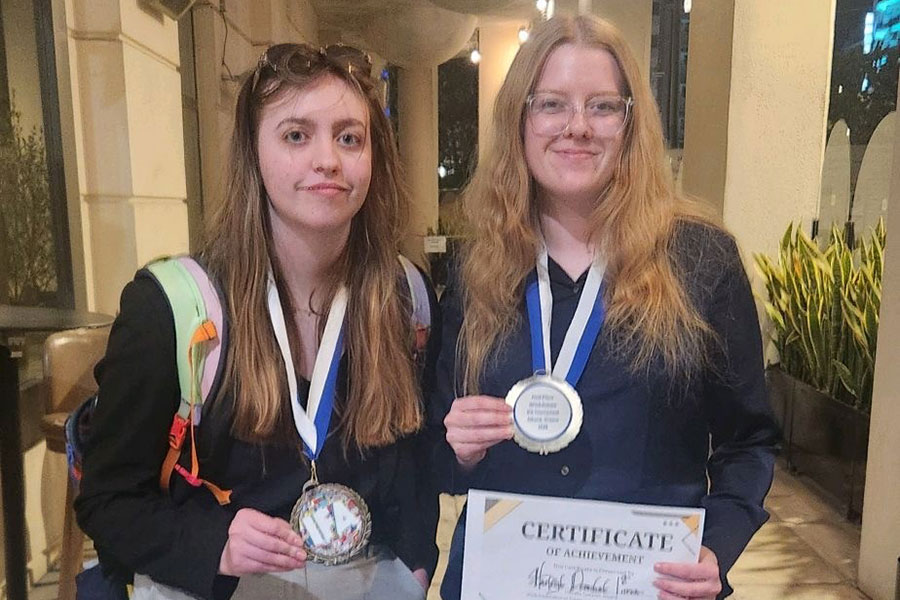
Two students in Florida State University’s Forensics Program were recently named worldwide champions after competing at the International Forensics Association tournament, which took place March 8-12 in Athens, Greece.
FSU students Harleigh Demchak, a junior studying economics, and Zoey Rotenberry, a senior studying political science, won first place at the 36th Annual International Forensics Association Speech and Debate Tournament and Conference under the guidance of Avery Henry, program director and teaching faculty II in the College of Communication and Information.
“This win fills me with pride because it is evidence of the hard work and dedication the team has put in this season,” Henry said. “In addition, it affords FSU the ability to market ourselves as international debate champions. We are the best in the world at NPDA (National Parliamentary Debate Association) style debate.”
Forensics, a term taken from Aristotle’s classification of the types of rhetoric, is a type of judicial rhetoric with the aim of persuading a judge. Modern competitive forensics builds on this Aristotelian art by usingevidence, logic and persuasive speech to win a judge’s ballot.
The FSU Forensics Program gives undergraduate students the opportunity to develop their communication skills through participation in one of two nationally competitive traveling squads: the speech or debate team. Students travel several weekends each semester to intercollegiate speech or debate tournaments where they can compete against fellow students and receive feedback from members of the academic community.
“Being part of the FSU Forensics Team has solidified my decision to pursue a career in law,” Demchak said. “Participating in critical debates and engaging with complex concepts has deepened my appreciation for argumentation and research. “Overall, the experience has strengthened both my passion for the activity and my long-term academic and professional goals.”
Throughout this season, members of the Forensics Program traveled to cities such as Portland, Las Vegas, Dallas and Nashville, in addition to competing internationally in Greece. This year the program will compete in a total of 14 domestic and international competitions. These experiences allow students to engage with peers from across the world while gaining cultural exposure.
“Competitive forensics gives students the opportunity to travel all over, compete against some of the brightest minds, and gain cultural experiences that are not available when you are just learning in the classroom,” Henry said.
The International Forensics Association is a non-profit organization dedicated to promoting and expanding speech and debate on a global scale. It supports students and programs by creating opportunities for international competition, collaboration and cultural exchange. Every year the International Forensics Association hosts a tournament in alternating geographic locations. In addition to competing, students are given opportunities to engage in educational and cultural activities in the host country.
While in Athens, the team explored iconic landmarks and immersed themselves in Greece’s rich educational and intellectual history. In addition to competing, they toured sites such as the Acropolis, the Agoraand Pnyx Hill, which are widely recognized as the origins of speech and debate in the Western world.
“The actual debate tournament and topics revolved around Greek history or Greek policy, so being able to go and absorb the culture and learn more about the history of Greece was pivotal to our success for debate rounds,” Rotenberry said. “Being able to immerse myself in the modern and ancient world of Greece was a formative and surreal experience that I will be forever grateful for.”
Between competitions, members engage in rigorous preparation, meeting twice a week to refine valuable skills in critical thinking, public speaking and persuasive communication. Students spend months researching and debating complex global issues including nuclear policy, artificial intelligence and environmental exploration, developing a deep understanding of a range of contemporary topics.
“Being a part of the FSU debate team has forever changed my academic goals, depth of knowledge, and even changed me as a person,” Rotenberry said. “Before joining the FSU debate team, I didn’t really know what I wanted to do. After joining the debate team and debating policy, I finally found direction in a career and academic sense.”
In addition to the team’s recent success in Athens, the FSU Forensics Program earned top honors at the Florida Intercollegiate Forensics Association State Championship this year, bringing home both the first place Limited Entry Sweepstakes and first place Overall Debate Sweepstakes trophies.
“Students in competitive forensics have to gain a fluency to understanding topic areas, collecting research to be used as evidence, and then publicly test their arguments against some of the smartest students from schools all across the nation or in some cases the world,” Henry said.
The Forensics Program’s competitive season runs from September through mid-April. The program maintains an open-door policy, welcoming students of all degrees and experience levels to get involved. Those interested in joining can reach out to team director Avery Henry or attend a team meeting, held every Tuesday and Wednesday from 4:30 to 6:30 p.m. in UCC 4415.
To learn more about the College of Communication and Information, visit their website at cci.fsu.edu. For more information about FSU’s global footprint, visit the FSU Global website.