
65 years ago, on 12 April 1961, Soviet citizen Yuri Gagarin carried out the first-ever human space flight, paving the way for space exploration to benefit all humanity.
As the United Nations marks this historic milestone on the International Day of Human Space Flight, the UN’s Champion for Space, Professor Brian Cox, wants to show the world that “space is no longer science fiction,” but rather an “important part of all our lives and our economy.”
Space technology solves Earthly problems
Appointed the UN’s advocate for space in 2025, internationally acclaimed physicist, author and broadcaster Professor Cox is using his new role to champion the potential of space technology to address some of the biggest challenges facing our planet: these include climate change, disaster management and sustainable development.
“More and more of the things we take for granted here on Earth are becoming part of the space-based economy,” Cox highlights in an interview with UNRIC in Brussels.
From satellite navigation to weather forecasting, and connecting individuals all over the world, space technology is already impacting our daily lives.
Satellite imagery gives us a clearer view of the challenges we face on Earth, such as monitoring crop yields, managing water resources, and tracking deforestation in real time.
Artificial Intelligence and space-powered technology can visualise the impact of flash flooding and coastal erosion.
Meanwhile, satellite connectivity can bridge the data divide by supporting e-learning for isolated schools or enabling telemedicine in remote areas.
“It’s not just about exploration anymore; it’s about making everybody’s life better,” Cox underlines.
Space has the power to unite
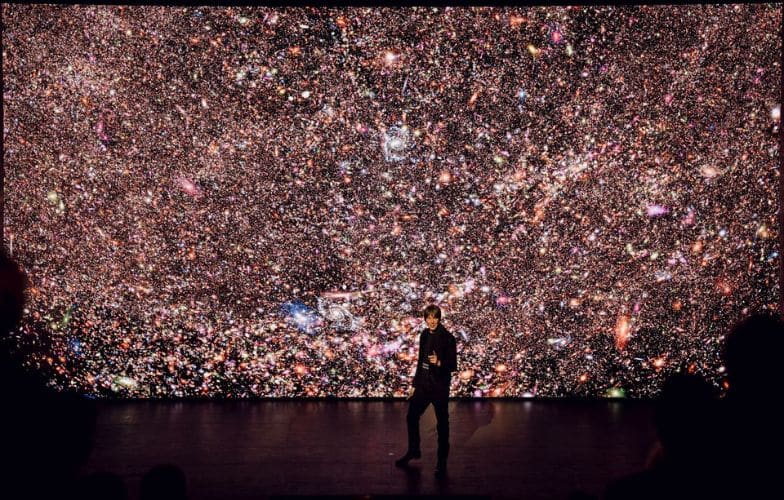
Born in 1968, as the Apollo space programme got underway, with the first men landing on the moon a year later, Cox grew up in a house where space was a regular topic of conversation. His parents spoke often of the famous astronauts of the day, such as Neil Armstrong, Buzz Aldrin, and Jim Lovell. Cox’s fascination with astronomy inspired him to pursue a career as a scientist: “I just loved looking at the night sky.”
Cox wants to share his passion for space with the world, reminding us that space “belongs to everyone.”
Through his role as Champion for Space, Cox shines the spotlight on the role of the UN in space as a convenor, a gateway to space, and a capacity-builder for nations to peacefully explore and use space.
UNOOSA, the UN Office for Outer Space Affairs, leads the United Nations’ efforts to promote international cooperation and ensure the peaceful and sustainable use of outer space. Together with COPUOS, the Committee on the Peaceful Uses of Outer Space, they play an essential role in space governance by providing a platform for inclusive dialogue and consensus-building among Member States.
Peaceful exploration of space
Under the auspices of the UN, Member States have established frameworks that have preserved space as a domain for peaceful use and international cooperation — a status that requires continued political commitment to maintain.
“Space brings people together because there are no borders there,” Cox affirms.
The UN plays a role in tackling potentially thorny issues, such as lunar cooperation, space traffic, space resources, and planetary defence.
“There has always been an idealism to space, but it’s not a naïve idealism,” Cox emphasises.
Cox recalls in particular the 1975 Apollo–Soyuz Mission, a major moment of scientific and political cooperation between the United States of America and the Soviet Union, and the first time a spacecraft of two nations docked together in orbit.
“It was unthinkable that the United States and the Soviet Union, as it then was, would collaborate to dock in space, and develop technologies for collaboration that we are still using today.”
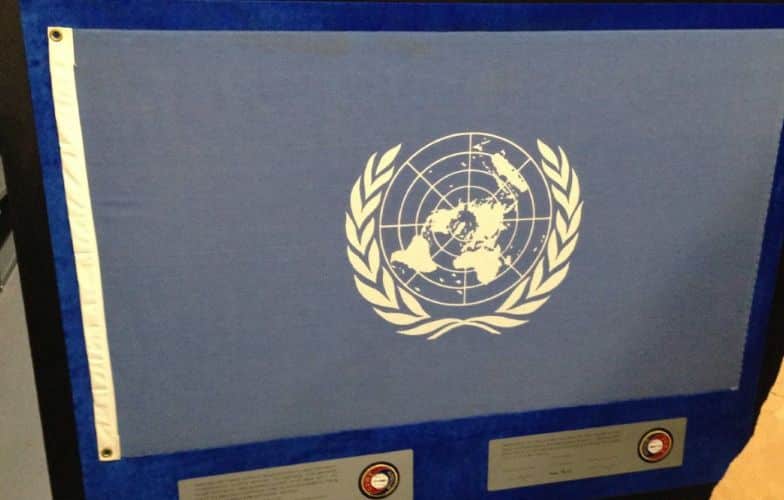
A UN flag was among the items exchanged between the astronauts to recognise all humankind’s achievements in space, and beyond any particular national accomplishment.
The province of all humankind
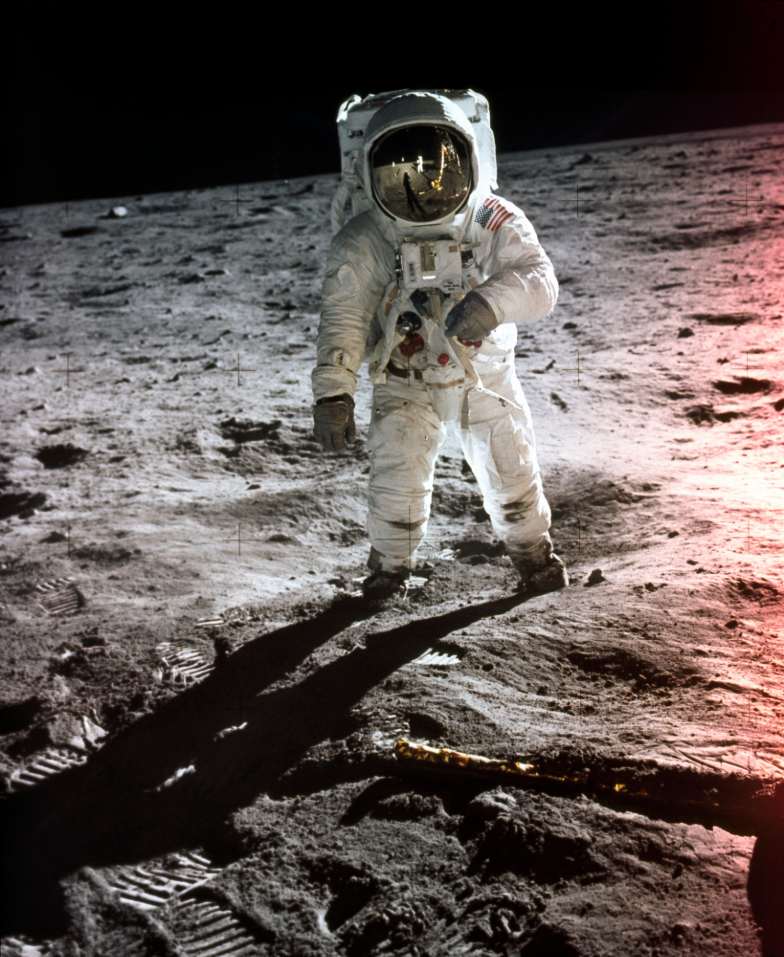
Space is not only the province of wealthy countries and companies, and UNOOSA works to ensure that the benefits of space reach every nation.
“Ensuring everybody can contribute and benefit ultimately makes our voyage outwards into space easier,” says Cox. “It will happen more rapidly if everybody is collaborating together, and by nature it will benefit everybody. It’s a new frontier.”
UNOOSA has helped countries including Kenya, Mauritius, Moldova and Guatemala deploy their first satellites. And as more countries join the space community, it has assisted emerging space nations draft national space laws that align with international obligations.
Space junk
Space is vast, but is becoming increasingly crowded. In 2025, roughly over 4,500 new satellites were launched, although not all were registered with the UN. Many legacy space objects fragment and create new junk, with estimates suggesting there are as many as 130 million pieces of debris.
As we develop more infrastructure in space, and come to rely on it more on Earth, “this becomes more and more of a serious problem,” Cox warns.
A crash or collision in space tomorrow would render Earth’s precious orbital environment unusable for the services we each rely on.
The UN plays an important role in facilitating international dialogue on space traffic. COPUOS has been called on by Member States to address space traffic, space debris mitigation, and the governance of space resources.
A UN flag on Mars
Whilst recognising the practical ways that space can enhance our daily lives, Cox does not want to “take the romance away from space”.
The physicist added that the discovery he would most like to see in his lifetime would be “another living world.”
He is “sure there is life out there somewhere,” adding: “I would not be surprised if there were microbes on many of the moons in the solar system, and possibly also on Mars. I would, however, be surprised if there’s any complex life in the solar system, very surprised.”
For Cox, the goal of space exploration is to help us “flourish as a civilization” on Earth.
As well as another moon landing, he hopes that one day, humans will set foot on Mars, an opportunity to emphasise that space belongs to all humankind.
“I hope that when we plant a flag on the surface of Mars, then it will be a United Nations flag.”