
By Rob Battles
A diary of shows attended – good, bad, and indifferent — at this year’s Big Ears Festival, as well as comments on some of the non-musical joys and hassles.
Editor’s Note: For years I’ve been hearing how great and important the annual Big Ears Festival, in Knoxville, Tenn., is for music lovers of all stripes. For one reason and another, I’ve never made it down there. This year, when my friend Rob Battles told me of his plans to attend the festival for the sixth time, I asked him to send me updates. In response, he kept a diary of the shows he attended. To my surprise, he began by saying that this would probably be his last Big Ears and explained why. He followed with his diary of the shows he attended – good, bad, and indifferent — as well as comments on some of the non-musical joys and hassles. You can also read Paul Robicheau and Noah Schaffer’s comprehensive Arts Fuse review of this year’s festival. — Jon Garelick
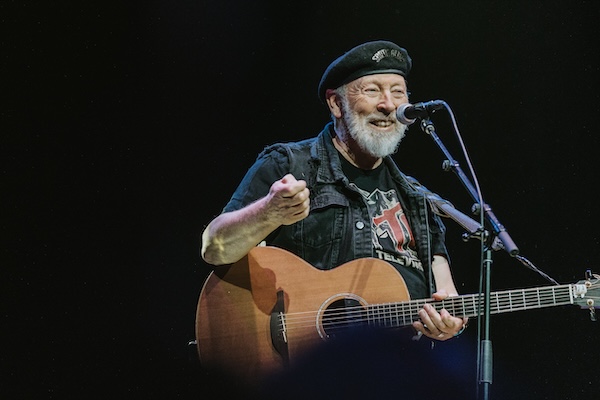
Richard Thompson at Big Ears Festival. Photo: Cora Wagoner
I believe that I am done shlepping to Knoxville, much as I dig the idea of it. The actual experience upon some reflection is more about racing from one venue to the next in order to pack as much as possible into the day/long weekend, and leaving time to cue up for the next thing to be sure to get the preferred seat, ad nauseam until I limp back to the hotel for not quite enough sleep.
There were artists I love and have seen repeatedly, and there were artists I wanted to check out, but the standing venues were where the newest stuff was happening, and I grew pretty weary of spacey explorations of tone and color in smoke-machine dungeons packed with nodding groovesters. The seated venues were of course more comfortable, but these were for the tried and true: Richard Thompson, Pat Metheny, Cécile McLorin Salvant.
I dictated thoughts at the end of each day into Claude AI, which did a bad job of writing on my behalf, and I spent the first full day back in New York re-editing Claude’s improvisations out of my record of the event.
Big Ears Festival 2026, Knoxville, Tennessee — March 26–29
This seems to have inadvertently become a guitar player festival, and, oddly, the highlight for me was two presentations, a panel discussion and a 10-year-old movie, much of that about Ethiopian music.
The guitarists included Pat Metheny, John Scofield, Richard Thompson, Jeff Parker, Bill Orcutt, Nels Cline, Mary Halvorson, Rafiq Bhatia, Julian Lage, Fred Frith, and Gary Lucas.
Thursday, March 26
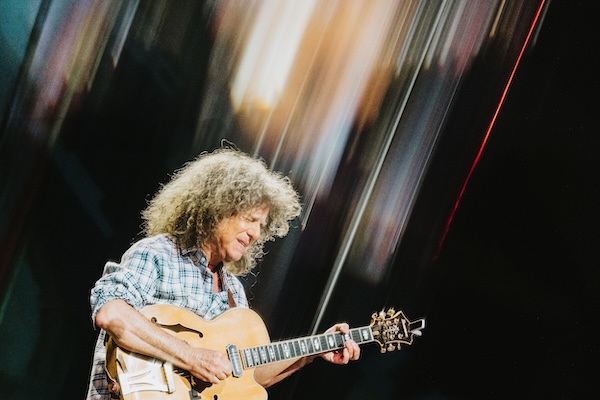
Pat Metheny at Big Ears Festival. Photo: Cora Wagoner
First show was at the Standard, 416 W. Jackson Ave., a former industrial space, to hear Ches Smith’s Clone Row quartet: Liberty Ellman and Mary Halvorson on guitars, Nick Dunston on bass and electronics, and Smith himself on drums, vibraphone, and electronics. Abstracted funk, Smith using electronics to spice up his beats, Dunston providing a fat bottom, the two guitars saying sophisticated things while shaking their behinds. The highlight of the night, and possibly of the fest, was Pat Metheny’s Side-Eye III+ at the Tennessee Theatre. The core trio is Metheny, Chris Fishman on piano and keyboards, and Joe Dyson on drums — extended on this tour by bassist Jermaine Paul and percussionist and vocalist Leonard Patton. Metheny put on a long, wide-ranging show that demonstrated how he developed and expanded his unique sound.
The highlight of the night was Metheny and Joe Dyson alone on stage — what I think was a spectacular Ornette Coleman section, Metheny playing acoustic guitar through filters that made it sound like the heaviest of rock guitars, Dyson keeping up with no apparent effort.
The encore had Metheny alone with a simple acoustic guitar playing “America the Beautiful,” which morphed into something else, and then something else again, and the band came out and joined him. I decided to call it quits after the show, to quit while I was ahead.
Friday, March 27
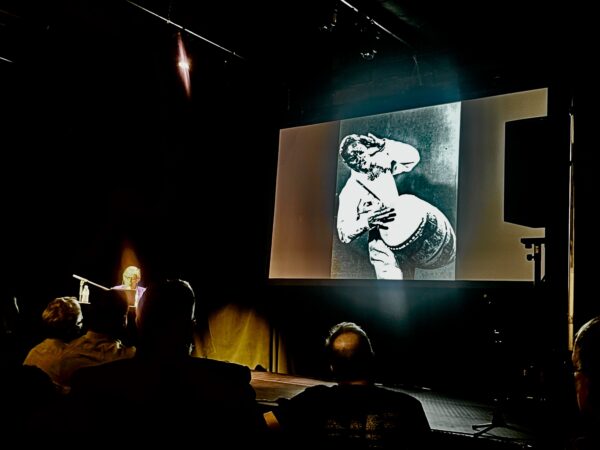
Joe Boyd at Big Ears Festival. Photo: Rob Battles
Joe Boyd and the first of two lectures with film clips at the Blackbox, taken from his brick of a book, And the Roots of Rhythm Remain. The film clips were fascinating: Dizzy Gillespie explaining how he integrated Cuban rhythms into a jazz ensemble, footage of Taj Mahal recording with Boyd producing, early footage of the Maytals and other reggae performers — I can’t remember which was on Friday, which on Saturday, and I kept thinking, this show has got to go on the road; [former Coolidge Corner Theater owner and longtime jazz fan] Justin Freed needs to present this, and it needs to be presented in NYC. I’d go again.
I stood around at the Greyhound, a filthy former bus station, and watched Tomas Fujiwara: Dream Up make interesting music for a while, then listened to Nik Bärtsch noodle like a samurai Keith Jarrett wannabe (he wore an all-black getup that might have included a sword at some point), and got out of there quick to ride a battery-powered scooter to the church now called the Point, for a real high point, Jimmie Dale Gilmore and Butch Hancock playing straightforward contemporary Texas songs and ballads. They were great, and I was struck by Gilmore’s presence and sincerity. I want to hear more of his music.
Petra Hayden sang with a strong trio backing her up, but the songs, by John Zorn, didn’t do much for me, and she didn’t do much with them, so I moved on to Jeff Parker at the Mill & Mine, and as much as I dig Parker, the dungeon-like atmosphere put me off, and I found myself short of patience for more spacey noodling. I like spacey noodling as much as the next guy, but there was maybe more of it on the program than I was interested in.
I heard 15 or 20 minutes of the always wonderful pianist Marilyn Crispell with a drummer I didn’t know, Harvey Sorgen, and he was cool. They were cool. But I had to go hear Roscoe.
I got back to the Standard early and ran into two pals from home, also there for Tyshawn Sorey backing up Roscoe Mitchell, who was dressed to the nines and surrounded by his own artwork onstage. I managed to snag a sitting spot on the wooden box on one side of the room and pretended I belonged there through the soundcheck. Mitchell only sounds like himself, playing a bass sax or a soprano, as well as little percussion. Sorey seemed chastened to share the stage with an icon of first wave free jazz, a poor description but I know what I mean.
I caught the second half of Caroline Shaw performing with Sō Percussion, and was happy to miss Ringdown, Shaw’s duo with her partner, who doesn’t bring much to the party. Shaw and Sō were fun as usual.
A few minutes of Julianna Barwick at St. John’s was all I needed or wanted, and then back to the Tennessee for John Scofield with Vicente Archer on bass, Bill Stewart on drums. What a trio! The bigger named performers were the ones I was most enjoying, perhaps because I could sit my mature ass down to listen.
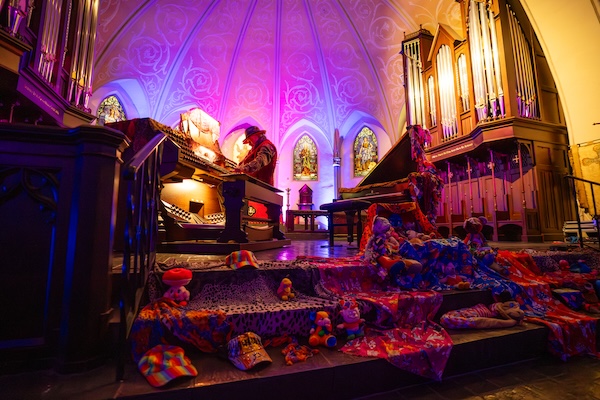
Charlemagne Palestine at Big Ears Festival. Photo: Billie Wheeler
I knew next to nothing about Charlemagne Palestine but was trading texts with some friends attending a hockey game in upstate New York when I noticed the Palestine program notes referred to Tony Conrad, an avant-garde multi-hyphenate artist — whose widow was at the hockey game. When she heard where I was, she instructed me to say hi from her to Charlemagne and texted, “He’s TOASTED on Chivas trust me.” Palestine is lumped in with minimalists Terry Riley and La Monte Young but prefers to call himself a “maximalist,” and the density and volume of the music he was creating on the church organ was overwhelming. And cool. I split before my eardrums did, so I wasn’t able to pass along my friend’s regards, and I went to the Hampton Inn to bed.
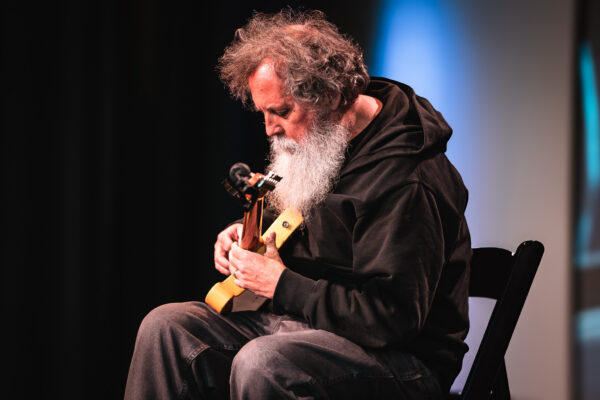
Bill Orcutt at Big Ears Festival. Photo: A. Ogle
Saturday, March 28
Joe Boyd: And the Roots of Rhythm Remain, Part Two at the Blackbox. As good as part one, and well attended, SRO.
I wanted to sit so I left early for Bill Orcutt at Regas Square. Orcutt looks like a large portion of the crowd at Big Ears, shapeless hoodie and grey pants, clutching a Fender guitar, making no eye contact with his adoring audience, wailing away in an autodidactical way. It was loud, rather relentless. Orcutt is not a poser, and he seemed like somebody I would not want to annoy.
The Crossing performed David Lang’s poor hymnal at First Presbyterian Sanctuary, conducted by Donald Nally. I heard just a few of the 14 movements and left for the Tennessee and Mary Halvorson: Canis Major. This music felt like graduate work, thoughtfully composed but not emotionally affecting. I left early and rode an electric scooter to Pioneer House of Letterpress & Vintage. I bought some postcards.
Then another high point — Richard Thompson at the Tennessee, performing mostly solo, joined at the midpoint by his wife, Zara Phillips. Thompson talked about how Joe Boyd had produced some of his early records, asked if he was present, and then feigned annoyance if he wasn’t. I love Thompson’s stage work.
On to St John’s and L. Shankar with Selvaganesh Vinayakram, the son of original Shakti percussionist Vikku Vinayakram, and Swaminathan Selvaganesh. Shankar sports long blonde hair — odd looking, but the guy can play and sing. I left at 7:15 to make it to Robert Plant.
It started okay — sitting next to a couple from Boston, he with a broken leg, she explaining they were visiting their daughter and, knowing nothing about Big Ears, copped tickets online for Robert Plant’s Saving Grace. Just before Plant came out, a batty looking troll of a woman with a shellshocked man sat next to the Bostonians and me, and she began howling like a banshee in heat as Plant appeared. The shrieking went on, I sat in an empty seat ahead of me, and I realized this crowd was here for Led Zeppelin. Plant’s band was very good, the song selection was choice, but I had to get out of there.
I decided to go hear Rafiq Bhatia’s trio — Rafiq Bhatia: Environments, with Ian Chang on drums and Riley Mulherkar on trumpet — got there during sound check, snuck in, and found my spot sitting on top of a large wooden box against one wall. The room filled with smoke for a psychedelic effect. By the time the band started playing I was already losing patience. More self-indulgent electronic noodling. These musicians are all exceptional players, I have no doubt, but I didn’t want to hear more space jazz odyssey, so I ditched early.
I wanted to call it a night when I remembered that a couple of people had mentioned SML, a Los Angeles collective I’d been listening to in recent months. I got on the electric scooter and rode back to the Greyhound Bus Terminal. Inside I encountered John Schaefer — host of New Sounds on WNYC, one of the most important figures in American music broadcasting for more than 40 years — standing alone against a wall in a New York Giants jacket, looking like I felt. At a festival like this, old misfit freaks with highfalutin tastes in music look sadly like one another. Sure, I’m projecting.
After maybe 15 perfectly interesting high-energy danceable minutes of SML, I got back on the scooter, rode past the Tennessee Theatre where the line for Don Was & the Pan-Detroit Ensemble was already forming, and headed back to the Hampton Inn.
Sunday, March 29
I began the last day of the festival in a movie theater, watching Roaring Abyss (2015), a beautifully made documentary about music being created across various communities in Ethiopia. Joe Boyd introduced it. It made me want to hear more Ethiopian music.
Next, at the Blackbox, Boyd interviewed Francis Falceto — the French musicologist who in 1997 began curating the Éthiopiques series on Buda Musique, eventually producing more than 30 volumes documenting Ethiopian music from the 1950s through the 1970s. Also on stage was Russ Gershon, leader of Either/Orchestra, the long-running Boston-based large ensemble, who talked about his own relationship with Falceto and previewed the Either/Orchestra concert that would take place later that day at the Bijou Theatre. He was joined by the singer Munit Mesfin and the band’s bassist, Rick Mclaughlin, both of whom would be performing with him later.
Next, at St. John’s Cathedral, a few minutes of Marc Ribot, who I can live without, but I had to make sure. He was on the plane with me the next day, and I heard him ordering food to be delivered presumably to his apartment which included horseradish. After two songs, surrounded by awe-struck fans, I headed back to the Tennessee.
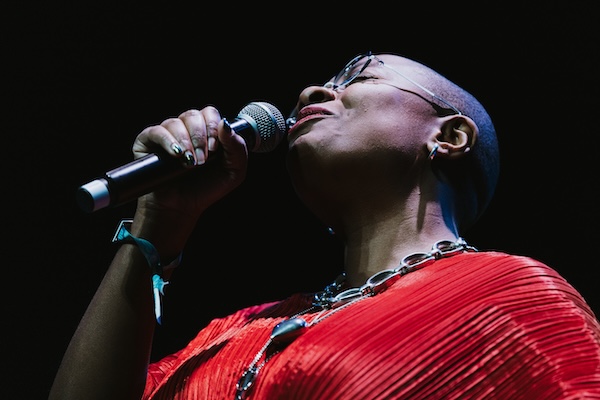
Cecile McLorin at Big Ears Festival. Photo: Cora Wagoner
Cécile McLorin Salvant with Sullivan Fortner on piano began without applause — I couldn’t tell what had happened, but the audience warmed up, and she did, too. At one point Salvant warned the audience that she was about to perform something atrocious and very inappropriate — a blues from the Smithsonian collection of Jelly Roll Morton’s sheet music. Specifically: “The Murder Ballad,” a half-hour extended blues that Morton recorded for Alan Lomax at the Library of Congress in 1938, drawn from material he used to perform in the Storyville brothels of New Orleans. The raw language Morton insisted on including — Lomax had to persuade him it was acceptable to leave it in — makes it one of the most extraordinary and scandalous documents in American music history. Salvant performed it at considerable length: a story of a woman who, using very coarse language, threatens and then murders another woman who has been sleeping with her man, is subsequently tried and found guilty, and sent to prison, where she enters into a relationship with another woman who seems to satisfy her sexually. McLorin Salvant was still singing it when I left to go hear Russ Gershon lead the Either/Orchestra in their Ethiopian music program at the Bijou Theatre.
The Either/Orchestra was swell, with two singers, Bruck Tesfaye joining Blackbox panelist Mesfin. I’ll be putting Ethiopian music on around the house a lot more after this.
I was running out of steam, but I returned to the Tennessee for Nels Cline: Lovers, an easy-listening exercise with a large ensemble that included fellow passengers on my trip home, guitarist Gregg Belisle-Chi and bassist Chris Lightcap. I’m not so into post-ironic easy listening, and I made my way back to the Bijou for the last show of the fest for me, Dave Douglas GIFTS Quintet, Rafiq Bhatia, James Brandon Lewis on tenor, Ian Chang an out-of-control drummer, and the always wonderful Tomeka Reid on cello.
So let’s see: 28 shows, more or less. Fourteen or 15 good or great ones. Probably about $4,000, including airfare, hotel, tickets, food, and incidentals like scooter rides. Presume it’s 10 great shows, so a unit cost of $400 per great show. This may be the last of my Big Ears adventures. Of course, I said that two years ago and couldn’t stay away this year. We’ll see how much fun the New Orleans Jazz & Heritage Festival is in a few weeks.
Rob Battles is a retired TV promo guy. From 1972 to 1979, he was the host of the jazz program Things We Like on WBUR-FM. He can be reached at robbattles@ me.com.