

Happy Friday and welcome back to The Microdose, an independent journalism newsletter brought to you by the U.C. Berkeley Center for the Science of Psychedelics.
Scientists engineered plants to produce five psychedelics at once
Scientists in Israel genetically engineered tobacco plants to simultaneously make five psychedelic compounds. Researchers added genes to the Nicotiana benthamiana plant that enabled it to produce psilocin and psilocybin, naturally found in mushrooms; DMT, known for its psychoactive effects in ayahuasca; and bufotenin and 5-methoxy-DMT, naturally secreted from the Sonoran Desert toad.
The authors published their findings on April 1 in Science Advances. Their goal is to allow for scalable production of psychedelics for therapeutics, without straining natural sources. “Harvesting these organisms for their psychoactive compounds raises ecological and ethical concerns, being increasingly threatened by habitat loss and overexploitation,” the scientists write.
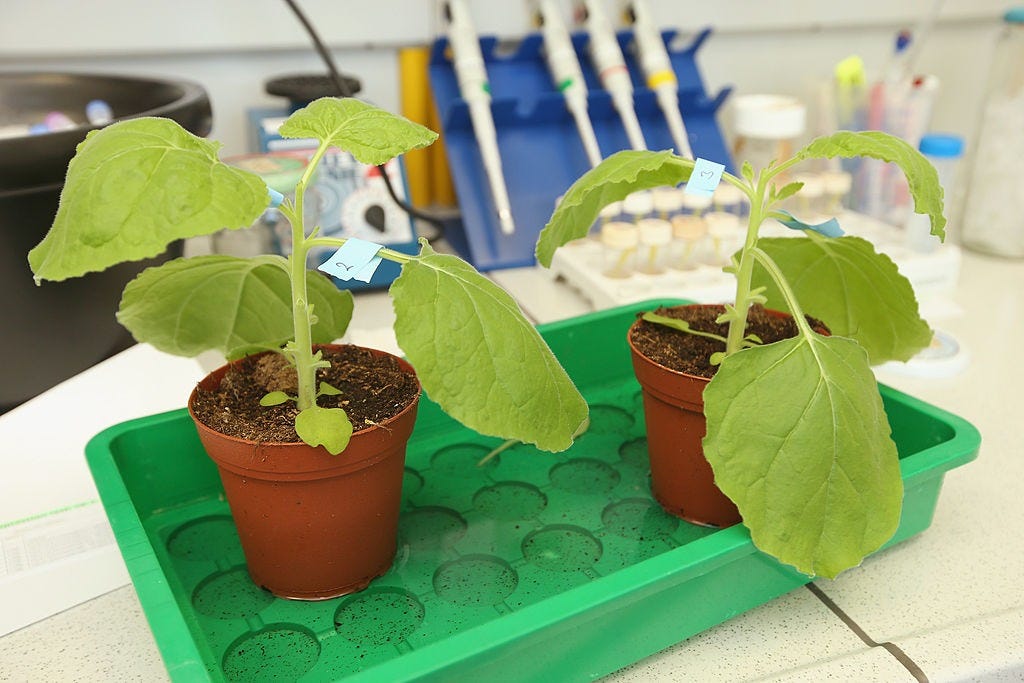
Because the five psychedelic compounds contain similar chemical structures, scientists were able to genetically engineer plants to create all their biosynthetic pathways. After elucidating the complete biochemical pathway for DMT synthesis in plants, the authors went on to overexpress select enzymes in N. benthamiana, which prompted the production of all five psychedelic compounds within a week.
Producing the five drugs at once is not necessarily pharmacologically useful, Miami University bioengineer Andrew Jones (who wasn’t involved with the research) told Science. The psychedelics were produced at low concentrations when synthesized together, compared to when the synthetic pathways were expressed individually. Still, the paper’s authors said their genetically engineered plants demonstrate the feasibility of biosynthesizing psychedelic compounds in a more sustainable way.
‘Mega-analysis’ shows five psychedelics share a neural “signature”
In the largest analysis of its kind, an international cohort of scientists recently found that five psychedelics all produce strikingly similar changes in brain network connections. The authors applied a uniform analysis to brain scans from over 500 people on psychedelics from 11 datasets – bringing together evidence from 267 participants across five countries. They published their results April 6 in Nature Medicine.
The brain mechanisms behind psychedelics’ effects remain elusive. By analyzing multi-center functional magnetic resonance imaging, or fMRI, data, the researchers found psilocybin, LSD, mescaline, DMT, and ayahuasca all impact how brain regions involved in cognitive and sensory processing interact. Specifically, the scientists found increased functional connectivity between high-level cortical networks and networks for visual, tactile and motor processing.
“Usually, the brain’s perception of the external world is very distinct from our memory and abstract thinking,” lead author Manesh Girn told National Geographic. “This is suggesting the psychedelics might close that gap between how we think and how we perceive—between the internal and external.” In addition, the mega-analysis contradicts a popular theory that psychedelics ‘disintegrate’ brain networks, instead finding that the crosstalk between brain regions was boosted, Nature reports.

Want the latest psychedelics news? Subscribe! (It’s free!)
Texas moves forward with ibogaine trials alone, after an unsuccessful search for a drug company partner
Texas plans to launch its ibogaine research program alone after its search for a drug company partner came up empty. The program was initiated by Senate Bill 2308 in 2025, kicking off a $50 million pledge of state dollars for ibogaine clinical trials. The legislation said state leaders must partner with a private drug developer that will collaborate to match state funds and help the trials advance towards Food and Drug Administration approval.
But on March 31, Lieutenant Governor Dan Patrick and House Speaker Dustin Burrows announced new plans after the state Health and Human Services Commission received no qualified drug company applications in its search. “Texas will proceed with our own research program,” Patrick and Burrows write in a joint statement. “We intend to fully fund this program, and will work in partnership with our great medical research teams in Texas to conduct the research.” Advocates said this move will position UTHealth Houston as the state’s “drug developer” and in total commit $100 million in Texas funds for the effort.
The state’s unsuccessful search for a drug company partner isn’t surprising, drug policy fellow Katharine Neill Harris of Rice University told multiple Texas news outlets. It suggests competitive companies were not enticed by the program outlined by Texas officials. “Without the private partner, I don’t know that they actually have the appetite to spend what needs to be spent on this,” Harris told the Dallas Observer. “I think $100 million is a kind of low-ball for what it would take to get to the FDA approval process.” The typical cost of developing new medications is nearly $1 billion, and sometimes more.
Following Texas, many other states are now passing similar legislation to initiate their own ibogaine research trials. For example, Mississippi’s HB314 requires its research consortium to partner with the same drug developer as the leading consortium in another state, Psychedelic Alpha reports. The non-profit advocacy group Americans for Ibogaine has championed these efforts. The group’s CEO W. Bryan Hubbard said Texas doubling its independent funds for this project is a “fabulous evolution of circumstances,” and added that other states may still decide to partner with private drug companies.
“Because of the nature of the multi-state framework that is being built, if the University of Texas at Houston falters in their execution of this project, then there are other states that are ready and willing to lead this effort nationally,” CEO Bryan Hubbard told The Microdose Wednesday.
UC San Diego study identifies factors associated with psychiatric hospitalization following psychedelics use
As recreational use of psychedelics continues to rise, UC San Diego researchers recently analysed emergency department visits associated with taking the drugs. The scientists looked at 232 cases associated with recreational psychedelic use at UC San Diego Medical Center between 2010 and 2023, and found about 11 percent of those patients required psychiatric hospitalization.
“Concurrent cannabis use and pre-existing psychotic or bipolar disorders are associated with increased odds of psychiatric hospitalization,” the authors write. Psychedelic clinical trials often exclude people who could have psychotic or bipolar disorders. The UC San Diego authors published their results on April 1 in the Community Mental Health Journal. They found most of the psychedelic emergency visits were made by patients who were young, white and male after they took LSD, MDMA, or psilocybin. Common symptoms were agitation, anxiety and nausea and vomiting.
U.S. Senators want to create a federal office to prepare for possible approval of psychedelic treatments for veterans
A bipartisan group of federal lawmakers recently introduced Senate Bill 4220 to establish an “Office of Novel Therapeutics” inside the Department of Veterans Affairs (VA). The goal is to have a center to coordinate research and care standards ahead of potential FDA approval of psychedelic treatments. The “Veterans Health Administration Novel Therapeutics Preparedness Act”, introduced in late March, directs the new office to make “implementation-readiness plans” and prepare the VA to approach such treatments safely.
“FDA approval is coming. This bill ensures the VA prepares now so it can deliver these treatments as soon as they’re available. Not years later,” Marine Corps veteran Juliana Mercer, executive director of the advocacy group Healing Breakthrough, told The Microdose Wednesday. “What the VA builds now, in clinical models, training, and reimbursement pathways, can shape how care is adopted across the broader healthcare system, including insurers and pharmacy benefit managers.”
The bill would also create a Veteran Advisory Committee on Novel Therapeutics to guide the office on patient safety, informed consent, and barriers to treatment access. The act would further help designate “Centers of Excellence” to lead the VA’s approach to new therapies and share their best practices with other VA centers. At the same time, S4031, the Innovative Therapies Centers of Excellence Act, is moving through the Senate. The act would establish and fund at least five VA centers focused on psychedelic therapies.

-
On March 27, Japan’s Otsuka pharmaceutical company announced its American subsidiary will acquire Transcend Therapeutics, Inc. for $700 million dollars. Psychedelic Alpha reports Transcend’s methylone TSND-201 drug (an MDMA analog) will soon be tested for PTSD in a Phase 3 clinical trial.
-
After receiving an unexpected marketing email recruiting influencers to publicize the promise of psychedelics on behalf of certain drug companies, STAT investigated such social media campaigns. They found the resulting exaggerated promos could undermine psychedelic biotechs’ efforts to “gain a foothold in the medical mainstream and with established pharma companies that may be interested in acquiring them.”
-
On April 8, Jasveen Sangha was sentenced to 15 years in prison after pleading guilty to selling ‘Friends’ actor Matthew Perry the ketamine that led to his death in 2023, AP reports.

You’re all caught up! We’ll be back in your inbox on Monday with a new issue of 5 Questions.
If you know anyone who might like the latest on psychedelics in their inbox, feel free to forward this to them, or click below.
Got tips? Email us at themicrodose@berkeley.edu.