
A star right here in the Milky Way galaxy is the purest ancient star astronomers have found to date.
That means that it’s remarkably (although not entirely) unpolluted by the metals that only formed after stars had already lived and died – a fossil relic of the early Universe, likely born from gas enriched by one of the early Universe’s first supernova explosions.
Once a low-mass Sun-like star, SDSS J0715-7334 has reached the end of its main-sequence lifespan and is now a red giant nearing the end of its life – surviving just long enough to teach us about times eons past.
“These pristine stars are windows into the dawn of stars and galaxies in the Universe,” says cosmologist Alexander Ji of the University of Chicago, who led the research.
After the Universe burst into existence in the Big Bang, space was filled with a hot, dense fog of plasma consisting of small atomic nuclei and free electrons.
What little light there was wouldn’t have penetrated this fog; photons would simply have scattered off the electrons floating around, effectively making the Universe dark.
By about 300,000 years after the Big Bang, however, the Universe had cooled enough to allow protons and electrons to come together to form neutral hydrogen and a little bit of helium. It was from dense clumps in this pristine hydrogen and helium that the very first stars were born, known as Population III.
Elements heavier than helium did not enter wide distribution throughout the Universe until these stars died.
Stars are powered by fusion – the process whereby atoms glom together to form heavier elements, first hydrogen into helium, then helium into carbon, and so forth. Elements heavier than helium are referred to as metals in astronomy.
The chain ends at iron, because fusing it takes more energy than the process emits, but even heavier elements are forged in the energetic supernova explosions that mark the deaths of massive stars. These explosions seed heavy elements through space, where they can be incorporated into the formation process of new stars.
Every star ever measured has had some degree of this metal enrichment – but some more than others. Those with the least, known as Population II, have metallicity so low that their composition can only have been enriched by Population III.
“No Population III stars have ever been observed, either because they were massive, lived fast, and died young, or the lowest-mass Population III stars that could persist to the present day are extremely rare,” explains astronomer Kevin Schlaufman of Johns Hopkins University.
“Either way, the properties of this first stellar generation are some of the most important unknowns in modern astrophysics.”
Population II stars are, therefore, highly sought by astronomers, who probe their chemical properties to learn about the stars that made them.
This brings us back around to SDSS J0715-7334, discovered almost by accident by Ji and his students, looking for interesting stars using the Sloan Digital Sky Survey (SDSS) as part of their curriculum.
On their first night on the telescope, the second star the students looked at was SDSS J0715-7334. The plan was to look at it for 10 minutes. They ended up staring at it for three hours.
“I was looking at that camera the whole night to make sure it was working,” says astronomer Natalie Orrantia, one of the students involved.
On closer inspection, the star turned out to have a composition that was almost completely hydrogen and helium. Its metallicity is just 0.005 percent that of the Sun, and nearly half that of the previous record-holder for low metallicity.
There was a mere skerrick of iron in its spectrum – its total metallicity 40 times lower than the next most iron-poor star known. But what truly wowed the researchers was its shockingly low carbon content.

“The star has so little carbon that it suggests an early sprinkling of cosmic dust is responsible for making it,” said Ji. “This formation pathway has only been seen once before.”
Usually, gas needs certain elements like carbon or oxygen to cool enough to form stars. The formation pathway for Population III stars is thought to have relied on hydrogen molecules, which are less efficient, but once carbon emerged, it became the dominant player in the cooling required for star formation throughout the Universe.
The lack of carbon in SDSS J0715-7334’s spectrum does not point to pure hydrogen cooling, as the Universe’s first stars likely used.
Instead, its chemistry suggests it formed in a rare intermediate regime, where there was too little carbon for the usual cooling route, so tiny amounts of cosmic dust, the leftover ashes of Population III supernovae, probably helped the gas collapse.
Related: We Finally Know What Turned on The Lights at The Dawn of Time
“However, many more similarly metal-poor stars will need to be found in different environments to test this hypothesis,” Ji and team write in their paper.
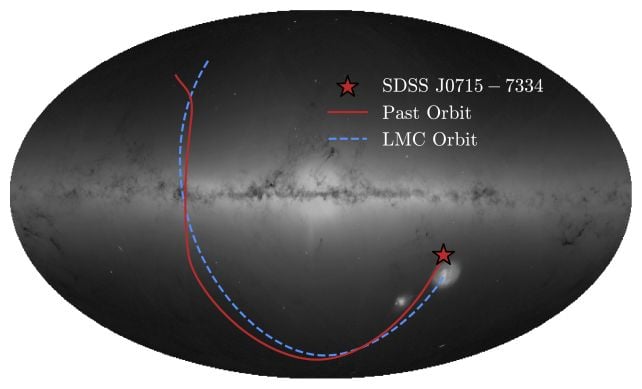
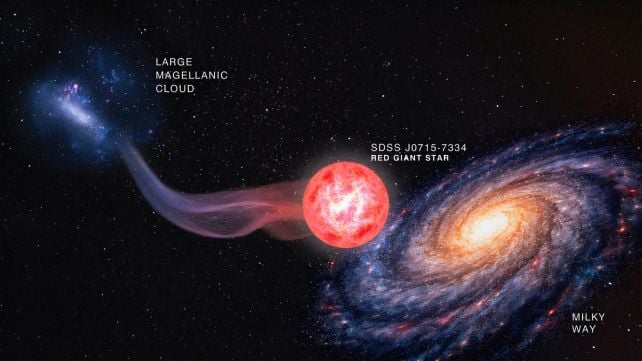
The star’s position and motion through the sky suggest it came not from the Milky Way, but the Large Magellanic Cloud, a dwarf galaxy orbiting the Milky Way. This could mean that the Large Magellanic Cloud contains more such stars awaiting discovery.
“It’s possible that we’re going to find a relatively higher proportion of ultra-metal-poor stars in galaxies like the Magellanic Clouds than in our own Milky Way Galaxy,” Schlaufman says.
“There is still lots to be done to understand what actually was going on in that era long, long ago when the Milky Way was young. We’ve only scratched the surface.”
The discovery has been published in Nature Astronomy.