
The RNA world hypothesis posits that molecules made up of ribonucleic acids (RNA) are responsible for kickstarting evolution and all life on Earth – and scientists just discovered a crucial new piece of evidence backing it up.
Figuring out how complex life formed from simple chemical building blocks is a daunting challenge that scientists have been grappling with for years.
One of the nagging doubts about the RNA world hypothesis has been that RNA molecules capable of copying themselves (and thus sparking life) are too big and sophisticated to arise spontaneously.
Enter an RNA molecule dubbed Quite Tiny 45 (QT45), detailed in a study led by a team from the Medical Research Council (MRC) Laboratory of Molecular Biology in the UK.
QT45 is what’s called a polymerase ribozyme, an RNA that can act as an enzyme, speeding up chemical reactions, to help build molecules from genetic templates.
It can also get close to self-replication, the researchers showed, by copying its complementary strand (a mirror image sequence of the original RNA molecule), and using that strand to then make a copy of itself in a separate reaction.
This isn’t full self-replication yet, but it’s a demonstration of two key steps of the process – each completed individually. And it’s happening in a molecule that’s small and simple enough to have possibly existed before life itself. Once genetic material can copy itself, life can begin.
“This research offers a glimpse into what the earliest steps of life might have looked like and deepens our understanding of the fundamental molecules that underpin all living systems,” says biochemist Edoardo Gianni from the MRC Laboratory of Molecular Biology.
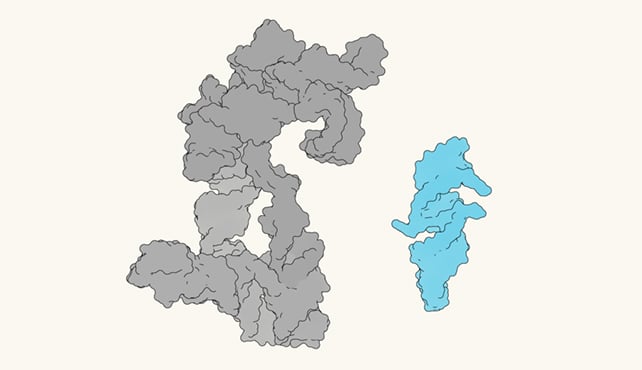
Today, RNA actually outsources the self-replication job to proteins. Scientists have previously shown it is possible for teams of RNA molecules to create copies of themselves – but up until now these molecules, cooked up in lab experiments, have been too large and complex to feasibly have come together in the primordial ooze.
To get to the simpler, smaller QT45, the researchers created specially engineered, freezing cold pools of liquid. In these pools were a trillion RNA sequences, all random and extremely short: The researchers wanted to see if any of these combinations would show the ability to copy and stitch together RNA building blocks.
Through several rounds of testing and refining, QT45 emerged. Further analysis and experiments demonstrated that in optimized conditions the RNA molecule could synthesize itself (across the course of 72 days), as well as other RNA templates of increasing complexity – capability and versatility that’s particularly promising for the RNA world hypothesis.
 frameborder=”0″ allow=”accelerometer; autoplay; clipboard-write; encrypted-media; gyroscope; picture-in-picture; web-share” referrerpolicy=”strict-origin-when-cross-origin” allowfullscreen>
“By identifying a small RNA, it makes the whole idea that self-replicating RNA emerged spontaneously much more likely, and thanks to its size, it managed to copy all of itself and its template – unlike previous work where only small parts were copied,” says Gianni.
While this doesn’t achieve full self-replication, QT45 has proved that it can do two of the hardest steps. Some lab trickery was still required from the researchers to create a full cycle like the one that would be needed in nature.

Next, the researchers are hoping to increase both the speed and the yield of the QT45 copying process – right now, it takes a relatively long time to create a relatively small amount of material, though we’re still at the very early stages here.
Although there are challenges ahead, we’re now significantly closer to understanding how life may have formed from the very beginning, and how the RNA world hypothesis might have played out.
Related: Molecule Vital to Happiness Found in Material From Asteroid Bennu
These discoveries are important in the search for life elsewhere in the Universe too. Once we have a full picture of what sparked basic chemicals into life here on Earth, it means scientists will be better able to spot that picture happening on distant moons and planets.
“Beyond its scientific significance the discovery also has implications with regards to how likely life is to emerge spontaneously and whether similar processes could occur on other planets,” says Gianni.
The research has been published in Science.