
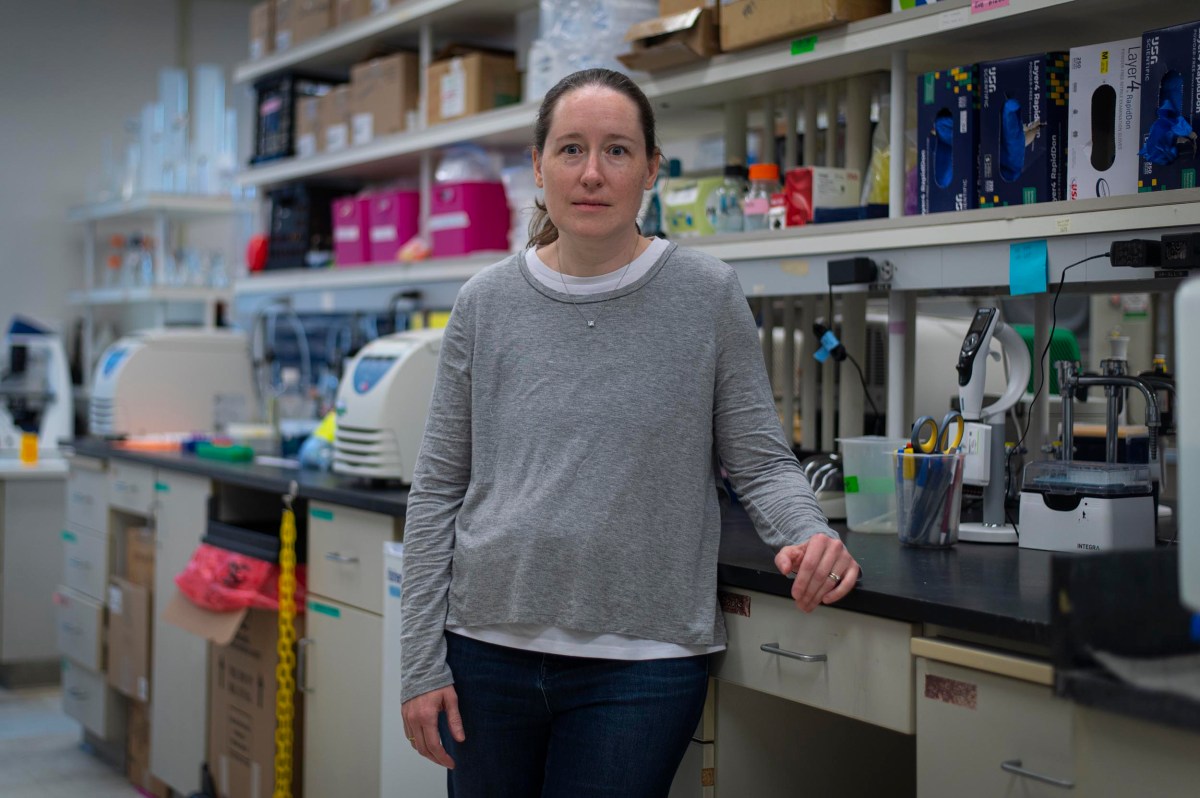
Emily Bruce keeps a bullet journal, in which she records a meticulous tally of the grants she’s applied to and received.
Since beginning as an assistant professor at the University of Vermont’s Larner College of Medicine five years ago, she’s applied for 40 grants and received three small ones. She is still waiting to hear about the status of 11.
That seems unusual to Bruce.
Her experience is a local manifestation of a trend in federal funding for research that scientists across the U.S. are facing: Robust research dollars from the National Institutes of Health are not reaching scientists on the timeline or at the scale researchers have come to expect.
As one congressperson, U.S. Rep. Rosa DeLauro, D-Ct, put it: “NIH grant funding for fiscal year 2026 has dwindled to a trickle.”
She said that in a March 17 congressional committee where lawmakers heard from officials at the National Institutes of Health. The agency’s allotted grant funds for 2026 had just been approved to disperse to researchers the day before, a long lag almost halfway into the fiscal year. In that hearing, NIH Director Jay Bhattacharya told lawmakers that the institutes intended to award all of this year’s congressionally allocated funds.
Bhattacharya’s tenure at the NIH, under the direction of Health and Human Services Secretary Robert F. Kennedy Jr., has been marked by vocal claims that his efforts undermine scientific research. President Donald Trump’s administration proposed a budget for fiscal year 2026 that would have drastically cut the funding NIH can award. Congress, though, rejected that proposal and restored the funding for 2026.
Still, delays followed — one reason some lawmakers pointed to is a new rule that the White House Office of Management and Budget must officially release congressionally designated dollars, and it was slow to do so.
Additional explanations include the exodus of nearly 4,400 NIH staff since Trump’s election and the fall 2025 government shutdown, but the upshot is the same: Federal funding for science is not flowing to researchers at the pace or scale academics say they need.
An analysis of the NIH’s data by the Association of American Universities found that by the end of February, the federal body had awarded 66% fewer awards this fiscal year than it had during the same period for fiscal years 2021 to 2024.
The dollar amount awarded also dropped by 54% in that same period, according to the analysis.
“This has been the most turbulent, unpredictable, complicated, difficult period of the American biomedical research enterprise,” said Steven Bernstein, the chief research officer at Dartmouth Hitchcock Medical Center, in an interview.
Vermont is no exception to these national trends. Halfway into the 2026 fiscal year, the state has received $10.3 million for 23 projects. Throughout the 2025 fiscal year, Vermont received $41 million for 74 projects, an NIH database shows.
UVM received the lion’s share of the money the state receives from the NIH.
Kirk Dombrowski, who heads research at the university, said he has primarily seen this shift as an increase in what he called “forward funding.” Instead of doling out award dollars on an annual basis for the duration of a five-year grant period, as has been typical in years past, the NIH has been allocating the money in bigger lump sums.
“It’s a way of spending their whole budget without actually making as many new awards as they might,” Dombrowski said.
An analysis from the New York Times found that this trend is widespread. Its authors found the average size of a competitive grant nearly doubled from $472,000 in the first half of 2025 to more than $830,000 by the end of the year. It means that fewer projects received funding: bigger slices of pie, fewer slices.
The authors described this as a “fundamental shift” in how the government funds science.
In response to an inquiry from VTDigger, NIH’s press secretary Emily Hilliard did not respond to questions about the shift toward lump funding.
She wrote that the federal body had made revisions to “simplify and streamline the grant application process.” Yet, she said the agency now directs people to apply under broader announcements of funding opportunities, rather than to the specific research needs it has historically outlined in these announcements.
The change “reduces administrative burden and supports more efficient funding decisions. NIH continues to make funding decisions promptly while maintaining rigorous review standards,” Hilliard wrote.
This reflects a trend researchers have also noticed, of far fewer notices of funding opportunities. In the Chronicle of Higher Education, former NIH official Elizabeth Ginexi calculated that, as of March 15, the NIH posted 14 notices of funding opportunities for 2026. That contrasts with 756 notices in 2024 — an average of 189 every three months. From 2012 to 2023, the NIH published an average of just over 700 notices annually, she found.
Ginexi described a new process of review at NIH that is making grants move more slowly, where funding needs to be approved by political appointees rather than by the specializing scientists.
Bernstein, at Dartmouth Hitchcock, described the same thing. He said the institution has seen the fallout of these additional lags.
The medical institution has one pending grant application that scored very well, and Bernstein expects it to receive funding, but it’s been pending at this final review step for several months.
That’s highly atypical, he said.
Bernstein also explained how unusual funding in lump sums is for NIH. Typically, the agency awards multi-year grants one year at a time, as researchers submit progress reports along the way, he said.
He called the shift to multiyear funding “highly problematic,” though at Dartmouth Hitchcock, the impact has been modest, since the university has some bridge funding to carry through any gaps.
However, not everyone with mult-year grants has received forward funding. A number of researchers at Dartmouth Hitchcock have seen delays in funding for their second or third years of research, Bernstein said.
“When you start your grant, you may hire some people, you have a team, a lab. You’re doing your thing, and then at the end of year one or year two, the work continues. You can’t sit around to wait for that next check to come in from NIH,” he said.
The effect of the lump sums at UVM has been that the number of new awardees decreased, Dombrowski said, though the university has also seen many current grantees “funded forward” and receive big lump-sum payments for the coming years.
It means those with established grants have been weathering the NIH upheaval “relatively OK,” as Dombrowski said.
READ MORE

However, he worries for the early career scientists who do not have established long-term funding for their research. People like Emily Bruce.
Bruce described trying to procure funding like an increasingly crowded game of Whac-A-Mole, as more researchers are competing for a smaller yearly pool of grants and trying to dodge the changing federal rules and preferences.
A virologist by training, Bruce set up her lab to study Covid-19 when she began as a professor in 2021. She placed papers in a number of prestigious journals and had a small but very competitive NIH grant fueling her work, she said.
But then, she pivoted to study influenza, which she had studied during her PhD. In the current research and political climate, Bruce felt it was too risky to stake her whole lab on the study of Covid-19. She restarted the process of building a research program from scratch.
In her latest round of grant applications, she broadened even further and applied for funding for a project on cell biology, without including viruses at all.
“It’s not where all of my publications and my strengths and my expertise is,” she said, “but it seemed like something that I had to try, given what was happening to biology.”
She’s frustrated that she’s spending so much time on writing grant application after grant application, rather than doing the science itself.
“That’s not the way to get the most bang for our buck, having all these people that we’ve invested a lot of money in training and so on, spending most of their time writing,” Bruce said.
She also feels this same resource drain in the rest of her lab, where she has not been able to keep talented researchers because she simply cannot commit to hiring them.
It’s frustrating to Dombrowski at the university level as well. Research, he said, is the central means to education at UVM.
“We are a teaching university by virtue of being a research university,” he said. “When we can’t do that, well, it really is a threat. It’s intrinsic to everything.”