
A team of physicists has pushed the limits of quantum control by cooling the rotational motion of a nanoscale object to its lowest possible energy state.
Quantum mechanics tells us that no particle can ever be completely motionless. But how precisely can its orientation be controlled? Researchers at the University of Vienna, working with colleagues at TU Wien and Ulm University, have now cooled the rotational motion of a levitated silica nanorotor to its quantum ground state in two orientational degrees of freedom.
Writing in Nature Physics, the team shows that optical cooling can confine the particle’s orientation within the limits set by quantum zero-point fluctuations. These fluctuations represent the unavoidable uncertainty required by Heisenberg’s uncertainty principle.
Reaching this level of control marks a key step toward rotational matter-wave interferometry and highly sensitive quantum torque measurements.
Rotation at the quantum limit
In everyday conditions, tiny particles constantly move and rotate due to thermal energy, and temperature reflects how much motion they have. Classical physics suggests that, in theory, particles could be cooled until they stop completely and hold a fixed orientation. Quantum mechanics, however, sets a stricter limit. Even at absolute zero, particles retain a minimum amount of energy and cannot be perfectly aligned.
When silica nanoparticles are held in place by tightly focused laser beams in an ultra-high vacuum, they behave like nearly ideal harmonic oscillators. They oscillate both in their position and in their rotation, similar to a system that combines a linear pendulum with a twisting, or torsional, motion.
As the temperature drops to less than one ten-thousandth of a degree Celsius above absolute zero (0.0001 °C or about 0.00018 °F), energy changes no longer occur smoothly. Instead, the system moves between discrete energy levels. The lowest of these levels is the quantum ground state, which still contains a small but unavoidable amount of energy.
Previous experiments have already cooled levitated nanoparticles to this ground state, including work by Uroš Delić and Markus Aspelmeyer at the University of Vienna (Science 2020). However, controlling rotational motion has been more difficult. Until now, it had only been achieved along a single axis by a team led by Lukas Novotny at ETH Zürich (Nat. Phys. 2025).
Achieving Two-Dimensional Quantum Alignment
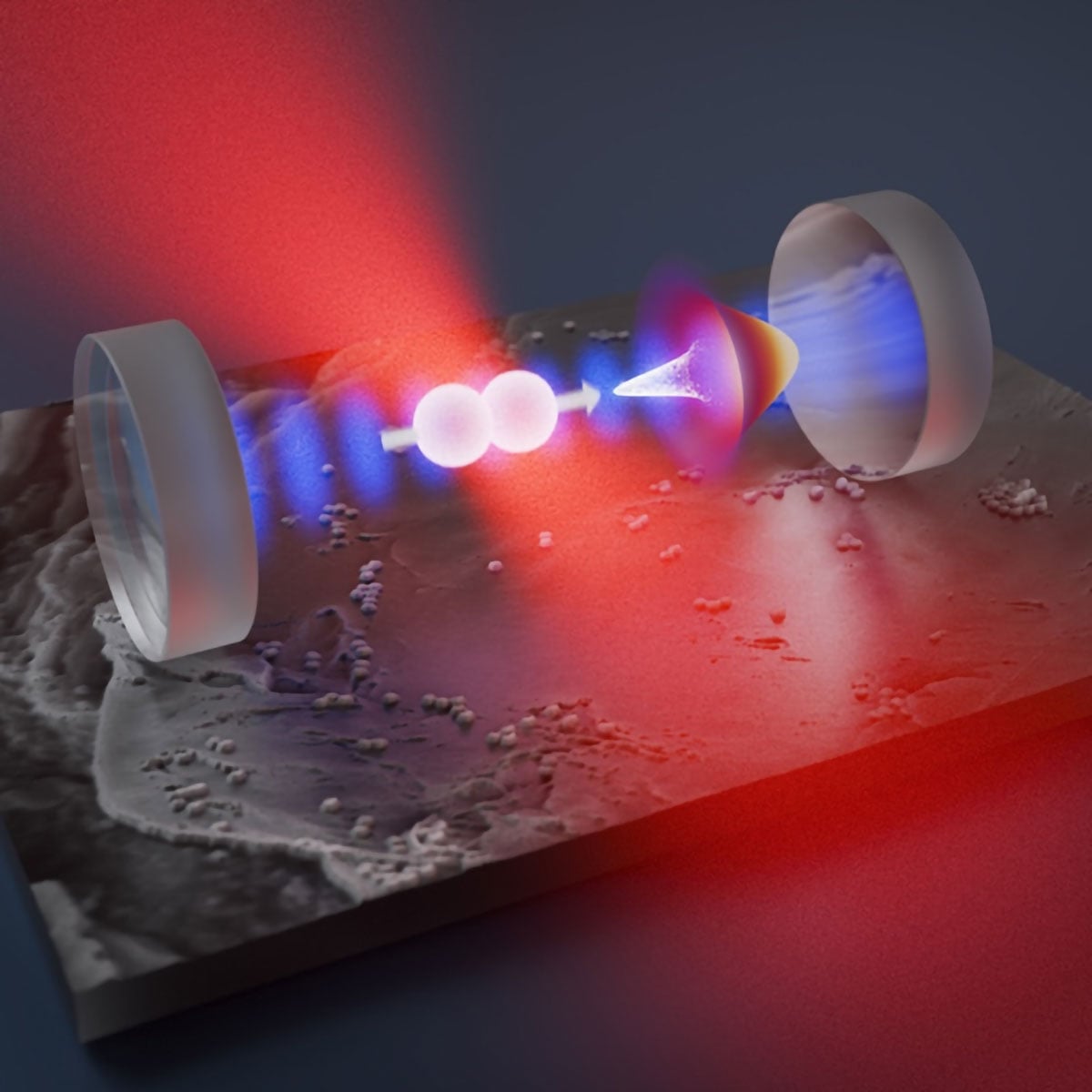
In the latest study, led by Markus Arndt (University of Vienna), Uroš Delić (TU Wien), and Benjamin Stickler (Ulm University), researchers used a tiny dumbbell-shaped rotor made of two silica spheres, each 150 nm in diameter (150 nanometers or about 5.9 × 10⁻⁶ inches). The laser’s electric field holds and aligns the particle, acting like an invisible spring.
At first, the trapped rotor still shows thermal rotational motion, known as libration. As optical cooling is applied, its temperature drops to just a few tens of microkelvin above absolute zero. At this point, quantum effects dominate, and the system reaches its lowest energy state.
By cooling rotation along two axes, the team achieved quantum-limited alignment in multiple directions for the first time. Even at this level, the rotor’s orientation cannot be perfectly fixed. Its direction remains uncertain by about 20 µrad (20 microradians, or about 0.0011 degrees).
“The tip of the rotor then moves less than one hundredth of the diameter of a single atom,” says Stephan Troyer, lead author of the study. “This is like a compass needle oriented to better than the width of a bacterium.”
A new window into the quantum world
This level of control is not just a technical milestone. It opens the door to new types of quantum experiments. Most current quantum systems involve individual atoms, ions, or molecules. In contrast, these silica nanorotors contain around 100 million atoms and still display quantum behavior.
Rotational motion introduces effects that do not appear in linear systems. After a full rotation, the object returns to the same orientation. If the trapping light is turned off, the rotor can enter a quantum superposition, effectively rotating in all possible directions at once.
Over time, the particle’s initial alignment spreads out and becomes undefined, then later reappears in a predictable way. This process, known as quantum revival, forms the basis for rotational matter-wave interferometry. Observing this effect may require smaller particles, potentially approaching the size of a tobacco mosaic virus, which is about 100 times lighter than the rotor used here.
“The beauty of our 2D cooling method is that it works across scales,” says Stephan Troyer. “Cooling is easier for larger bodies but applying our techniques to smaller structures we hope to be able to observe this rotational quantum interference. This is an interesting system for probing the interface between quantum physics and phenomena of our daily lives.”
This approach could also advance quantum sensing. A cooled nanorotor can act as an extremely sensitive detector of tiny torques, which are the rotational equivalent of very small forces.
How it works: intense light can cool the motion
To reach such low temperatures, the researchers use a method called coherent scattering cooling. The nanoparticle is trapped in a very intense light field, about 100 MW/cm2 (100 megawatts per square centimeter, or about 6.45 × 10⁸ watts per square inch), and scatters light into an optical resonator.
Each scattered photon can remove a single unit of rotational energy from the particle and transfer it into the optical field. Repeating this process steadily reduces the rotor’s energy, cooling it down to its quantum ground state.
Reference: “Quantum ground-state cooling of two librational modes of a nanorotor” by Stephan Troyer, Florian Fechtel, Lorenz Hummer, Henning Rudolph, Benjamin A. Stickler, Uroš Delić and Markus Arndt, 6 April 2026, Nature Physics.
DOI: 10.1038/s41567-026-03219-1
The experiment was substantially funded by the Office of Naval Research Global (ONRG, grant N62909-23-1-2029), the Austrian Academy of Sciences (ÖAW, ESQ Discovery Project awarded to S. Troyer), the Carl-Zeiss Foundation (QPhoton project led by B. A. Stickler), the Deutsche Forschungsgemeinschaft (DFG, grant 510794108 to B. A. Stickler), and the Austrian Science Fund (FWF, grant 10.55776/STA175 to U. Delić).
Never miss a breakthrough: Join the SciTechDaily newsletter.
Follow us on Google and Google News.