

Lieutenant General Georgios Tsolakoglou, who declared defeat and signed the surrender to the Germans in April 1941, is one of the most divisive figures in modern Greek history.
He was a hero when the Greek troops under his command thrashed the Italian army in the mountains of northern Epirus in the winter of 1940-41, but became a villain when, despite orders, he surrendered and formed the first collaborationist government. He was convicted of treason immediately after the end of the Second World War, but his legacy still divides Greece.
Before he became the face of collaboration, Georgios Tsolakoglou was actually a highly respected and decorated career officer. He was considered a “soldier’s soldier,” which is precisely why his eventual surrender carried such a heavy emotional weight for the Greek public—it felt like a betrayal by one of their own heroes.
Tsolakoglou and his surrender to the Germans
By mid-April 1941, the Greek army was in a dire position. They had successfully repelled the Italian invasion earlier in the winter, but the German invasion (Operation Marita) that began on April 6 proved overwhelming.
On April 20, 1941, Tsolakoglou, then commander of the Army Corps of Western Macedonia, took the initiative to surrender despite the explicit orders of the Greek High Command and King George II.
He argued that further resistance was futile and would only lead to the needless “useless shedding of Greek blood.”
Tsolakoglou’s memoirs, titled simply “Απομνημονεύματα” (Memoirs), were published posthumously in 1959 (and reprinted as recently as 2023). They are a fascinating, though highly defensive, window into the mind of a man trying to justify what most of his countrymen considered the ultimate betrayal.
Justifying surrender
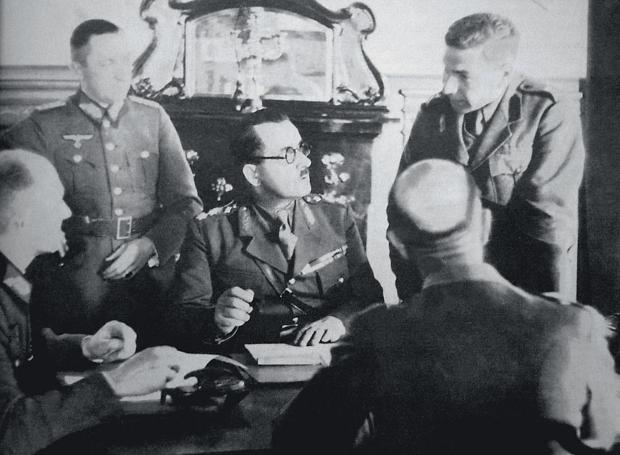
He repeatedly claims that by signing the surrender, he “fell into the fire” to save the Greek army. He describes the moment of signing as the most painful of his life, framing it as a self-sacrificial act to prevent the “biological extinction” of the Greek youth who were trapped in Epirus.
He also held a specific pride: he was willing to surrender to the Germans (whom he felt had technically defeated the Greeks), but he initially refused to surrender to the Italians, whom the Greeks had successfully held off for months.
Collaboration with the Germans
In his memoirs, he claimed he took the role of Collaborationist Prime Minister to act as a shield between the Greek people and the Nazi occupiers, hoping to mitigate the harshness of the occupation.
He justifies taking the Prime Minister’s seat by claiming that if a Greek general hadn’t stepped up, the Germans would have installed a “gauleiter” (a German governor) or allowed the much-hated Italians and Bulgarians to occupy the entire country, including Athens.
Interestingly, in the early days of his government, he issued statements calling National Socialism a “new political religion” created by the “luminous mind” of the Führer. In his later memoirs, he tends to downplay this rhetoric, focusing instead on his role as a “stabilizer” during the Great Famine.
Tsolakoglou and his deference to Hitler
The prevailing historical and legal verdict, however, is overwhelmingly against him.
He disobeyed the direct orders of his Commander-in-Chief and the King. In military terms, his “surrender” was technically a mutiny.
By forming a collaborationist government, he gave the Nazi occupation a “Greek face.” This helped the Germans manage the country with fewer of their own administrative resources.
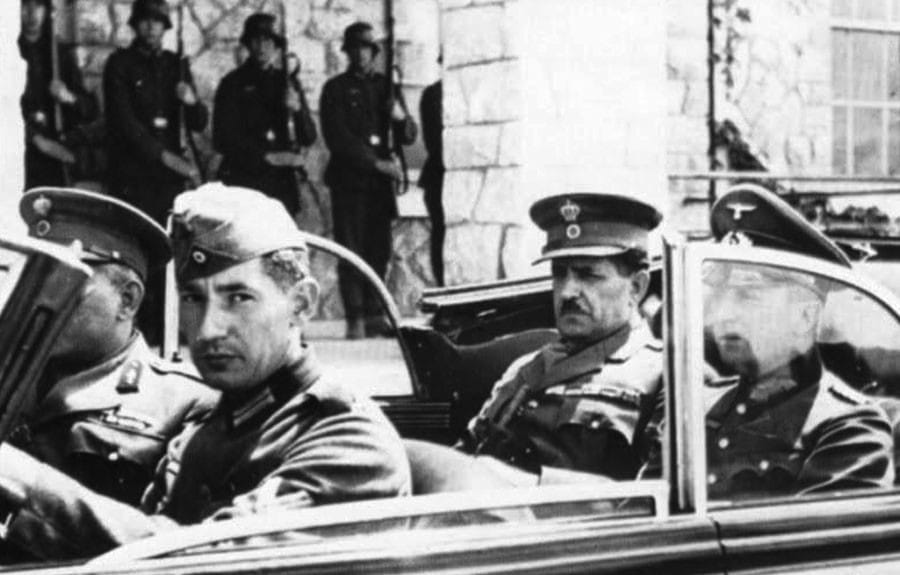
He wrote a formal letter to Hitler on April 26, 1941, the day before German tanks entered Athens.
In the text, Tsolakoglou used highly deferential language to appeal to Hitler’s ego and vision for Europe. The main points included:
- The Offer of Leadership: He formally proclaimed his willingness to head a collaborationist government composed of senior military generals.
- The “British Problem”: He framed the surrender and his new government as a way to “cleanse” Greece of British influence. He argued that the legal Greek government (the King and Prime Minister) had committed a “crime” by inviting the British to Greek soil.
- Acknowledgment of German Supremacy: He referred to Hitler as the “Führer of the German People” and expressed a desire for Greece to align with the “New Order” in Europe.
- Territorial Integrity: He pleaded with Hitler to ensure that Greece remained intact and not divided among the other Axis powers (specifically Italy and Bulgaria), arguing that the Greek people would be more compliant under a domestic administration.
On April 30, 1941, three days after they entered Athens, the Germans set up a collaborationist government under the premiership of Tsolakoglou, one of the three chiefs of staff.
Tsolakoglou issued orders that decreed the conduct of the Greek population toward the occupying forces. A “Daily Address of the President of the Government to the Army,” issued in the first days of May 1941, announced:
“Now that, on account of the magnanimous gesture of the Führer, Leader of the German Nation, freedom has been granted to all military officers and soldiers, I must address the following matters to all those who fought on my side and those who fought on the side of my collaborating generals. …The German Army has not come here as an enemy, as an adversary. It has come as a friend. It occupied our land in order to expel the English from mainland Greece. They, an evil fortune, had been invited to our national land by our criminal government. We are obligated to exhibit our friendly feelings toward the Germans, to submit to the new order of things, and to take to heart the great dogmas and the great principles of National Socialism, this new political religion, which has been created by the luminous mind and great psyche of the Führer. Returning now to your homes, maintain your gratitude to the Führer and apply yourselves to your peaceful endeavors…”
Despite his claim that he would “shield” the people, his government oversaw the beginning of the Great Famine (1941–1942), where hundreds of thousands of Greeks died of starvation. He was also unable (or unwilling) to prevent the Bulgarian occupation of Eastern Macedonia and Thrace, which involved brutal “Bulgarianization” campaigns.
Convicted of high treason
At his trial for high treason in 1945, Georgios Tsolakoglou’s defense was built on a strategy of “Patriotic Realism.” He did not deny his actions; instead, he argued that his intent was to preserve the Greek nation when the official government had “abandoned” it. A Special Court for Collaborators found him guilty of high treason. The court ruled that his surrender “facilitated the enemy” and that his government served German interests over Greek lives.
The court pointed out that despite his claims of being a “shield,” the occupation under his watch was one of the most brutal in Europe. The Great Famine of 1941 occurred while he was Prime Minister, and he had been unable to stop the Bulgarians from annexing Greek territory in the north.
He was sentenced to death for high treason and for the “illegal surrender” of the army.
However, because of his long previous service as a decorated officer in the Balkan Wars and WWI, and perhaps recognizing the genuine military dilemma he faced in those first few days of April, his sentence was commuted to life imprisonment. He died in prison three years later from leukemia, still maintaining that he was a patriot whom history had misunderstood.
In the eyes of the Greek state and the public consciousness, the label of “Traitor” stuck. While he may have started with the intention of saving his soldiers’ lives, his transition from a surrendering general to a puppet politician made him the face of a dark era.
He is rarely viewed with the same nuance as someone like Marshal Pétain in France; in Greece, Tsolakoglou is almost universally remembered as the man who handed the keys of the country to the Axis.