
Archaeologists in Poland are finally solving an over 2,000-year-old mummy mystery. After modern warfare erased vital information about the ancient Egyptian child, researchers were unsure about the boy’s origins and life. Now, they’ve discovered a striking detail while examining the delicate remains—a once-hidden ritual object resting on the boy’s chest. Their findings published in the journal Digital Applications in Archaeology and Cultural Heritage are now helping fill in the gaps of our understanding of ancient burial practices, while also underscoring how much is left to learn about the complex art of Egyptian mummification.
The child’s precise origins are an unfortunate casualty of war. Although the mummy has remained a part of the Archdiocesan Museum in the city of Wrocław since 1914, its records were lost during World War II. The well-preserved body remained in the museum’s archives for decades, but archaeologists only began a first comprehensive analysis in 2023. Led by historian Agata Kubala at the University of Wrocław, the team utilized techniques including CT scanning and X-ray imaging to create highly detailed, 3D images of the mummy and its decorated casing known as the cartonnage. This allowed them to gain unprecedented looks at the specimen without damaging it.
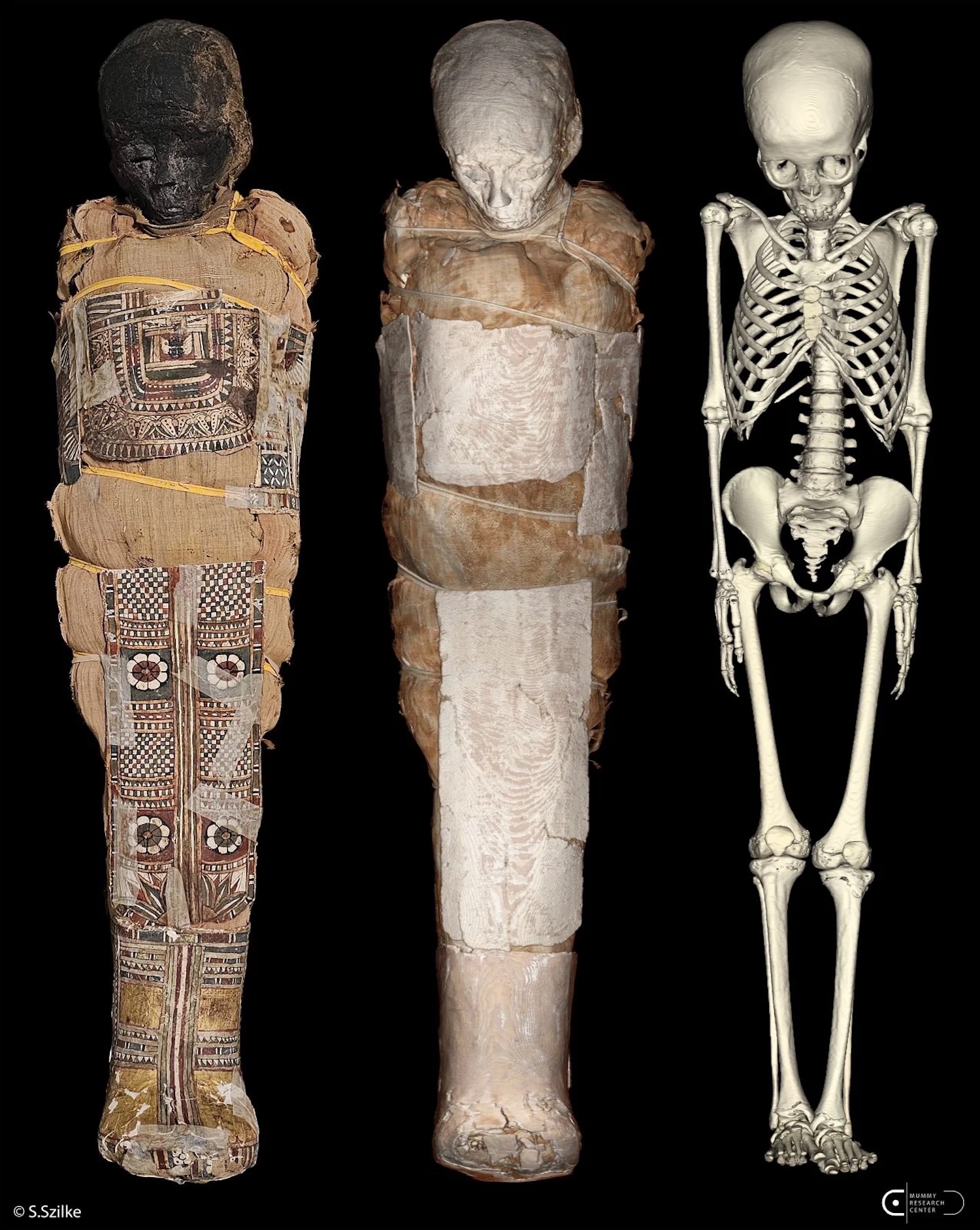
Kubala and her team determined the boy was around eight years old when he died based on his teeth development. However, without any obvious signs of disease or physical trauma, his exact cause of death remains unclear. Despite these gaps, they still could confidently assess other details about the mummy. Preparers extracted his brain through the nasal cavity using traditional methods, but also removed most of his vital organs via some unconventional routes. Mummification frequently relied on organ removal via abdominal incision, but in this case, they appear to have done so through the rectum. The body itself was then partially filled with textile materials, but lacked a large amount of resin. Taken altogether, researchers say these details point to a middle-class family’s burial during the Ptolemaic Period (about 332–30 BCE).
Although the historical records are gone, the mummy’s cartonnage offered numerous clues about its origins. It included iconography and thematic images of rosettes, a winged scarab, and lotuses all point to Upper Egypt—more specifically the area near Kom Ombo or Aswan. There is even the depiction of a hybridized deity carrying a mummy. The study’s authors theorize this may be the primordial snake god, Nehebkau.
But according to the archaeologists, the most intriguing find isn’t the mummy’s preservation techniques or cartonnage design. During 3D imaging, experts noticed an unknown object placed on the child’s chest. Attempting to physically examine the item is far too risky given the overall state of the remains. While a definitive answer isn’t possible just yet, the archaeologists think the item is possibly a papyrus scroll containing personal information on the boy—maybe even his name. The researchers are undeterred, and plan on exploring alternative methods to reveal the object’s secrets.
“This is not the end of the research,” Kubala said in a university statement. “We are still working on the mummy.”

2025 PopSci Best of What’s New