
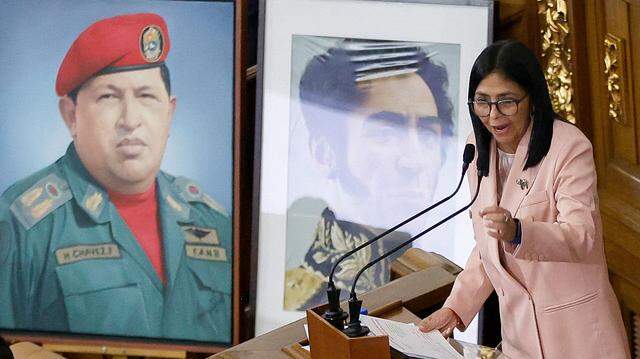
In this file photo, Venezuelan Vice President Delcy Rodriguez speaks near portraits of late Venezuelan President Hugo Chavez and liberator Simon Bolivar during the presentation of the 2026 fiscal year budget at the National Congress in Caracas on Dec. 4, 2025.
AFP via Getty Images
The United States on Tuesday lifted key sanctions on Venezuela’s state-run financial system, allowing the country’s central bank and major public lenders to reenter global finance and conduct transactions in U.S. dollars.
The U.S. Treasury Department said the measure applies to the Central Bank of Venezuela and several state-owned institutions, including Banco de Venezuela, Banco del Tesoro and Banco Digital de los Trabajadores, as well as any entities in which they hold a majority stake.
Treasury’s Office of Foreign Assets Control also issued a license authorizing certain commercial transactions with the Venezuelan government, although such dealings will require prior approval from U.S. authorities.
The decision marks the latest step in a rapid thaw in relations between Washington and Caracas following the January detention of former strongman Nicolás Maduro during a U.S. military operation.
Since then, the Trump administration has moved to unwind years of sanctions imposed to pressure Maduro from power while seeking to bolster the interim government of acting President Delcy Rodríguez.
U.S. officials say the easing of financial restrictions is intended to unlock billions of dollars in oil revenues and facilitate economic recovery in a country battered by years of crisis, hyperinflation and isolation from international markets.
By restoring access to dollar transactions, the move allows Venezuelan institutions to resume correspondent banking relationships and process payments through the U.S.-dominated financial system — something that had been largely impossible since the U.S. imposed sanctions in 2019.
The policy shift comes as pressure mounts on Rodríguez’s administration at home. In recent weeks, public-sector workers have staged protests in Caracas demanding higher wages, with many earning about $160 a month, well below private-sector averages.
Rodríguez has resisted raising salaries, wary of fueling inflation by printing money without sufficient foreign currency reserves. The sanctions relief is expected to ease that constraint by giving the government access to fresh revenue from expanding oil exports.
Washington has also taken steps to revive Venezuela’s energy sector, granting licenses for U.S. firms to engage with state oil company PDVSA and backing new production agreements, including a recent deal with Chevron to increase output.
Treasury on Tuesday issued additional general licenses permitting financial transactions involving Venezuelan government entities and authorizing negotiations for commercial contracts, though final execution remains subject to separate approvals.
Analysts say the coordinated measures reflect a broader U.S. strategy to stabilize Venezuela’s economy while opening the door to American investment, particularly in oil and mining.
For nearly a decade, Venezuela’s central bank and state lenders have struggled to conduct transactions abroad due to a lack of correspondent banks — a problem that worsened after Washington imposed sweeping sanctions in 2019. Correspondent banks provide services to facilitate international wire transfers, currency exchange and trade finance.
The new policy framework is expected to help channel increasing oil revenues into the domestic financial system through a revamped dollar allocation mechanism managed by the central bank.
Still, challenges remain. Economists warn that rebuilding trust in Venezuela’s financial institutions will take time and that smaller businesses may continue to face difficulties accessing foreign currency under a system that has historically favored larger firms.
This story was complemented with reporting from el Nuevo Herald’s wire services.

Galardonado periodista con más de 30 años de experiencia, especializado en la cobertura de temas sobre Venezuela. Amante de la historia y la literatura.