
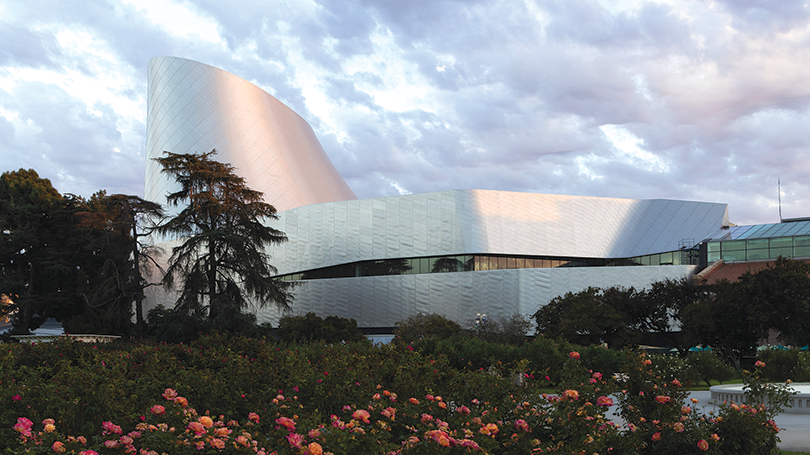
The new expansion was designed to emulate the aerodynamic geometry of the space shuttle. (photo © Mike Kelley/courtesy of the California Science Center)
As NASA’s Artemis II astronauts circled the moon and moviegoers flocked to theaters to see Ryan Gosling travel light years through space in “Project Hail Mary,” one local institution made a giant leap in its ongoing effort to bring space education to Angelenos. On April 13, the California Science Center announced that construction of the Samuel Oschin Air and Space Center is complete.
The 200,000 square foot expansion will nearly double the museum’s educational exhibit space, with 100 new interactive galleries constructed around the 20-story display of Space Shuttle Endeavor. The spacecraft – the last ever built for NASA’s Space Shuttle program – will be the only shuttle in the world displayed in an upright launch position.
“It is the culmination of decades of planning and work to create one of the best science centers in the world, to really inspire and motivate the next generation of young people – scientists, engineers and explorers,” California Science Center President and CEO Jeffrey Rudolph said. “This project … creates a worldwide destination. The space shuttle itself is absolutely amazing, and everybody who has seen it so far as we’re going through construction is in awe. That sense of awe or wonder is what really motivates young people – people of all ages – to want to learn more about science and engineering.”
The $450 million project is part of the latest phase of the Science Center’s ambitious master plan, adopted in 1993 – just a year after Endeavor embarked on its first mission. The now-complete construction, which began in 2022, coincides with several other major developments in Exposition Park. In fall 2024, the adjacent Natural History Museum of Los Angeles County unveiled its NHM Commons, a community-focused wing to expand access to the museum. The highly anticipated Lucas Museum of Narrative Art, just across the park’s South Lawn, is scheduled to open in September. Exposition Park will also receive approximately $100 million in state and federal funding ahead of the 2028 Olympics, when the world’s greatest athletes descend on the park’s iconic L.A. Memorial Coliseum and BMO Stadium.
“[In 1993], when we were doing the work on the master plan, I think few people could have believed what’s happened to Exposition Park,” Rudolph said. “Honestly, we had a lot of people saying, ‘Why don’t you just move somewhere else?’ We said, ‘No, we are at exactly the right place to reach exactly the people that need to be inspired to learn more and to pursue their education, particularly in science and engineering.’”
In addition to the Science Center, many other Southland museums and institutions are currently undergoing transformations and expansions ahead of the 2028 Olympic Games. LACMA’s new David Geffen Galleries will officially open to members on April 19 and the general public on May 4, and the Getty Center and La Brea Tar Pits recently announced temporary closures to allow modernization efforts before the Summer Games.
“It’s a really exciting time for L.A.’s museums – LACMA’s opening now, with the Lucas Museum, with the Science Center,” Rudolph said. “When we opened the first phase of the Science Center in 1998, it actually coincided with the opening of the Getty Center and the Aquarium of the Pacific in Long Beach. So similarly, three major institutions opened at the same time, and it really helped elevate L.A.’s stature as a museum community, which has only grown since. We have an incredible set of museums in L.A.”
The expansion was designed by ZGF Architects with a unique curvilinear stainless-steel exterior, inspired by the aerodynamic geometry of the space shuttle. Its modern design is reminiscent of another L.A. landmark – Frank Gehry’s iconic Walt Disney Concert Hall.
“At the outset of this project we challenged ourselves to achieve something that has never been done before – to design the only place in the world for the public to see a space shuttle in launch position,” said Ted Hyman, ZGF Partner. “We are proud to deliver an iconic architecture that translates the California Science Center’s moonshot ambition into an approachable experience that feels welcoming, immersive and engaging to all.”
Next steps for the Samuel Oschin Air and Space Center include the installation of approximately 100 artifacts – launch vehicles, rocket boosters and space shuttle engines, to name a few – which Rudolph said will take a few months to complete. He added that the museum expects to announce an opening date this summer.
Rudolph said that the launch will come at a “perfect time,” as space travel receives renewed attention through the Artemis II mission and appearances in pop culture. He hopes the Air and Space Center inspires young people who may be just beginning to gaze up at the cosmos and wonder what lies beyond our home planet.
“People have dreamt about flight through space and through the atmosphere forever,” Rudolph said. “It’s one of those human endeavors that really excites people. That’s one of the reasons we chose air and space … because we saw its potential to motivate and inspire.”
For information, visit californiasciencecenter.org. The California Science Center is located at 700 Exposition Park Drive.