
Market Overview
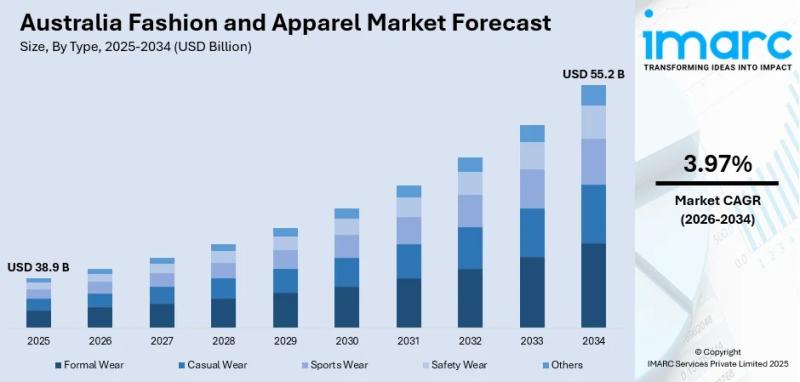
The Australia fashion and apparel market size was USD 38.9 Billion in 2025 and is projected to reach USD 55.2 Billion by 2034, growing at a CAGR of 3.97% during the forecast period of 2026-2034. Market growth is driven by increasing disposable incomes, heightened consumer interest in sustainable fashion, and the expanding digital shopping platforms. The rising influence of social media influencers and a focus on customization and inclusive sizing also contribute significantly to market demand. For more information, visit Australia Fashion and Apparel Market
https://www.imarcgroup.com/australia-fashion-apparel-market
How AI is Reshaping the Future of Australia Fashion and Apparel Market:
• AI is enabling personalization of shopping experiences by analyzing customer browsing history and preferences, resulting in tailored product recommendations.
• The Australian Fashion Council’s FashTech Lab pilot program facilitated a 50% reduction in sampling costs and shortened sampling time from 12 to 4 weeks, also eliminating 225 meters of textile waste through digital sampling.
• AI-powered virtual try-on technologies are enhancing online shopping convenience, making e-commerce the preferred shopping method.
• Data analytics and AI support omnichannel strategies integrating physical stores and online platforms, providing seamless customer experiences.
• AI assists in product concept testing and brand perception surveys, allowing companies to pivot quickly in response to consumer trends.
• AI-driven supply chain optimization supports circular fashion initiatives, promoting sustainability by improving inventory management and reducing waste.
Grab a sample PDF of this report: https://www.imarcgroup.com/australia-fashion-apparel-market/requestsample
Australia Fashion and Apparel Market Growth Factors
Sustainability is another driver for growth in the Australian fashion industry. There is a consumer demand for ethically and sustainably produced clothing with companies using organic cotton, recycled polyester and biodegradable organic materials. The Australian Fashion Council has produced Social & Environmental Toolkits to help fashion businesses adopt UN Sustainable Development goals, and improve transparency in their environmental and labor impact. The fashion industry is moving towards circularity with garment recycling and resale, such as at companies like RCYCL that process returned garments into new textile. This movement aligns to consumer values and shows no signs of slowing.
Digital technologies transform as e-commerce leads and consumers find improved convenience, which continues to grow the market. The pandemic popularized online shopping and Australians prefer to shop through mobile apps, online stores, and try-ons. The AFC’s FashTech Lab program has already demonstrated reductions in sampling costs in some cases by up to 50%, faster product development cycles through digitization, and personalization through AI analytics and cross-channel shopping experiences. These developments let brands reach larger audiences in addition to optimizing operations and offering new business models like subscription services and direct-to-consumer sales.
Developing climate-positive fabrics within textile science is an emerging field. In Australia, scientists developed natural fabrics that reflect light and allow heat to escape, providing urban heat relief that is up to 6.2 °C cooler than the area around. These textiles could offer air conditioning alternatives that are energy-efficient and eco-friendly. New growth opportunities could be expected upon the introduction of performance-improving textiles that combine cooling with sustainable components. This trend appears within a wider industry-wide environmental awareness that promotes innovation and diversifies markets.
Australia Fashion and Apparel Market Segmentation
Type Insights:
• Formal Wear
• Casual Wear
• Sports Wear
• Safety Wear
• Others
Distribution Channel Insights:
• Online
• Offline
End User Insights:
• Men
• Women
• Kids
Regional Insights:
• Australia Capital Territory & New South Wales
• Victoria & Tasmania
• Queensland
• Northern Territory & Southern Australia
• Western Australia
Key Players
• Acler
• APG & Co
• Camilla and Marc
• Cotton On Group
• Country Road Group Pty Ltd
• Lorna Jane
• R.M.Williams
• The Aje Collective
• The Iconic
• Zimmermann
Recent Development & News
• July 2025: M&S formally entered the Australian market through a wholesale partnership with David Jones, offering a curated range of its top womenswear, lingerie, and sleepwear collections both online and in 24 department stores nationwide, enhancing brand availability.
• May 2025: SHEIN launched Aralina, a new label inspired by Australian culture emphasizing simplicity and sustainability, with collections focused on loungewear, swimwear, athleisure, and everyday apparel designed for comfort and confidence.
• May 2025: R.M. Williams and the Australian Fashion Council unveiled the country’s first National Manufacturing Strategy aimed at revitalizing the fashion and textile sector by fostering innovation, technology adoption, and talent development to strengthen local manufacturing capabilities.
If you require any specific information that is not covered currently within the scope of the report, we will provide the same as a part of the customization.
https://www.imarcgroup.com/request?type=report&id=28761&flag=F
Contact Us
IMARC Group,
134 N 4th St. Brooklyn, NY 11249, USA
Email: sales@imarcgroup.com
Tel No: (D) +91 120 433 0800
United States: +1-201971-6302
About Us
IMARC Group is a global management consulting firm that helps the world’s most ambitious changemakers to create a lasting impact. The company provides a comprehensive suite of market entry and expansion services. IMARC offerings include thorough market assessment, feasibility studies, company incorporation assistance, factory setup support, regulatory approvals and licensing navigation, branding, marketing and sales strategies, competitive landscape and benchmarking analyses, pricing and cost research, and procurement research.
This release was published on openPR.