
The presentation in the Italian capital last Friday, in the presence of the Minister of Culture, Alessandro Giuli, of a marble head more than twenty-five hundred years old, has revealed an unexpected and profound dimension of the cultural ties between ancient Greece and Etruscan civilization. The find, made in the Etruscan city of Vulci, in the Italian region of Lazio, belongs to a large-format sculpture of the kore type. Its exceptional quality, along with its place of discovery, compels a rewriting of the chapters related to artistic and religious exchange in the Archaic Mediterranean.
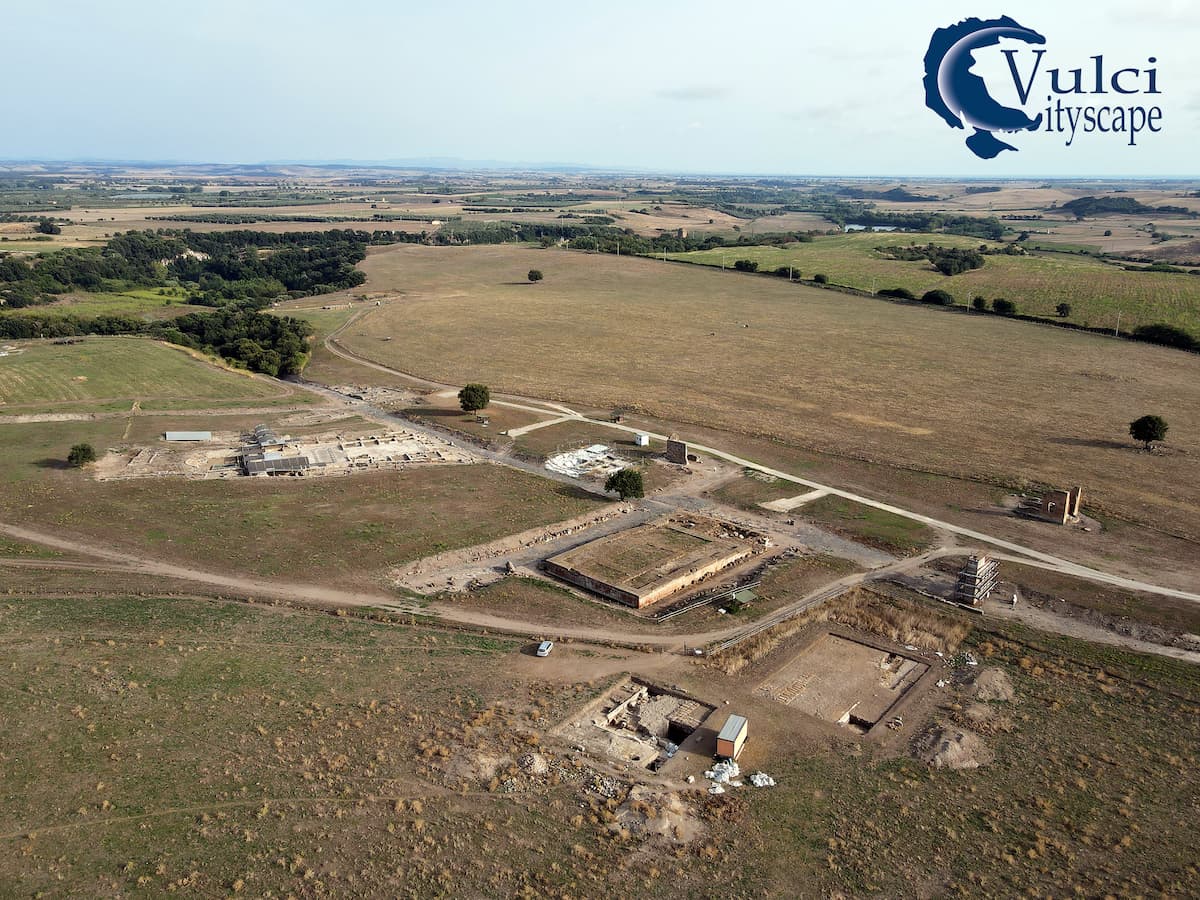
The piece was unearthed by the team of the interdisciplinary project Vulci Cityscape, co-directed by archaeologist Dr. Mariachiara Franceschini of the Albert Ludwig University of Freiburg and archaeologist Dr. Paul P. Pasieka of Johannes Gutenberg University Mainz. Its immediate context is the area of the new monumental temple from the Late Archaic period discovered by this same project in 2020. There, on the ground of what was once a crucial nucleus of southern Etruria, it remained hidden for twenty-five centuries.
The head, which is currently undergoing a meticulous restoration process at the Istituto Centrale per il Restauro in Rome, represents a young woman, slightly smaller than life-size. Her elaborate hair, crowned by a diadem, and the remains of polychromy preserved in excellent condition on the surface of the marble reveal craftsmanship of the highest quality. The most direct and unequivocal formal parallels are found in the korai of the Athenian Acropolis, allowing the work to be dated to the dawn of the 5th century BCE.
We start from the premise of an Attic production, later exported to Etruria, says Dr. Franceschini from her office at the Institute of Archaeological Sciences of the University of Freiburg. The researcher warns that, although the exact moment of its arrival in Vulci cannot be determined with absolute certainty, the highest probability points to a direct connection with the construction of the new temple, a project contemporary with the creation of the sculpture.
This building, classified among the Etrusco-Italic peripteroi—temples with a simple cella and a perimetral colonnade on a high podium, inspired by Greek prototypes—was erected in parallel with the already known Tempio Grande, between the late 6th and early 5th centuries BCE. Together, they formed a sacred district that dominated the urban image of Vulci from a central position on the plateau.
The uniqueness of the discovery lies in its material category and its location. It is one of the very few examples of large Greek Archaic sculpture found outside the territory of Hellas. In the entire area of Vulci, only a handful of sculptures were known, none of which possesses a state of preservation or a level of artistic quality comparable to this kore.

Beyond its plastic quality, the head stands out for unique details, either unseen or extremely rare, which make this kore a special discovery. The traces of the original paint are preserved in excellent condition, explains Dr. Pasieka of the Institute of Ancient Studies at the University of Mainz.
The historical implication of this sculptural fragment far exceeds its intrinsic artistic value. Until now, the panorama of cultural exchange between Greeks and Etruscans in this period was constructed mainly from the massive evidence of Attic painted pottery, which arrived in Etruria in large quantities. The presence of a monumental marble sculpture, a costly material associated with high-status votive or funerary art, substantially broadens that panorama.

Subscribe to our newsletter
Receive our news and articles in your email for free. You can also support us with a monthly subscription and receive exclusive content.
The transition from the 6th to the 5th century BCE was a moment of intense activity and cultural flourishing both in Greece and in Etruria, a context in which this kore fits perfectly, adds Franceschini. This discovery provides us with a completely new picture of cultural ties, which were previously perceived mainly through painted vessels, but which apparently extended far beyond that.

The discovery underscores the deeply Hellenized nature of the Etruscan elites in a center of power like Vulci, who did not merely import luxury objects but integrated central elements of Greek religious art and architecture into their own sacred spaces of greatest civic relevance. The kore was not an isolated object, but part of the decorative or votive program of a monumental temple built under direct Greek influence.
While scientists finalize the academic publication of their conclusions in collaboration with the team of the Istituto Centrale per il Restauro, the Vulci Cityscape project is already planning new excavation campaigns in the area of the new temple. This central public monument functions as an exceptional palimpsest for tracing the city’s history, from its foundation in the late Bronze Age to Late Antiquity and the early Middle Ages, as demonstrated by the late Roman burials located during the summer 2025 campaign.
The project, which has been investigating the urban structure of Vulci since 2020, carries out its work in close cooperation with the Soprintendenza Archeologia Belle Arti e Paesaggio per la provincia di Viterbo e per l’Etruria Meridionale, the Parco di Vulci, and other international institutions. Funding has been provided by the Fritz Thyssen Stiftung (2020–2022), the Gerda Henkel Stiftung (2022–2024), and the research area 40,000 Years of Human Challenges of the University of Mainz. Since 2024, the Deutsche Forschungsgemeinschaft (DFG) has supported the work in Vulci with a grant scheduled through 2027.
The head of the Vulci kore has therefore ceased to be a fragmentary testimony. It has become incontrovertible material proof that the dialogue between Greece and Etruria was also articulated in the solemn and enduring language of large marble sculpture, embedded at the very heart of the sacred and political space of one of the most powerful cities of pre-Roman Italy.