
Like many AI startups, Maison AGI announced its business model with a long tweet (opens in new tab) that was equal parts breathless, vague, hype-coded, and hyperbolic.
CEO Karina Nguyen, a former researcher at OpenAI and Anthropic, wrote that Maison AGI is a “fashion house creating cultural artifacts for the AI era,” because “we’re living through something extraordinary that deserves to be remembered” through “tangible objects.” The first of these tangible objects would be made in collaboration with OpenAI cofounder Ilya Sutskever, “featuring his original artworks alongside a signature hat modeled after his iconic head. It is a study in conviction and the clarity of vision that gives thought its form.”
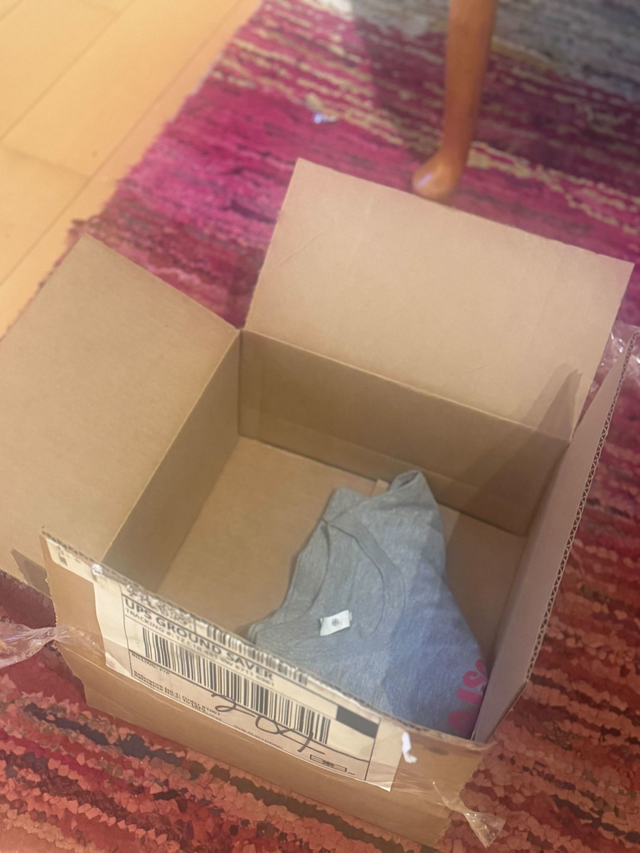
What exactly did that mean? I paid $150 to find out. And last week, the results arrived, two weeks late, crumpled in a too-big box, looking like a Dollar Store buy.
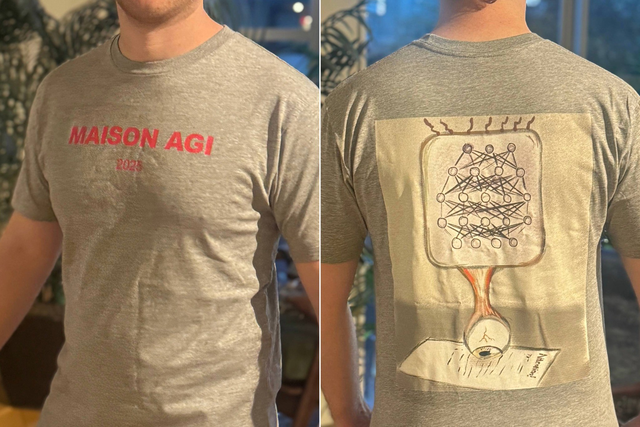
It was a gray crewneck T-shirt from Maison AGI’s first collection, “Relic of Thought.” The front of the shirt reads in red block letters, “Maison AGI 2025.” On the back is a Sutskever drawing of a neural network made of lattices and circles funneled onto a page titled “Attention!” via a disembodied eyeball. It is meant as a subtle nod to the landmark 2017 research paper entitled “Attention Is All You Need, (opens in new tab)” which many credit with jumpstarting the AI boom.
Sutskever is famously reclusive, and people who are interested in AI are deeply interested in what he plans to do next. In 2024, he split from OpenAI CEO Sam Altman after failing to oust him over disagreements around AI safety. That June, he launched his AI alignment startup, Safe Superintelligence, and has raised $3 billion at a $32 billion valuation, despite sharing diddly-squat about what the company does. Since then, he’s been mum.
Which might explain why people were so excited to jump on the T-shirt train. When Sutskever tweeted about Maison AGI’s first collection — a bland “Really cool project!!” — it was just his fourth X post of 2025 (opens in new tab) and got 252,000 impressions. That’s how starved people are for Ilya crumbs. The drop sold out in two days.
Nguyen, who did not respond to requests for comment, said in her announcement post that the stakes for the items couldn’t be higher: “This may be humanity’s last time to create a hand-crafted project before what we build surpasses us.”
The positioning that this isn’t just a T-shirt but a statement of proximity to legend is classic Silicon Valley hype-machine. But you could also see the T-shirt as a warning sign. Because it is deeply mid. The fabric doesn’t feel worth $150, and the messy packaging — no paper around the shirt to keep it folded, no note to explain the item — left me with the impression that this was more afterthought than artifact. Plus, the promised “early access to the long-awaited hat” — a baseball cap, (opens in new tab)modeled on Sutskever’s balding head (opens in new tab), was missing completely.
“I got the shirt in a way too big, simple parcel, no additional branding or a nice card,” another unhappy buyer to me. “I think the entire concept of the project has potential but it was noticeable that this was not thought through enough.”
Listen toThe Standard Podcasts
Life in Seven SongsTuesday, Sept. 24

Ashley Wong Tsui, CEO of Gemnote (opens in new tab), which develops merchandise for big AI companies, didn’t buy a shirt but offered her assessment. “The website gives off more sophistication than the actual product and unboxing,” she said. “You want the experience to be Insta-worthy, something you can put on social media.”
“It wants to come across cool, high-fashion, editorial,” said Karine Hsu, CEO of Slope (opens in new tab), a creative agency for startup merchandise and branding. “[But] it would be disappointing if I received that package after purchasing it for $150.”
Sutskever surfaced Nov. 25, breaking his self-imposed silence in a 96-minute chat on (opens in new tab) “Dwarkesh Podcast,” hosted by Dwarkesh Patel, a 25-year old AI obsessive whose guests have included Meta CEO Mark Zuckerberg and Microsoft CEO Satya Nadella.
True to form, Sutskever refused to share what Safe Superintelligence is building, but did say that today’s models “generalize dramatically worse than people,” and that as AI stops making mistakes, companies will become “much more paranoid” about safety, and we might be five to 20 years from superintelligence.
Considering this, the T-shirt feels extra anticlimactic. While other AI companies experiment with coffee shops and glossy IRL brand plays to create repeatable rituals, Maison AGI’s opening move was a $150 master class in poor user experience. I wanted a clue into Sutskever’s mind; I got a crumpled-up shirt.
Nguyen’s message that “each collection is also a message to superintelligence itself: that we cared, and that we tried to make beauty out of understanding” is a clear overreach. Maybe AGI is too.