
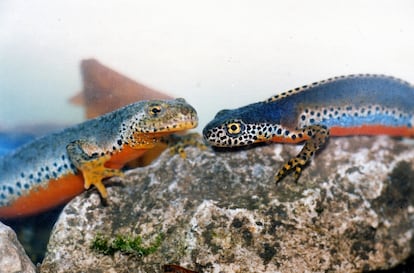
Alpine newts are born and live as larvae in puddles, ponds and streams. After metamorphosis, while still young, they leave the water and spend almost the entire year in the dense, humid forests of Europe. But when mating season arrives, they return to the same body of water where they were born. To assess their sense of direction, some were taken up to 26 miles (42 km) from their place of birth. And they made their way back home in a straight line, without any problems, despite being only 4.7 inches (12 cm) long.
Like many other animals, these amphibians can perceive the Earth’s magnetic field, which serves as both a compass and a GPS, allowing them to know their location on Earth and find their way back. Humans are only just beginning to understand this “superpower” known as magnetoreception.
“The Earth’s magnetic field permeates us all,” notes Francisco Javier Diego-Rasilla of the Spanish Herpetological Association at the National Museum of Natural Sciences. “But the magnetic sense, unlike other senses, is the most elusive of all,” he adds. Amphibians such as newts and frogs are known to perceive the planet’s magnetic field. It has also been documented in at least 20 species of birds, and not just migratory ones. Among fish, rays and sharks orient themselves using magnetic polarity. In reptiles, it is believed that loggerhead turtles return to the beach where they were born because a mental map with the coordinates is stored in their brains. Even a few mammals, especially bats and naked mole-rats, rely on it to fly at night or move underground in complete darkness.
But knowing that many animals have this magnetic sense is one thing, and pinpointing its mechanism is another. There isn’t, or at least nobody has yet found, a specific organ for perceiving magnetic fields, like the nose for smell. In the retinas of migratory birds, researchers have located proteins called cryptochromes, sensitive to blue light: these are the first steps in a complex orientation mechanism based on quantum physics. It’s believed that loggerhead turtles have magnetite particles, a magnetic mineral, somewhere in their bodies, which they generate internally. And amphibians have a key gland inside their heads for navigation.
“You need to know where you’re going, but also where you are,” says Diego-Rasilla. In other words, a compass pointing north isn’t enough to guide you. You also need a map as a starting point. “There are tasks, like moving along a perpendicular axis, or heading towards the edge of a pond, where a compass is sufficient,” adds the researcher, who has spent decades studying the magnetic sense of amphibians. “But alpine newts, which migrate at night, use a mental map for their migrations in addition to a compass,” he adds. This map stores the coordinates that allow them to return. What Diego-Rasilla has discovered after years of experiments capturing these newts (Ichthyosaura alpestris) and taking them far away, is that they recalibrate their compass by updating the map every day: just as the sun sets, they align themselves with a north-south axis, but slightly offset to the east, “and precisely when there are the fewest disturbances in the magnetic field,” the researcher notes.
When, in the 1960s, two German ornithologists, W. Merkel and W. Wiltschko, discovered that European robins flew from northern Europe to Africa using magnetoreception, skepticism was the norm among their colleagues. And yet their experiments were rigorous: released into long cages surrounded by Helmholtz coils, which generate their own magnetic field, canceling others (such as the Earth’s), the birds readjusted their flight according to the new field.
However, the evidence kept piling up. It was soon discovered that what guides the birds is not just the polarity of the field (magnetic north), but its intensity. The Earth’s magnetic field is due to the presence of a partially molten iron core in a rotating planet. It is, as elementary school children are taught, a giant electromagnet. The bird compass, which doesn’t work like those made by humans, presumably relies on magnetite nanoparticles in their beaks to perceive the strength of the magnet.
There is another possible mechanism that is not yet fully understood: robins and other birds detect the tilt of the magnetic field thanks to photosensitive molecules in their eyes, especially the right one. These cryptochromes trigger a biochemical process with effects characteristic of quantum physics: they form pairs of free radicals, where the electrons are not paired and their behavior depends on the magnetic field.
Wireless in-ear chargers
But pigeons seem to work differently. No magnetite has been found in them, and they can navigate in complete darkness. In a study recently published in Science, a group of scientists explain the neuronal and molecular mechanism by which pigeons perceive the Earth’s magnetic field, following a different principle: magnetic induction. “It’s the same principle used in wireless chargers,” explains Gregory Nordmann of the Max Planck Institute for Biological Intelligence and the University of Munich (Germany).
“When a magnetic field changes, it produces an electric current in a conductor. In pigeon navigation, the magnetic field doesn’t move; it’s the bird that does. By flying or turning its head, it moves through the Earth’s magnetic field, and this movement induces tiny electrical signals in the semicircular canals of the inner ear,” explains Nordmann. “A set of specialized electrosensory cells detects these signals: they capture the induced currents and send the information to the brain, providing the pigeon with a reliable compass that is independent of light,” the German scientist adds.
The mechanism confirmed in pigeons, the same one believed to be used by rays and sharks, brings to three the number of known systems by which animals navigate: magnetite nanocrystals, light-dependent quantum biochemistry, and magnetic induction. “This suggests that magnetoreception evolved convergently; that is, different species, with distinct anatomies and ecological needs, have developed similar sensory capabilities through different biological mechanisms,” Nordmann argues.
Perhaps the most fascinating case of magnetic sense is that of loggerhead sea turtles (Caretta caretta). The hatchlings emerge from the sand, swim out to sea, and after 20 to 30 years, after traveling thousands of miles, return to the same beach to lay their eggs. In a recent experiment, a group of researchers interfered with their magnetic perception. Collected off the coast of North Carolina, they were fed for eight months while simultaneously being exposed to a magnetic pulse that made them feel the magnetic field located much further south, in Haiti or the Turks and Caicos Islands (a British Overseas Territory). The researchers sought to condition the turtles, similar to Pavlov’s work with dogs, so that they would associate magnetic coordinates with the reward of food.
Once conditioned, they sought to magnetically “blind” them before virtually placing them back on one of the Caribbean islands. The small creatures ceased to display the exuberance they had shown before being disoriented. This suggests the presence of magnetite within them.
“It has been proposed that animals’ magnetic orientation sense could involve biochemical reactions influenced by the Earth’s magnetic field,” notes Alayna Mackiewicz, a researcher at the University of North Carolina at Chapel Hill and first author of this study, published in the Journal of Experimental Biology, in an email. “Since the proposed chemical reactions are temporary, a magnetic pulse should not have a lasting effect,” she points out. “Instead, it is likely that magnetite crystals are embedded in specialized sensory cells, and the magnetic pulse could remagnetize these tiny magnets and thus alter the magnetic information sent to the nervous system,” she adds.
Magnetite could be what connects them to the beach where they were born. Thanks to these nanocrystals, their coordinates would be fixed in their brains just before they venture into the sea. Mackiewicz summarizes it this way: “There are clues that support the geomagnetic imprinting hypothesis in sea turtles, where individuals identify with the magnetic field of their birthplace and use this information to return to their birthplace beaches.” But she concludes by acknowledging that “the exact mechanism is unknown, but it is likely that they use magnetic information to guide themselves back to their place of origin.”
Sign up for our weekly newsletter to get more English-language news coverage from EL PAÍS USA Edition